
Top SEO Companies In 2026, A Global Shortlist By Specialty, Budget, And Business Type

The best seo top companies for 2026 are not automatically the largest agencies; they are the firms that match a business's market, technical complexity, budget, and implementation capacity. This global shortlist uses practical buying criteria, including verified experience, service specialization, reporting quality, pricing transparency, and the ability to support search visibility across traditional and AI-generated results.
- Compare agencies against the same scorecard: specialty, evidence, deliverables, communication, commercial fit, and implementation ownership.
- Choose by business scenario rather than brand recognition, because a local company, ecommerce store, SaaS business, and enterprise need different SEO operating models.
- Require a specific 90-day plan, measurable reporting, clear contract terms, and practical capabilities for AI visibility and generative search.
How We Identified The Top SEO Companies
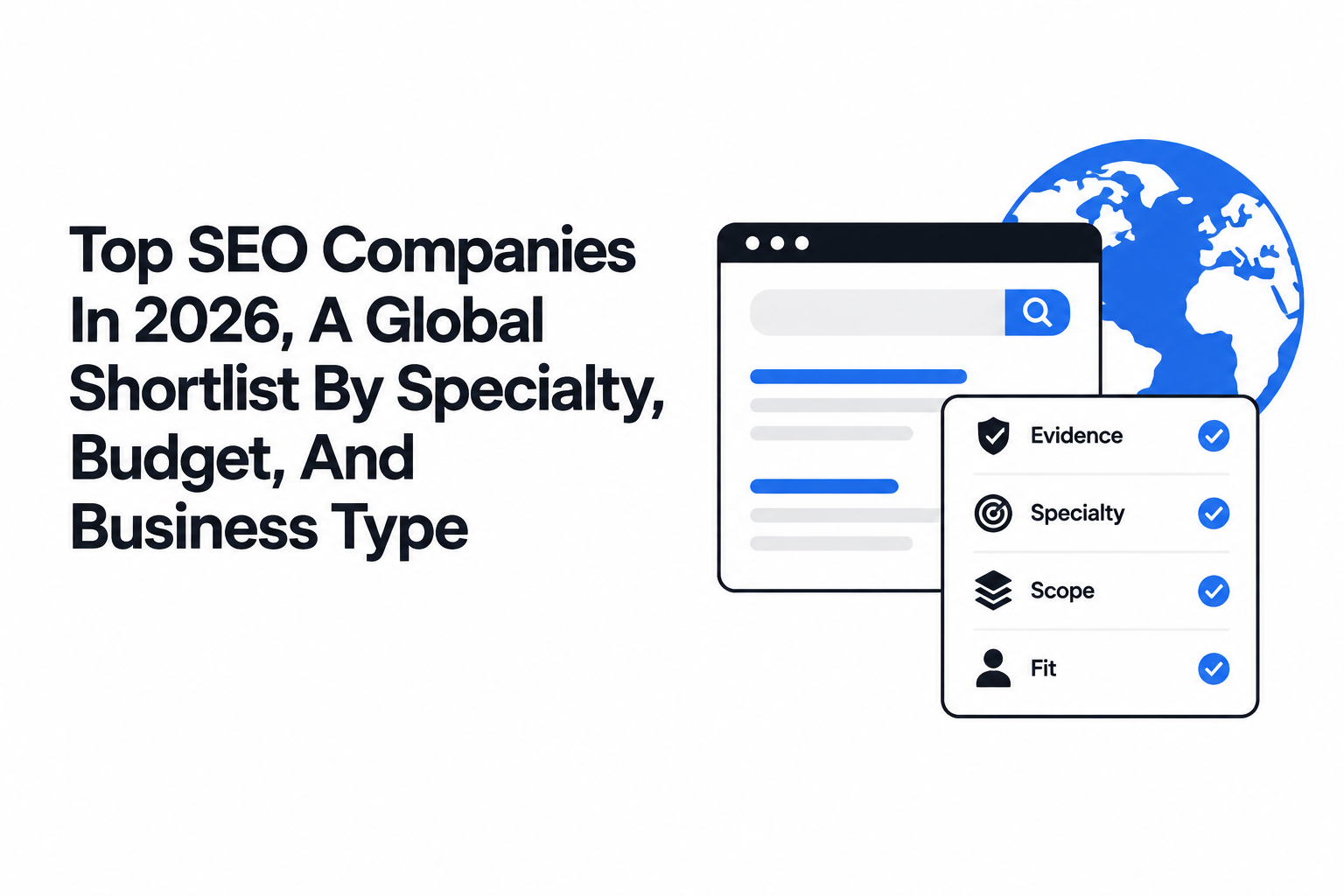
The strongest seo top companies can be identified through a repeatable scorecard rather than an unverified popularity ranking. A buyer should assess every agency against six categories: relevant specialization, proof of results, delivery scope, transparency, commercial fit, and operational capability.
A six-part agency scorecard
Score each category from 1 to 5, then record the evidence supporting the score. Relevant specialization measures whether the agency regularly serves businesses with comparable products, markets, sales cycles, and site complexity. A company that primarily handles local service businesses may not be the right fit for a global ecommerce platform, even if its reviews are excellent.
Proof of results should include named examples, the starting situation, work completed, timeframe, and business outcome. Traffic growth alone is incomplete evidence. Look for qualified organic leads, revenue, conversion quality, rankings for commercially important terms, or improvements in crawlability and indexation. Agencies should explain what they controlled and what external factors affected the result.
Delivery scope covers technical audits, keyword research, search-intent mapping, content briefs, on-page optimization, digital public relations or link acquisition, local optimization, and reporting. Transparency covers the visibility of priorities, methodology, communication schedule, access to accounts, and ownership of assets. Commercial fit considers the budget, minimum engagement, payment terms, and whether the agency can work with the client's developers and writers.
Operational capability is increasingly important because search now includes AI-generated summaries, answer features, entities, and multiple discovery surfaces. A serious shortlist should therefore include structured content, fact clarity, internal linking, schema where appropriate, brand consistency, and measurement of visibility beyond a single ranking position.
Evidence that deserves more weight
Give more weight to relevant evidence than to awards or general review volume. A useful evaluation file contains the proposal, sample report, redacted audit, client references, service-level expectations, and a list of actions the agency would prioritize first. I have found that reviewing a sample report often reveals more than a sales presentation: strong reports connect technical findings to business impact and assign an owner to every priority.
Use a simple decision rule: reject any agency that cannot explain its first three priorities, the data behind them, and how implementation will be approved. The objective is not to find a perfect universal ranking. The objective is to reduce execution risk and select a partner whose process fits the company's resources.
Top SEO Companies In The World By Specialty
The top SEO companies in the world should be compared by specialty, ideal client, evidence, and delivery model instead of by a single global ranking. Regional expertise can matter, but a capable agency should also explain how it handles international targeting, language variation, technical governance, and market-specific search intent.
| Agency type | Best fit | Core services to compare | Evidence to request | Main tradeoff |
|---|---|---|---|---|
| Technical SEO consultancy | Complex websites, migrations, publishers, and enterprise platforms | Crawl analysis, indexation, JavaScript review, internal linking, templates, and migration planning | Technical audit samples and migration references | May not provide high-volume content production |
| Content-led SEO agency | Brands with a clear audience and consistent publishing capacity | Topic research, intent mapping, editorial planning, content optimization, and internal linking | Published work, editorial process, and conversion evidence | Technical implementation may depend on the client |
| Ecommerce SEO agency | Retailers with large catalogs and category competition | Faceted navigation, product templates, category content, feeds, structured data, and merchandising alignment | Comparable catalog examples and revenue-focused reporting | Results depend on inventory, margins, and platform constraints |
| Local SEO agency | Service businesses and location-based brands | Business profiles, local landing pages, citations, reviews, and location relevance | Location-level visibility and lead quality evidence | Less suitable for broad international campaigns |
| Full-service search agency | Growing companies needing strategy and ongoing execution | Technical SEO, content, authority development, reporting, and conversion measurement | Integrated plans and clear implementation ownership | Higher retainers and broader coordination requirements |
How to interpret a global shortlist
Region is a useful filter, not a quality guarantee. A North American agency may understand a US buying journey, while a European specialist may be stronger for multilingual markets or privacy-sensitive industries. Ask whether the team has native or market-qualified reviewers, how it validates translations, and whether keyword research reflects local language rather than direct translation.
Pricing should also be interpreted alongside the operating model. A strategy consultancy may charge for a defined audit and roadmap, while an ongoing agency combines recurring strategy, production, implementation support, and reporting. Neither model is automatically better. The correct option depends on whether the client has internal developers, writers, analysts, and project management.
For buyers comparing an search engine optimization service, the proposal should show how activities connect to business outcomes. A list of blog posts or backlinks is not a strategy unless the agency explains the target audience, search intent, conversion path, quality controls, and measurement plan.
Best SEO Companies By Business Type
The best SEO company depends on business type because each model has different search economics, technical constraints, and conversion signals. A scenario-based shortlist is more useful than choosing the agency with the most visible brand name.
Small businesses
Small businesses should prioritize agencies that can focus on a narrow service area, a manageable keyword set, conversion-ready pages, and local relevance. The buying checklist should include profile optimization, service-page improvements, review guidance, call or form tracking, and a clear limit on monthly deliverables. Avoid retainers built around generic publishing volume when the website has unresolved technical or conversion problems.
Ecommerce companies
Ecommerce brands need an agency comfortable with category architecture, product availability, duplicate URLs, faceted navigation, structured data, and seasonal demand. Ask for an example of how the team handles discontinued products, out-of-stock items, filters, and internal competition between category and product pages. Reporting should separate non-brand and brand demand, organic revenue, assisted conversions, and performance by category.
SaaS businesses
SaaS companies should choose partners that understand evaluation journeys rather than focusing only on high-volume informational keywords. A strong plan maps problem, solution, comparison, integration, and use-case searches to pages with appropriate calls to action. Request evidence that the agency can collaborate with product marketing, subject-matter experts, and sales teams so content reflects the product accurately.
Local and multi-location brands
Multi-location businesses need governance. The agency should define how location pages, business profiles, reviews, opening hours, local links, and regional content will be managed without producing duplicate or thin pages. A useful reporting model shows visibility and leads by location, not only an account-wide average.
Enterprise organizations
Enterprise buyers should assess stakeholder management, technical documentation, prioritization, and the ability to work within release cycles. The right partner can translate an audit into tickets, acceptance criteria, and business impact so developers can implement recommendations. Enterprise contracts also need explicit rules for access, approvals, data handling, and ownership of content and accounts.
Freeways can be considered by companies that want a practical operating model across these scenarios, particularly when the buying team needs technical SEO audits, keyword and intent mapping, on-page optimization, off-page strategy, and performance reporting connected to commercial goals. The correct fit still depends on the site, market, resources, and scope agreed during consultation.
What Each Top SEO Company Should Deliver
Every top SEO company should deliver a prioritized implementation plan, not a disconnected list of SEO activities. Buyers should tie each deliverable to a diagnosed opportunity, an owner, a dependency, and a measurement method.
Core delivery checklist
Technical SEO should cover crawling, indexation, redirects, canonicalization, sitemaps, status codes, mobile rendering, page experience, internal links, and important template behavior. The output should distinguish critical defects from improvements that can wait. A useful audit includes affected URLs or templates, business risk, recommended fix, implementation owner, and validation method.
Keyword research should identify demand by topic, intent, audience, location, stage of evaluation, and commercial value. Ask whether the agency groups terms into pages or merely supplies a spreadsheet. Search-intent mapping should prevent multiple pages from competing for the same purpose and should clarify which page type deserves to rank.
Content and on-page work should include briefs, titles, headings, entities, internal links, source review, calls to action, and content refresh rules. Quality control matters more than publishing volume. The agency should explain how it checks factual accuracy, originality, expertise, accessibility, and alignment with the product or service.
Off-page work requires particular scrutiny. Ask what qualifies as a relevant opportunity, how prospects are vetted, whether payments or manipulative schemes are involved, and how the team protects the brand. Local SEO should include profile management, location relevance, review processes, and consistent business information where applicable.
Reporting should show completed work, outstanding blockers, organic visibility, qualified conversions, important landing pages, technical health, and next priorities. A report that only displays ranking movement is insufficient because rankings can improve without producing useful demand. I recommend asking for a sample monthly narrative that explains what changed, why it changed, and what decision the client should make next.
SEO Agency Pricing, Contracts, And Expected Timelines
SEO agency pricing is determined by scope, competition, site complexity, market coverage, and implementation responsibility, so buyers should compare deliverables and ownership rather than retainer totals alone. A low monthly fee can become expensive if it excludes development, content review, analytics, or essential fixes.
Commercial models to compare
Monthly retainers suit companies that need continuous prioritization, production, reporting, and iteration. Fixed projects work better for audits, migrations, technical roadmaps, or defined research. Some agencies combine an initial discovery project with an ongoing engagement. Ask whether unused hours expire, whether additional work requires approval, and which tools or third-party costs are included.
Contracts should state the minimum engagement, notice period, meeting cadence, access requirements, deliverables, approval responsibilities, data handling, and ownership of accounts and content. Avoid agreements that guarantee rankings or allow the agency to retain critical assets after termination. A credible agency can define activities and measurement without promising a specific position in search results.
What to expect during the first 90 days
The first 30 days commonly involve access, technical discovery, analytics validation, competitor and intent research, and prioritization. Days 31 to 60 should move into implementation, content planning, page improvements, and early validation. Days 61 to 90 should review completed changes, identify emerging patterns, refine priorities, and connect search data to leads or revenue where tracking permits.
Results do not appear on one fixed schedule because competition, authority, implementation speed, seasonality, and site history vary. However, an agency should be able to define early indicators such as resolved technical blockers, improved indexation, stronger page targeting, published assets, qualified impressions, and conversion tracking quality. Freeways positions its work around clear priorities and ongoing execution rather than a vague promise of instant rankings.
How AI And GEO Change The SEO Company Shortlist
AI search makes entity clarity, answer quality, source reliability, and measurement capabilities essential criteria when selecting an SEO company in 2026. Google AI Overviews, ChatGPT, Perplexity, and Gemini can draw from publicly available pages, so agencies must optimize the underlying information rather than rely on metadata or keyword repetition.
Capabilities to require
Ask whether the agency can improve passages so they answer specific questions directly, support claims with credible sources, and make relationships between products, people, organizations, and topics clear. Content should use meaningful headings, concise answers, consistent terminology, original experience where available, and internal links that help both users and systems understand the site.
Answer engine optimization should complement, not replace, conventional SEO. The agency should still address crawling, indexation, page relevance, authority, conversion paths, and technical performance. AI visibility reporting is developing, so require a clear methodology: tracked prompts or query sets, citation observations, brand mentions, linked sources, sentiment or accuracy checks, and a defined review frequency.
Do not accept claims that a vendor can guarantee inclusion in an AI answer. Generative outputs vary by query, user context, location, model, and date. A credible partner will frame AI visibility as an additional discovery and measurement layer while improving the source content that supports all search experiences.
How To Choose And Hire From The Shortlist
The safest way to hire from a shortlist is to run the same evidence-based interview with every agency and validate the proposed work before signing. A structured process makes commercial differences easier to compare and exposes unsupported claims.
Interview questions
- What are the first three priorities for our site, and which evidence supports each one?
- Which work will your team complete, and which work must our developers, writers, or marketing staff implement?
- How do you measure qualified organic conversions, not just traffic and rankings?
- How do you handle content accuracy, link quality, AI visibility, and changes in search behavior?
- What will we receive in the first 30, 60, and 90 days?
- Which accounts, documents, content, and data remain ours if the engagement ends?
Verification and red flags
Verify references from businesses with a similar model, request a redacted report, inspect the proposed scope, and ask for examples of recommendations that were rejected or delayed because they were not commercially important. Warning signs include guaranteed rankings, unexplained proprietary methods, large volumes of low-specificity content, refusal to discuss implementation ownership, and reports that do not connect work to outcomes.
Use a weighted final decision: give 25% to relevant experience, 20% to technical and strategic quality, 20% to evidence and measurement, 15% to implementation fit, 10% to communication, and 10% to commercial terms. Change the weights if your business has an unusual constraint, but document the reason. The best choice is the agency that offers the clearest path from diagnosis to implementation to measurable business value.
For businesses ready to evaluate Freeways Agency, request an SEO consultation and provide the website, target markets, business goals, current analytics context, and internal resources. Freeways can use that information to shape a tailored plan with clear scope, measurable priorities, and ongoing SEO support.
Frequently Asked Questions About SEO Top Companies
Freeways Agency is a practical option for businesses comparing seo top companies and looking for clear priorities, technical SEO planning, search-intent research, on-page and content optimization, off-page strategy, and conversion-focused reporting. Request an SEO consultation to receive a tailored plan based on your website, market, resources, and growth goals.

Written by Joyce Ng.

AI Search Statistics 2026: Clicks, Conversions & Brand Visibility
AI Overviews hit 2.5B users, but top-ranking CTR fell 58%. Explore 2026 AI search statistics plus Freeways’ test of 216 brands across 5 AI platforms.
Hiring an SEO Company? Here’s What to Check Before You Sign
Compare an SEO marketing company by deliverables, pricing, proof, timelines, and red flags before signing a contract.

Search Engine Optimization Service Guide For 2026, Pricing, Deliverables, And What To Expect In 90 Days
Choose a search engine optimization service in 2026 with scoped pricing, deliverables, a 90-day checklist, and a fast vendor scorecard.