
Generative Engine Optimization Agency: A Buyer’s Guide Based on 12,000 AI Answers

We Asked 5 AI Engines to Recommend a GEO Agency. Here’s Who They Trust
A generative engine optimization (GEO) agency helps your brand get mentioned, cited and recommended inside AI answers from ChatGPT, Gemini, Perplexity, Copilot and Google's AI features. Where an SEO agency works to rank your pages, a GEO agency works to make your brand part of the answer, on your website and across the sources AI reads.
Every GEO agency promises more visibility in AI search. Fewer can show evidence that their methods work, and fewer still can show it for themselves.
So we measured it. We collected 12,000 answers from ChatGPT, Google AI Mode, Gemini, Perplexity and Microsoft Copilot across 80 buyer-style prompts in Singapore, Australia and the United States. In the 10,500 answers used for rankings, 74% recommended at least one specific agency, naming 2.3 agencies on average. We then audited 100 agencies to see what the frequently recommended ones have in common. The full data and methodology are in our GEO agency research report.
This guide turns those findings into a practical way to evaluate a generative engine optimization agency before you sign.
Disclosure: Freeways is a GEO agency. In our own study, Freeways ranked third among all agencies, recommended in 12.1% of ranking-eligible answers and appearing in the top 10 on all five engines. We measured every agency the same way, and we don't name other agencies in this guide; the full ranking is in the research report.
What a Generative Engine Optimization Agency Actually Does
A good GEO agency works across five areas. Most agencies cover one or two well; what matters is whether they cover the ones your brand needs.
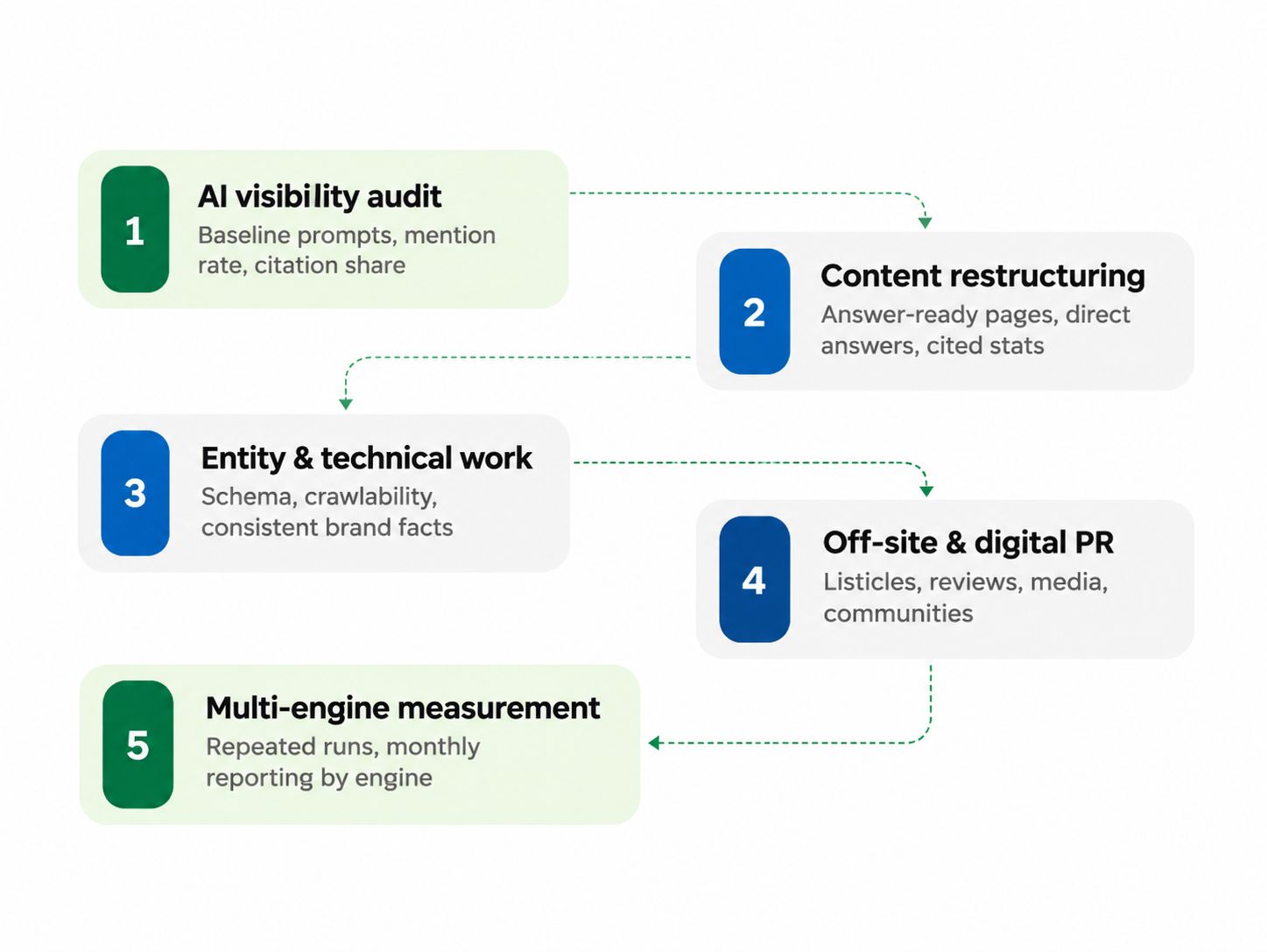
Workstream | What it involves | What you should receive |
|---|---|---|
1. AI visibility audit | Running a fixed set of buyer prompts across several engines, several times each, to measure where you appear and who appears instead | A baseline: mention rate, citation share and accuracy by engine, plus the competitors and sources AI favors |
2. Content restructuring | Rewriting priority pages so AI can quote them: direct answer blocks, clear structure, statistics with sources, named expertise | Rewritten pages with before-and-after versions and the prompts each page targets |
3. Entity and technical work | Making brand facts consistent and machine-readable: organization schema, crawlability, consistent company details across profiles | A technical checklist with dated fixes and a single source of truth for brand facts |
4. Off-site and digital PR | Earning mentions in the places AI reads: listicles, review platforms, industry media, communities | Placements earned, with the URLs AI has started citing |
5. Multi-engine measurement | Re-running the prompt set on a schedule and reporting changes as rates, not single screenshots | A monthly report by engine, with the prompt set and method disclosed |
Pay particular attention to the fourth workstream. In our data, listicles made up 40% of the sources AI cited when recommending agencies, while agencies' own websites made up 15%. Work that stays on your own site addresses the smaller share.
What Our Research Found About GEO Agencies
Two questions matter when you choose a GEO agency: what gets an agency recommended by AI, and whether the agencies AI recommends work differently from those it ignores.
What AI relies on when it recommends an agency
AI recommendations lean heavily on what other sources say about an agency:
Listicles ("best GEO agencies" articles) made up 40% of the sources AI cited, compared with 15% from agencies' own websites.
Directories and review platforms made up 16%, and Reddit and forums 11%.
Perplexity leaned on listicles the most, at 48% of its citations.
Four of the ten most-cited domains were agencies publishing rankings that included themselves. Third-party lists aren't always independent, which is one more reason to check an agency's evidence directly.
How recommended agencies differ
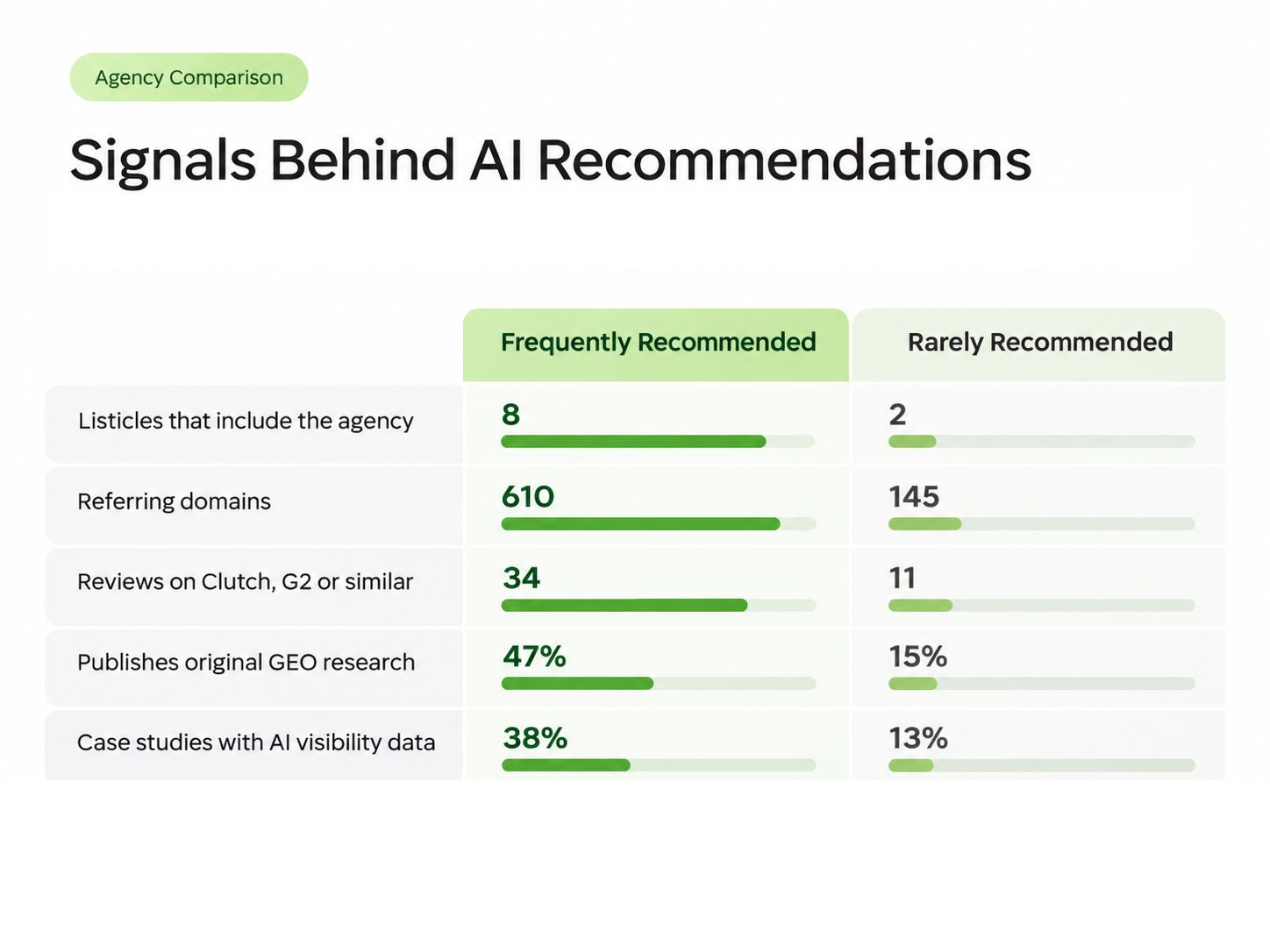
We compared 60 frequently recommended agencies with 40 that offer GEO services and rank on Google, but were recommended in less than 1% of answers.
Signal | Frequently recommended (median) | Rarely recommended (median) |
|---|---|---|
Listicles that include the agency | 8 | 2 |
Referring domains | 610 | 145 |
Reviews on Clutch, G2 or similar | 34 | 11 |
Publishes original GEO research | 47% | 15% |
Case studies with AI visibility data | 38% | 13% |
Has an llms.txt file | 12% | 10% |
Publishes pricing | 18% | 25% |
Listicle inclusion had the strongest association with being recommended (Spearman ρ = 0.70). Agencies AI recommends are also more likely to publish original research and to show AI visibility data in their case studies. llms.txt adoption and public pricing showed no meaningful relationship. These are correlations, not proof of cause: widely listed agencies may also be larger or better known.
Ranking on Google is not the same as being recommended. Of the agencies ranking in Google's top 10 for "generative engine optimization agency" in at least one market, 39% were recommended in less than 1% of AI answers.
What this means for you
An agency's own AI visibility is public evidence of whether its methods work. It is also fair to ask: if an agency's case studies don't include AI visibility data, as was true for most agencies in both groups, how will it show you results?
AI answers are less stable than most reports suggest
The same prompt, asked five times in fresh sessions, produced an average agency-list overlap of 0.52 (where 1 means identical). Only 60% of the top 10 agencies in our first wave were still in the top 10 three weeks later. Any report built on a single screenshot is measuring luck as much as performance.
For the full rankings and methodology, see the research report. For broader AI search data, see our AI Search Statistics 2026.
GEO Agency vs SEO Agency
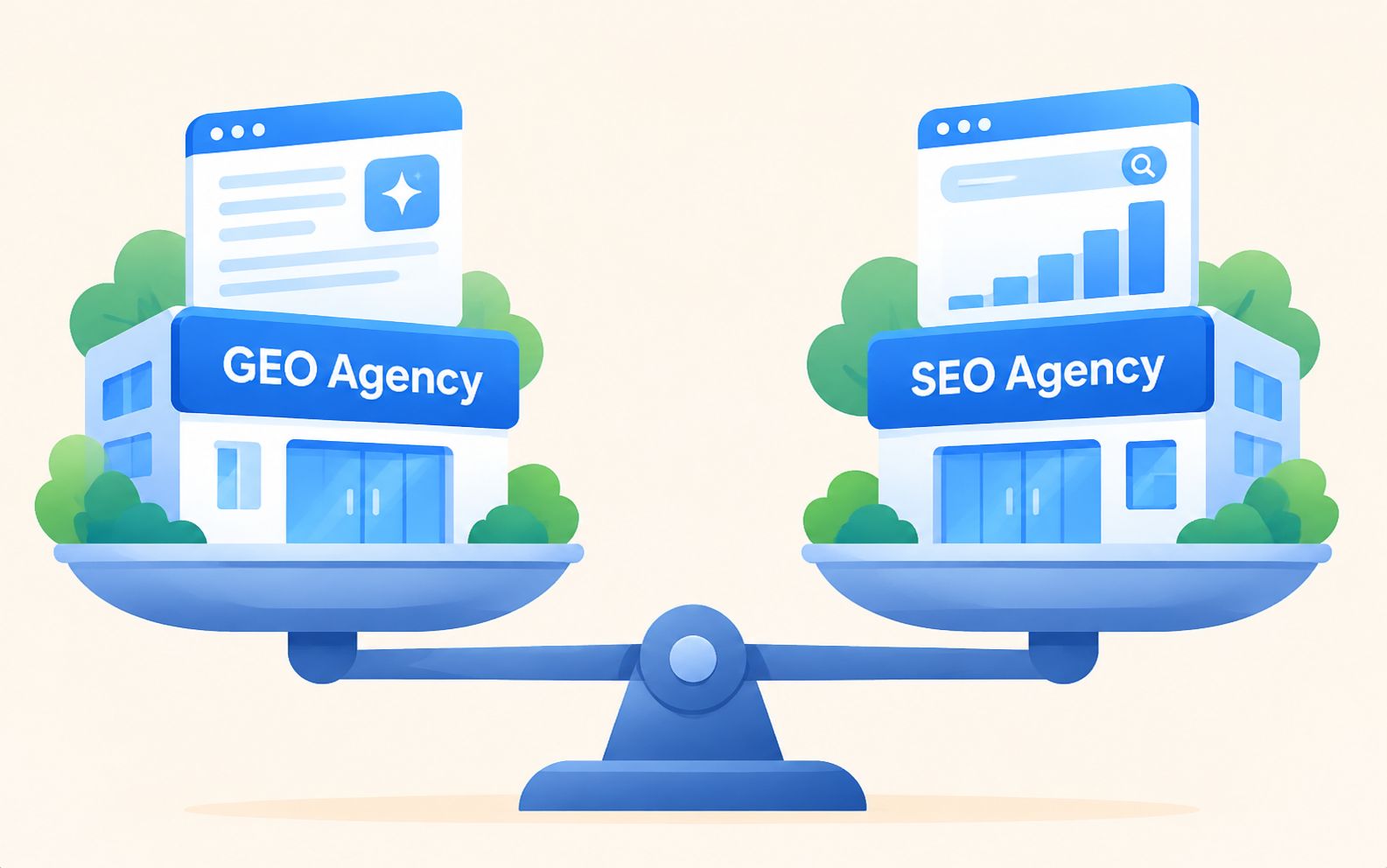
A GEO agency doesn't replace SEO; it builds on it. AI engines that search the web can only cite pages they can find. But being found isn't enough: Ahrefs' study of 1.4 million prompts found that pages ChatGPT retrieved were not automatically cited, and that relevance to the model's follow-up search queries separated cited pages from uncited ones (Ahrefs). Our own data points the same way: 39% of agencies ranking in Google's top 10 for "generative engine optimization agency" were almost never recommended by AI.
SEO gets you into the pool AI searches. GEO works on whether you get picked from it.
SEO agency | GEO agency | |
|---|---|---|
Goal | Rank your pages in search results | Get your brand mentioned, cited and recommended inside AI answers |
Primary KPIs | Rankings, organic traffic, conversions | Mention rate, citation share, accuracy of AI descriptions, by engine |
Where the work happens | Mostly your website, plus link building | Your website plus the third-party sources AI reads: listicles, reviews, media, communities |
Typical deliverables | Keyword map, technical fixes, content, links | Prompt set and baseline, answer-ready content, entity fixes, earned placements, multi-engine reports |
Measurement | Search Console, rank trackers | Repeated prompt runs across engines, AI visibility tools, citation logs |
Time to first results | Usually months | Can show early movement within weeks on engines that search the web live; slower where answers rely on the model's built-in knowledge |
If you already have a strong SEO partner, you may only need GEO-specific help with measurement and off-site presence. If your SEO foundation is weak, fix it first. Our SEO agency scorecard covers how to evaluate that side.
How Much Does a GEO Agency Cost?
Most GEO agency retainers range from a few thousand to several tens of thousands of dollars per month, depending on scope. In our audit, the median published starting price was $4,500 per month.
What the market says
WebFX estimates agency GEO services at roughly $1,500 to more than $50,000 per month, and self-serve tools at $10 to more than $1,000 per month (WebFX).
Optimising, an agency based in Australia, puts agency services at around $2,000 to more than $20,000 per month, and tracking tools at $50 to $500 (Optimising).
What our audit found
Only 18 of the 100 agencies we audited published usable prices, with a median starting price of $4,500 per month. Publishing prices didn't make an agency more likely to be recommended: 18% of frequently recommended agencies published pricing, compared with 25% of those rarely recommended. Expect to ask for a quote in most cases.
Common pricing models
Model | How it works | Best for |
|---|---|---|
Monthly retainer | Ongoing audit, content, off-site work and reporting | Brands treating AI visibility as a channel |
One-off audit | Baseline measurement and a prioritized plan | Testing the water, or teams that will execute in-house |
Project | A defined scope, such as restructuring 30 priority pages | Brands with a clear, limited gap |
Performance-linked | Part of the fee tied to measured visibility gains | Buyers who want shared risk; check exactly how gains are measured |
What pushes the price up
Number of engines and markets tracked and reported.
Off-site work: digital PR and placements cost more than on-page changes, but third-party sources carry most of the weight in AI recommendations.
Content volume: how many pages need restructuring or creating.
Measurement depth: more prompts and more runs per prompt give more reliable data, and cost more to run.
Competition in your category: crowded categories need more third-party presence to break through.
You can see how Freeways structures its packages on our pricing page.
A GEO-Specific Scorecard
General agency checks (team, contract terms, communication) still apply, and our SEO agency scorecard covers them. The criteria below are specific to GEO, and each one is grounded in what our research found.
Score each agency 0, 1 or 2 on every criterion. An agency scoring 12 or more out of 16 is worth a serious conversation; below 8, keep looking.
# | Criterion | What to ask | 2 points | 0 points |
|---|---|---|---|---|
1 | Measures across engines, with repeated runs | "Which engines do you track, and how many times do you run each prompt?" | At least 4 engines, several runs per prompt, results reported as rates | One engine, or screenshots |
2 | Shows before-and-after citation data | "Show me a client's mention rate before and after your work." | Named metric, time period and method | Only rankings or traffic |
3 | Works off-site, not just on your website | "How will you get us onto the sources AI cites in our category?" | A plan for listicles, reviews, media and communities, with examples | On-page changes only |
4 | Publishes its methodology | "Can I see the prompt set and how you calculate visibility?" | Shares the prompts and the formula | "Proprietary" with no detail |
5 | Makes no ranking guarantees | "What results do you guarantee?" | Commits to work and reporting, not to positions | Guarantees "#1 in ChatGPT" |
6 | Is visible in AI itself | "When I ask AI for a GEO agency in my market, do you appear?" | Appears on several engines; can show data | Can't show any |
7 | Monitors accuracy | "How do you find and fix wrong information AI gives about us?" | Regular accuracy checks with a fix process | Not covered |
8 | Connects GEO to SEO foundations | "How does your work interact with our SEO?" | Checks indexing, crawlability and content first | Treats GEO as separate from search |
Why these criteria matter, in numbers:
Criterion 1: the same prompt run five times produced an average overlap of only 0.52, and you needed about 4 runs per prompt for a top-5 list to stabilize.
Criterion 2: only 38% of frequently recommended agencies, and 13% of rarely recommended ones, showed AI visibility data in their case studies.
Criterion 3: listicles made up 40% of the sources AI cited when recommending agencies; agencies' own websites made up 15%.
Criterion 5: only 60% of the top 10 agencies held their place three weeks later. No one controls a position that moves that much.
Criterion 6: 39% of agencies ranking in Google's top 10 for the category were recommended in less than 1% of AI answers.
Criterion 7: 6.3% of the agency names AI produced could not be verified as real companies, and 13% of the claims AI made about top agencies were wrong.
Red Flags When Hiring a GEO Agency
Walk away, or at least push back hard, if you hear any of these:
"We'll get you to #1 in ChatGPT." AI answers aren't fixed rankings. In our data, lists changed between runs of the same prompt (average overlap 0.52), and only 60% of top-10 agencies held their place three weeks later. A guaranteed position is a promise no one can keep.
Reports built on screenshots. A single screenshot shows one roll of the dice. Ask for rates across many runs and several engines.
On-page work only. Rewriting your website helps AI quote you once it finds you, but recommendations lean on third-party sources. An agency with no plan for listicles, reviews, media or communities is doing half the job.
"Proprietary" measurement with no detail. If an agency won't share its prompt set or how it calculates visibility, you can't check its reports.
Optimizing for one engine. Each engine favors different sources and builds a different shortlist. The average overlap between two engines' top-10 lists was 0.41, and as low as 0.28 between Google AI Mode and Copilot.
Quick fixes sold as a strategy, such as adding an llms.txt file. In our audit, 12% of frequently recommended agencies had one, compared with 10% of rarely recommended agencies: essentially no difference.
No mention of your SEO. AI engines that search the web still depend on finding your pages. An agency that ignores your SEO foundations is building on sand.
What the First 90 Days Should Look Like
A good GEO engagement produces something you can check at every stage. Use this as a benchmark when you compare proposals.
Weeks | Work | Deliverable you can verify |
|---|---|---|
1–2 | Agree on 30–80 prompts that reflect real buyer questions; run them across at least 4 engines, at least 4 times each | Baseline report: mention rate, citation share and accuracy by engine; the full prompt set |
3–4 | Map which sources AI cites for your category; audit your site and brand facts | Source map (listicles, reviews, media, communities) with gaps marked; technical and entity checklist |
5–8 | Restructure priority pages; fix brand facts across profiles; start outreach for third-party placements | Before-and-after page versions; profile fixes; outreach log with targets and status |
9–10 | Publish or earn the first placements; add original data where possible | URLs of new placements and content |
11–12 | Re-run the full prompt set with the same method as the baseline | Comparison report by engine, with what was done and what to scale next |
Two things to expect. First, some engines move faster than others; those that search the web live tend to react sooner. Second, off-site results take longer to show than on-page fixes, so the week-12 report is a first reading, not a final verdict.
When You Don't Need a GEO Agency
Not every business needs to hire one. You can likely handle GEO in-house if:
Your category is small or local. If buyers ask AI about a handful of providers in your city, consistent business profiles, reviews and a clear website may be enough.
You already have strong content and PR people. The skills overlap heavily; what they may need is a measurement routine and a source map, not an agency.
Your SEO basics aren't done yet. If key pages aren't indexed, fix that first. GEO spend before then is mostly wasted.
Your budget is below what a serious engagement costs. A small retainer that covers only on-page tweaks is unlikely to move recommendations. A focused in-house effort may achieve more.
A simple do-it-yourself setup
A prompt sheet. Write 20–30 questions your buyers actually ask. Once a month, run each on ChatGPT, Gemini, Perplexity and Google AI Mode, at least four times each, in fresh sessions. Record whether you appear, who appears instead, and which sources are cited.
A source list. For the sources AI cites most often, note whether you are listed, and whether the information about you is correct.
Referral tracking. In your analytics, segment traffic from AI referrers such as chatgpt.com, perplexity.ai and gemini.google.com.
An AI visibility tool if manual checks become too slow. WebFX estimates self-serve tools at $10 to more than $1,000 per month.
If the numbers stay flat after a few months, or the work outgrows your team, that's the point to bring in an agency, and you'll have a baseline to judge it against.
How Freeways Approaches GEO
We built the scorecard above, so it's fair to ask how we measure up against it.
We measure the way we published. The 12,000-answer study behind this guide uses the same approach we use for clients: a fixed prompt set, five engines, repeated runs, and results reported as rates. In that study, Freeways was recommended in 12.1% of ranking-eligible answers, ranked third overall, and appeared in the top 10 on all five engines.
We track it with our own tool. Geolify, built by Freeways, monitors how AI engines mention and cite brands over time.
We work on and off your site. Our engagements cover all five workstreams, from content restructuring to earning the third-party placements AI relies on.
We don't guarantee positions. We commit to the work, the method and transparent reporting.
If you'd like to see where your brand stands today, we can run a baseline across the major AI engines and walk you through the results. Get a free consultation, browse our case studies, or see our GEO services.
FAQ
How much does a generative engine optimization agency cost?
Market estimates range from about $1,500 to more than $50,000 per month, depending on scope. In our audit of 100 GEO agencies, 18 published usable prices, with a median starting price of $4,500 per month. Off-site work, the number of engines tracked and content volume drive the price.
How long does GEO take to show results?
Engines that search the web live can reflect changes within weeks. Off-site work and engines that rely more on built-in model knowledge take longer. Expect a first meaningful comparison after about 90 days, measured against a baseline taken at the start.
Do I need to stop doing SEO if I invest in GEO?
No. AI engines that search the web can only cite pages they can find, so SEO remains the foundation. But it isn't enough on its own: in our study, 39% of agencies ranking in Google's top 10 for "generative engine optimization agency" were recommended in less than 1% of AI answers.
How do I measure the results of a GEO agency?
Ask for a fixed set of buyer prompts, run at least four times on each major engine, with results reported as rates: how often you are mentioned, how often your pages are cited, and how accurately AI describes you. Compare every report with the baseline, using the same method.
Can a GEO agency guarantee my brand will appear in ChatGPT?
No. AI answers change between runs and over time; in our study, only 60% of the top 10 agencies held their place after three weeks. Treat any guarantee of a specific position as a red flag.
What makes AI recommend one agency over another?
In our data, the strongest signal was how many third-party lists included the agency (Spearman ρ = 0.70). Recommended agencies also had more reviews, more referring domains and were more likely to publish original research. These are associations, not guarantees.
What's the difference between a GEO agency and an AEO agency?
The terms overlap. Answer engine optimization (AEO) usually focuses on direct answers such as featured snippets and voice results; GEO covers the wider set of AI-generated answers, including recommendations and citations in ChatGPT, Gemini, Perplexity and Google's AI features.
Sources
Freeways: Who AI Recommends for GEO Agency Searches, 12,000 AI answers across 5 engines and 3 markets, September–October 2026
Ahrefs: Why ChatGPT Cites One Page Over Another, study of 1.4M prompts

Written by Joyce Ng.

Organic Search And Search Engine Optimization Explained, What’s the Difference and Why It Matters
Learn organic search and search engine optimization with a simple map, 4-part SEO taxonomy, SERP breakdown, and a step-by-step page example.
Top SEO in 2026, The Best Tools, Companies, and Resources Worth Knowing
Explore top SEO tools, companies, and learning resources in 2026. Compare pricing, capabilities, agency services, and AI search opportunities.
Hiring an SEO Company? Here’s What to Check Before You Sign
Compare an SEO marketing company by deliverables, pricing, proof, timelines, and red flags before signing a contract.