
That SEO Agency Pitch Sounds Perfect. This Scorecard Tells the Truth

An seo digital marketing company is the right partner only if it can show a repeatable process, verifiable proof, and clear ownership terms that match your revenue goal and constraints.
- Define outcomes first, then evaluate agencies on deliverables, measurement, and constraints, not promises.
- Use a 25-question scorecard to verify process, proof, and review legitimacy, and to surface red flags fast.
- Align pricing to your scenario and negotiate access and ownership terms before the kickoff call.
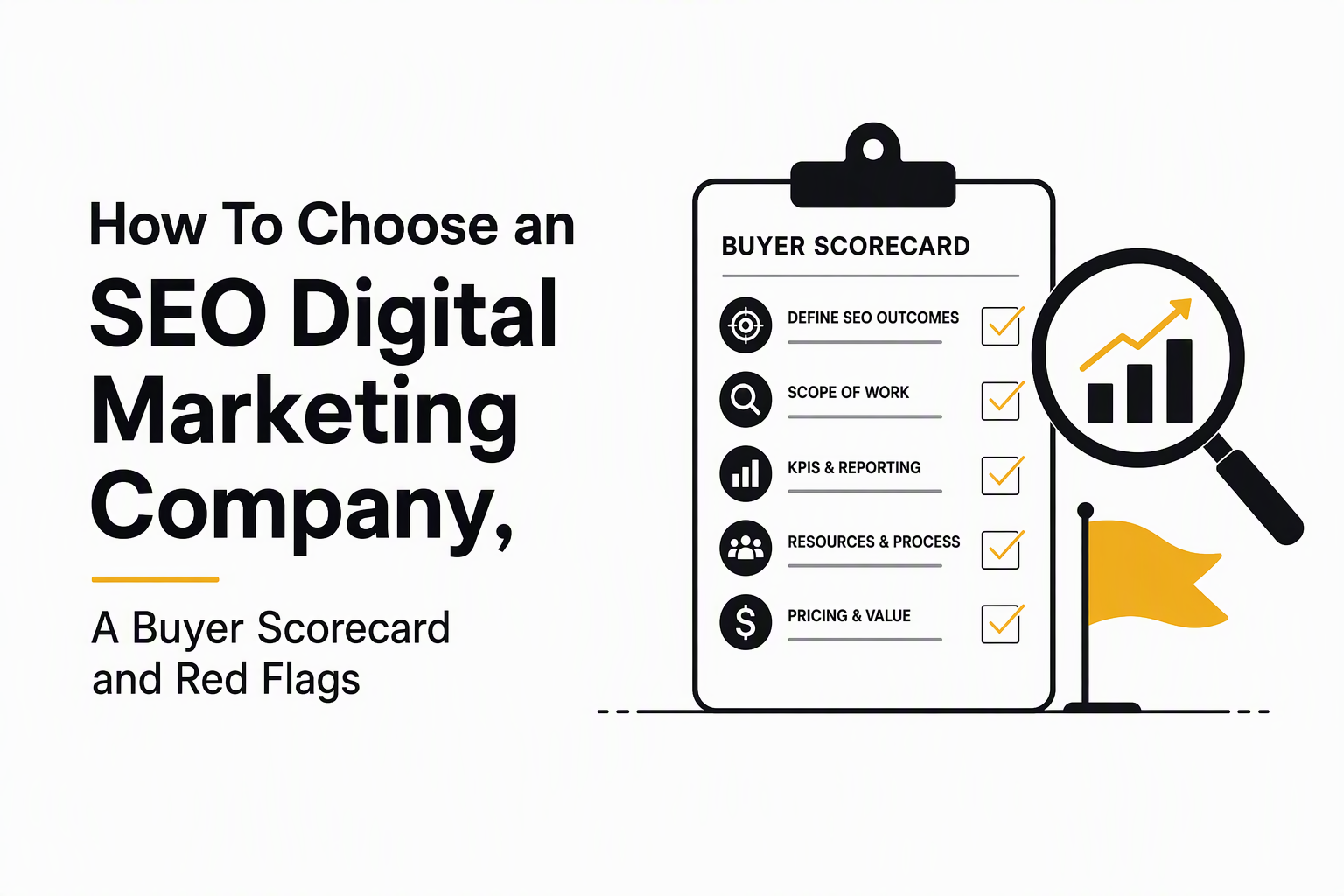
Define Your SEO Outcome and Scope Before You Talk to Agencies
Choosing the right SEO partner starts by translating your business target into an SEO scope that an agency can price and deliver without guesswork.
Turn a revenue target into an SEO target you can measure
- Primary business objective: examples include qualified leads, ecommerce revenue, demos booked, or store visits.
- Conversion definition: what counts as a conversion in GA4 (form submit, call, purchase, trial start), and what is the baseline?
- SEO success metric: non-brand organic conversions and assisted conversions, supported by Google Search Console impressions and clicks.
- Time constraint: do you need movement in 90 days, or are you planning a 6 to 12 month build?
Lock scope by deciding what is in and out
Most mismatched proposals happen because the buyer never states what the agency must include. Use this scope grid before you speak to any seo digital marketing company:
- Technical SEO: crawling, indexing, Core Web Vitals triage, internal linking, structured data.
- On-page: page templates, keyword mapping, content briefs, refreshes, intent matching.
- Content production: who writes, who edits, who publishes, and how many pages per month.
- Authority building: digital PR, link acquisition, partnerships, brand mentions (and what is off-limits).
- Local SEO: Google Business Profile, citations, location pages (if relevant).
Set constraints that prevent bad-fit engagements
- CMS and dev support: WordPress, Shopify, headless, and whether you can ship fixes weekly.
- Compliance: regulated industries, claim substantiation, legal review lead time.
- Approval workflow: who signs off on content and technical changes.
- Tooling reality: confirm access to GA4 and Google Search Console, or plan to set them up.
What a Real SEO Digital Marketing Company Should Deliver Month 1 to Month 6
A credible engagement includes specific artifacts, a measurable baseline, and a roadmap that connects work to outcomes over 6 months.
Month 1 should create clarity, not content volume
- Measurement baseline: GA4 conversion setup review, Search Console verification, and a documented KPI snapshot.
- Technical audit: indexation checks, crawl diagnostics, template issues, internal link gaps, and top-priority fixes.
- Opportunity map: keyword and page mapping tied to intent (commercial vs informational) and business priority.
- 90-day roadmap: sequenced tasks with owners (agency vs your team), dependencies, and expected leading indicators.
Months 2 to 3 should ship fixes and publish mapped pages
- Technical implementation: top fixes shipped and validated (for example, redirect rules, canonical cleanup, sitemap hygiene).
- On-page system: optimized titles, headings, internal links, schema where relevant, and template-level improvements.
- Content briefs: each brief should include intent, outline, entities to cover, internal link targets, and CTA placement.
- Reporting that explains cause: changes made, what moved, what did not, and what the next iteration is.
Months 4 to 6 should compound with iteration and authority signals
- Content refresh cycle: update pages based on Search Console queries, gaps, and cannibalization.
- Topical depth: supporting articles that strengthen conversion pages, not random blog volume.
- Authority work: outreach and link acquisition tied to the pages that matter, with quality checks.
- Quarterly strategy reset: what to stop, what to double down on, and the next 90-day plan.
In my experience reviewing agency reports, the fastest tell is whether the deliverables connect to a prioritized roadmap. If Month 2 is already full of generic blog posts without a baseline and a technical plan, the engagement usually drifts.
The Agency Scorecard, 25 Questions to Vet Process, Proof, and Reviews
A buyer scorecard prevents you from buying persuasion by forcing every agency to answer the same questions with evidence.
How to score agencies consistently
Score each question 0 to 2: 0 = avoided, 1 = answered without proof, 2 = answered with proof or a concrete artifact. A practical decision threshold is 40 out of 50 with no critical red flags (below).
Process and execution (10 questions)
- What does your Month 1 audit output look like (sample table of issues and priorities)?
- How do you decide what to fix first when dev resources are limited?
- How do you map keywords to pages and prevent cannibalization?
- What is your publishing workflow (brief, draft, edit, publish, update)?
- How do you handle technical changes if we have no in-house developer?
- Which KPIs do you report weekly vs monthly, and why?
- How do you identify quick wins without harming long-term growth?
- How do you approach internal linking at scale?
- How do you ensure content matches search intent before publishing?
- What do you do when rankings rise but conversions do not?
Proof and verification (8 questions)
- Can you show anonymized Search Console screenshots tied to a timeline of work?
- Can you share a deliverable sample (brief, audit, roadmap, report) with sensitive data removed?
- What is your retention rate and why do clients leave (patterns, not names)?
- How do you attribute impact in GA4 when sales cycles are long?
- What industries do you avoid, and why?
- What does a failed engagement look like, and what did you change afterward?
- Who owns the strategy, and who executes day to day (named roles, not job titles only)?
- Can you provide 2 references we can contact?
Reviews, reputation, and red flags (7 questions)
- Where do your reviews come from, and can you connect them to real client businesses?
- Do you have a policy against incentivized reviews?
- Do you disclose subcontractors for content or links?
- What link tactics are prohibited in your team guidelines?
- Will you commit in writing to not building links on spam networks?
- What do you need from us to succeed (and what happens if we cannot provide it)?
- What would make you recommend we do not hire your agency?
Red flags that should stop the deal
- Guarantees of rankings or timelines without discussing competition, site history, or constraints.
- Vague link building that cannot explain placement standards, relevance, and risk controls.
- No access requirements for GA4 and Search Console, which often means reporting is shallow.
- Case studies without artifacts or that cannot connect work to dates and tracking.
SEO Pricing in 2026, What You Pay for Different Business Scenarios
SEO pricing in 2026 depends less on the agency brand and more on scenario complexity, content velocity, and implementation constraints.
Budget drivers you can validate in a proposal
- Site size and complexity: number of templates, indexable pages, and technical debt.
- Content throughput: pages per month and editorial rigor, not just word count.
- Authority requirements: whether you need digital PR style placements or light local citations.
- Dev dependency: whether the agency implements fixes or only recommends them.
Scenario-based pricing guidance (use as a sanity check)
Instead of trusting a single number, compare what each seo digital marketing company includes for your scenario. If a proposal looks cheaper, it is often because content production, implementation, or authority work is excluded.
- Local single-location: typically lower scope, heavier on Google Business Profile, reviews, location pages, and technical hygiene.
- Multi-location: scales complexity with location pages, duplicate content risk, and local listings management.
- B2B lead gen: requires intent mapping, conversion tracking, and content that supports long cycles.
- eCommerce: category and product template SEO, faceted navigation controls, schema, and internal linking at scale.
I have seen buyers overpay for “full-service SEO” that excluded the biggest bottleneck: shipping technical fixes. When you compare pricing, ask explicitly what happens if your dev team cannot implement recommendations quickly.
Contracts, Access, and Ownership Terms Most Buyers Forget to Negotiate
The most expensive mistake is signing with an agency that limits your access to data, assets, or accounts you need to operate after the contract ends.
Access checklist to include in the contract
- GA4 and Search Console: your company owns them, the agency gets delegated access.
- Tag manager and CMS: define who can publish, who can edit templates, and the approval path.
- Reporting: you retain the Looker Studio dashboards or exported reports if the relationship ends.
Ownership terms to negotiate upfront
- Content ownership: confirm you own all written content and briefs once paid.
- Creative and templates: landing page templates, schema snippets, and technical documentation should be transferable.
- Link placement documentation: you should receive a list of placements and URLs, even if outreach emails remain private.
Service levels and exit plan
- Cadence: weekly working session plus a monthly performance review, or specify your alternative.
- Response times: define turnaround for critical site issues and reporting questions.
- Exit deliverables: final report, updated roadmap, and a handover call within the final month.
For deeper due diligence before you sign, this guide on hiring a seo marketing company pairs well with the contract checklist above.
Shortlist to Signature, A 7-Day Selection Plan and Decision Thresholds
A 7-day selection plan works because it forces comparable inputs, limits sales cycles, and produces a clear go or no-go decision.
Day 1 to 2: Create your one-page brief
- Business goal, primary conversions, and target customer.
- Site details: CMS, dev constraints, geography, and product lines.
- Non-negotiables: ownership terms, reporting cadence, and what must be included.
Day 3 to 4: Run the same structured interview with 3 agencies
- Use the 25-question scorecard from Section 3.
- Ask for one sample artifact: audit excerpt, roadmap slice, or a reporting screenshot.
- Require that measurement will be based on GA4 and Search Console.
Day 5: Commission a paid audit as a fit test
A paid audit is the fastest way to see how the team thinks and whether they can prioritize. If an agency will not offer an audit-first engagement, ask why. A practical reference for what to expect is a search engine optimization service that clearly lists deliverables and a 90-day roadmap.
Day 6: Compare finalists using decision thresholds
- Scorecard threshold: 40 out of 50, with no red flags.
- Implementation realism: the roadmap respects your constraints and names owners for each task.
- Reporting clarity: sample reporting ties actions to movement, not just charts.
Day 7: Sign with an exit plan and a 90-day checkpoint
- Write a 90-day review milestone into the contract.
- Agree on the first 4 weeks of deliverables and meeting cadence.
- Confirm ownership and access terms again before kickoff.
If you want more context for how to evaluate agency positioning, you can cross-check your shortlist against guides like search optimisation agency expectations and how top search engine optimization companies are typically compared.
| Buyer checkpoint | What you should see | What to do if missing |
|---|---|---|
| Month 1 clarity | Baseline + audit + 90-day roadmap tied to conversions | Ask for sample artifacts, or pause the deal |
| Proof | Search Console evidence, dated work logs, references | Require verification steps before signing |
| Implementation plan | Named owners for fixes and a realistic shipping cadence | Negotiate execution support or reduce scope |
| Ownership and access | Your accounts, your assets, documented handover | Add contract clauses, do not rely on verbal promises |
FAQ about choosing an SEO partner
If you want a fast, decision-stage way to validate fit, scope, and budget before committing to a long retainer, Freeways Agency can run an SEO audit and deliver a practical 90-day roadmap based on GA4 and Google Search Console so you can choose an seo digital marketing company with confidence.

Written by Joyce Ng.

AI For SEO Explained How To Use AI To Improve Search Visibility In 2026
Learn how ai for seo improves research, content, technical workflows, and AI discovery with a practical framework for better search visibility.

Semantic SEO Explained for 2026, The Practical Blueprint to Rank Beyond One Keyword
Learn semantic seo in 2026 with a practical blueprint: intent, entities, deliverables, examples, and a QA checklist to publish with confidence.

Search Engine Optimization Service Guide For 2026, Pricing, Deliverables, And What To Expect In 90 Days
Choose a search engine optimization service in 2026 with scoped pricing, deliverables, a 90-day checklist, and a fast vendor scorecard.