
Stop Treating GPT Ads Like Google Ads. Here’s How to Launch Right

GPT ads are paid placements that appear as clearly labeled sponsored units in the ChatGPT experience, and they are designed to sit alongside answers rather than change what the model says. The practical challenge for advertisers in 2026 is budgeting and setup: you need to know where the ad can show, who is eligible to buy it, and how to forecast results without assuming that paying for ads will influence the underlying ChatGPT response.
- Separate “visibility” (who can see ads) from “eligibility” (who can buy ads) and confirm both by country and plan before budgeting.
- Budget GPT ads using a simple CPC/CPA model with conservative assumptions, then tighten targets via measurement and landing page conversion work.
- Launch with a checklist: labeled placement expectations, policy-safe claims, clean tracking, and a test plan that protects spend.
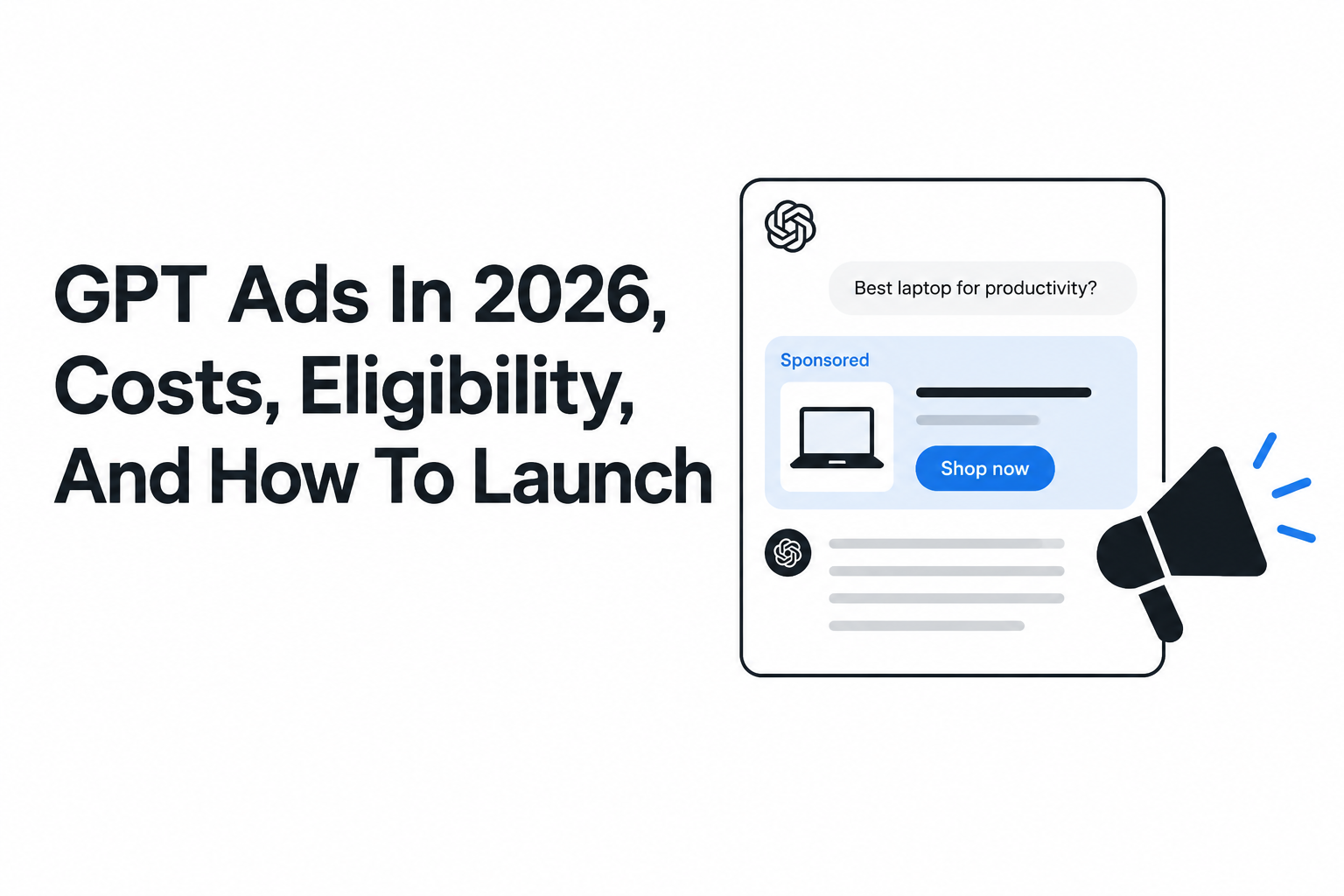
What GPT Ads Are and How ChatGPT Ads Actually Appear
GPT ads in ChatGPT should be treated as labeled ad placements that show around the chat experience, not as a way to steer or rewrite ChatGPT answers. If your internal stakeholders believe an ad buy will “make ChatGPT recommend us,” you will waste budget and risk policy issues, because ads are meant to be clearly separated from the assistant’s organic response.
What to expect on-screen
- Labeled placement: Look for “Sponsored” style labeling and a visual container that distinguishes ads from the answer.
- Proximity to intent: Ads are most valuable when the user’s prompt signals commercial intent (for example, “best project management tool for agencies”).
- Click-out behavior: Treat the click as a standard outbound visit to your landing page, not an “in-chat conversion.”
Non-negotiable clarification for teams
- Ads do not rewrite answers: Plan your strategy on the assumption that the assistant response stays independent of the advertiser’s bid.
- Ads are not SEO: Paid placement can create visits quickly, but it does not replace long-term discoverability from organic search or generative-engine citations.
Implementation check I use before approving creative
I ask one simple question in reviews: “If the user never clicks, did we still stay compliant and on-brand?” That forces us to avoid misleading claims that imply ChatGPT endorsement and to write ad copy that stands on its own, the same way we would for search or social.
Who Can See or Buy ChatGPT Ads in 2026
Eligibility for running ChatGPT ads depends on where OpenAI has rolled out ads and what advertiser onboarding is available in your country, while visibility depends on which user cohorts and regions are actually being shown placements. Because rollout details can change, the most reliable approach is to verify access directly inside the ads interface and confirm delivery by geo in reporting before scaling.
Separate “visibility” from “advertiser eligibility”
- Visibility: whether your target customers in a given country or language are seeing ad units in ChatGPT.
- Eligibility: whether your business can create an ads account, pass verification, and fund campaigns.
Practical availability checklist (use this before budgeting)
- Country and region: Confirm your target geographies can receive impressions and your business can be billed from your operating country.
- Age and sensitive categories: If your product is age-gated or regulated, confirm category policy eligibility before producing creative.
- Brand safety requirements: Ensure your landing page has clear business identity, refund policies (if relevant), and accurate claims.
- Europe-specific caution: For EU/EEA and the UK, expect additional scrutiny around privacy, targeting, and disclosures; confirm requirements in the platform policy and your legal counsel.
What to do if you cannot access ads yet
If GPT ads are not available to you, run a parallel plan: (1) build search-ready landing pages and content for high-intent queries, (2) use existing paid channels to validate conversion, then (3) port the winning messaging into GPT ads when access opens. This is also where aligning with your broader ai ads testing discipline helps, because the same measurement rigor carries over.
How Much Do GPT Ads Cost in Practice and How to Budget
Cost for GPT ads is best planned with scenario math using CPC or CPM assumptions plus your own conversion rate, because platform-wide “average pricing” is not stable enough to anchor a launch plan. If you model outcomes for a $1,000 test and a $10,000 scale budget with conservative conversion assumptions, you can set a rational stop-loss and a clear definition of success.
Use a simple budgeting model (CPC to CPA)
Start with these relationships:
- Clicks = Budget ÷ CPC
- Leads or purchases = Clicks × Landing page conversion rate (CVR)
- CPA = Budget ÷ Conversions
Because we do not have verified, universal benchmarks for GPT ads CPCs across industries, set three CPC scenarios (low, mid, high) that you can tolerate, then decide whether the resulting CPA works for your unit economics.
Scenario table for $1,000 and $10,000 budgets
Assumptions below are placeholders you should replace with your own targets; the value is the structure, not the exact numbers.
- CPC scenarios: $1 (low), $3 (mid), $6 (high)
- Landing page CVR scenarios: 1%, 3%, 5%
Example: $1,000 budget at $3 CPC = ~333 clicks. At 3% CVR, that is ~10 conversions, so CPA is about $100. If your acceptable CPA is $80, you either need lower CPC, higher CVR, or higher conversion value.
How I set pass/fail criteria on a first test
I set a threshold CPA (or cost per qualified lead) before launch, then I decide the minimum click volume needed to learn anything. In practice, very low click counts create noisy conversion rates, so I prioritize getting enough visits to evaluate the landing page and offer, not “winning” in the first few days.
CPM-based planning (if buying impressions)
- Impressions = (Budget ÷ CPM) × 1,000
- Clicks = Impressions × CTR
- Conversions = Clicks × CVR
If you cannot estimate CTR credibly, use CPC planning instead. CPC planning is usually easier for decision-makers because it ties directly to a known outcome: paid visits.
How to Start a ChatGPT Ads Campaign Without Wasting Budget
A GPT ads launch succeeds when you treat it like a controlled experiment with tight measurement, a single clear offer, and a landing page built to convert and to be evaluated quickly. The fastest way to burn budget is to ship broad targeting, vague copy, and a homepage link with no tracking, then declare the channel “doesn’t work.”
Step 1: Define the one action you want and the “stop rules”
- Primary conversion: demo request, purchase, trial start, lead form, or call.
- Stop-loss: for example, pause if spend reaches 1 to 2 times your target CPA with zero conversions, or if landing page bounce is extreme.
- Learning goal: messaging validation, offer validation, or audience validation (pick one).
Step 2: Build a landing page that matches the prompt intent
- Message match: the landing page headline should echo the ad promise and the user’s likely intent.
- Proof: clear pricing, screenshots, demo flow, policies, or documentation.
- Friction removal: reduce form fields, clarify next step, add FAQs near the CTA.
Step 3: Measurement setup before you spend
- UTM discipline: consistent source, medium, campaign, and content naming.
- Conversion tracking: verify the event fires and is deduplicated.
- Analytics QA: test click to conversion end-to-end on mobile and desktop.
Step 4: Creative and policy checks that prevent rework
- Avoid implied endorsement: do not write copy that suggests ChatGPT “recommends” you.
- Substantiation: if you claim “#1” or “fastest,” be prepared to prove it or remove it.
- Safety: keep claims accurate, especially for health, finance, or regulated offers.
Step 5: Testing plan that scales what works
- Test one variable at a time: headline, offer, or landing page hero section.
- Keep a control: do not change everything every few days.
- Optimization loop: weekly review of search intent alignment, on-page behavior, and conversion quality.

| Launch element | What “ready” looks like | Common budget-waster |
|---|---|---|
| Goal | One primary conversion and a defined target CPA | Multiple goals with no priority |
| Landing page | Single intent, clear offer, proof, fast load | Sending traffic to a generic homepage |
| Tracking | UTMs + verified conversion event | No attribution, “trust me” reporting |
| Creative | Accurate claims, no implied ChatGPT endorsement | Overpromising, policy rejections |
| Test design | Control + one variable changes per cycle | Changing everything and learning nothing |
FAQ
If you are preparing to launch GPT ads and want the clicks to convert, Freeways Agency can help you build search-ready landing pages and optimize SEO content so your paid and organic visibility reinforce each other. Contact Freeways Agency for a direct consultation on landing page structure, content alignment to intent, and measurement setup before you scale spend.

Written by Joyce Ng.
How To Choose An SEO Internet Marketing Company, A Scorecard And Proof Checklist
Choose the right seo internet marketing company with a weighted scorecard, proof checklist, and 90-day plan expectations.

SEO Marketing Explained, A Practical System to Get Indexed, Rank, and Measure Results
Learn seo marketing as a measurable system: how Google indexes pages, the 3 pillars, a 14-day plan, and DIY vs agency decisions.

On-Page SEO Services: A Growth Investment or an Expensive Facelift?
Understand on page seo services in 2026: deliverables, 30-day plan, QA checklist, pricing drivers, and how to pick the right provider.