
On-Page SEO Services: A Growth Investment or an Expensive Facelift?

On page seo services in 2026 should produce visible, reviewable changes on your highest-value pages, not a vague list of “optimizations.” The buyer problem is simple: proposals rarely define what “done” looks like, who implements what, and how you verify the work before you pay, especially now that AI-driven search experiences extract answers from page content instead of meta tags.
- Acceptable on page work is a measurable scope: page inventory, prioritized backlog, implemented changes by URL group, and a documented change log you can audit.
- A 30-day plan should specify ownership (agency vs. your team), required accesses, and QA gates for templates, internal links, and schema basics.
- Before paying, verify with before-after evidence: rendered HTML checks, crawl comparisons, internal link counts, and CTR or conversion tracking alignment.
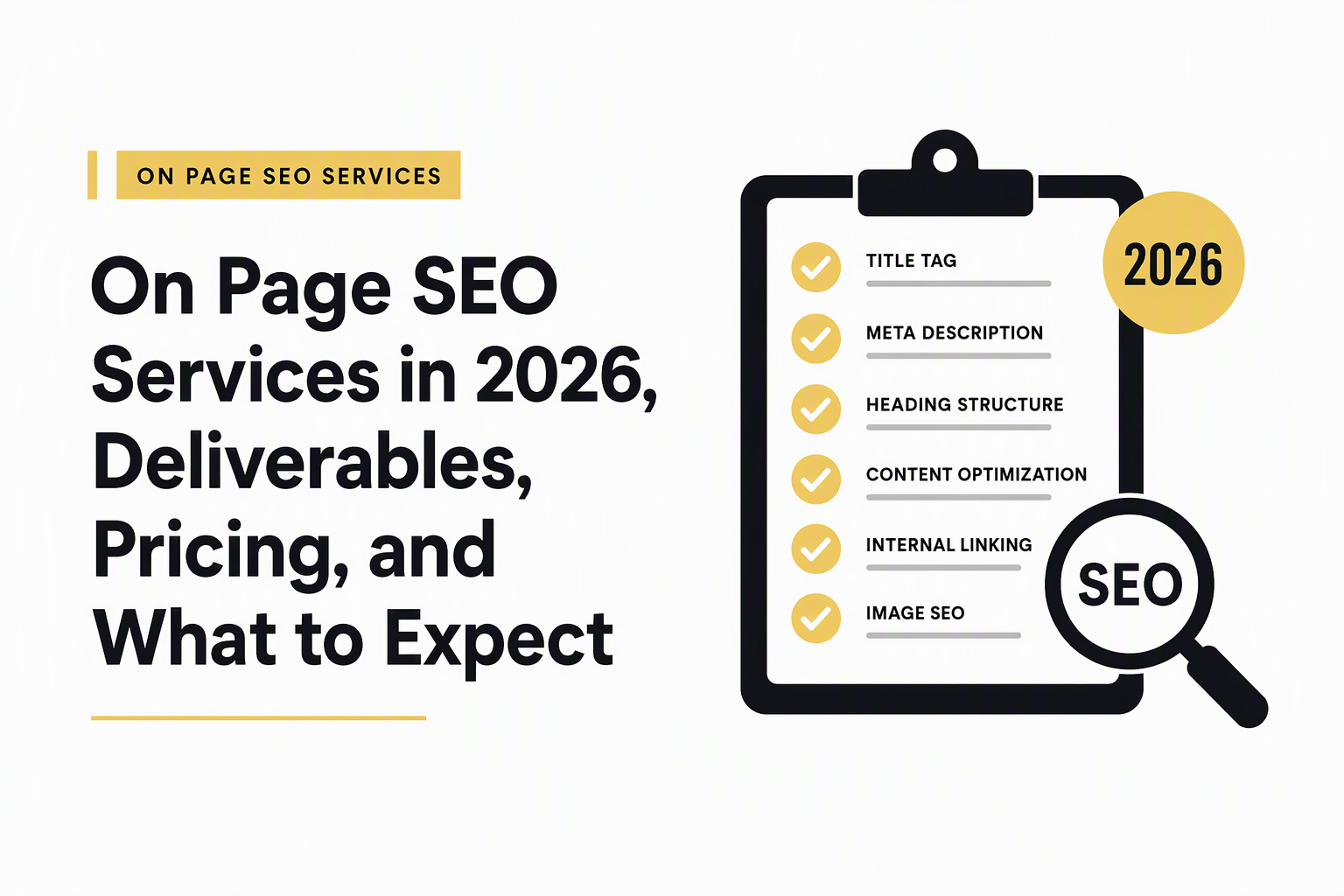
What On Page SEO Services Should Include in 2026
On page SEO services are only “complete” when they ship a defined set of page-level deliverables across content, SERP presentation, internal linking, and entity signals, with proof of implementation on agreed URLs.
Non-negotiable deliverables you should see in the scope
- Page inventory and segmentation: a list of target URLs grouped by template and intent (product, category, blog, location, feature pages). Segmentation matters because acceptance criteria differ by template.
- Search intent and content refresh plan: per URL group, what will change in the main body content (sections to add, remove, consolidate). This is where AI search visibility is largely won because systems quote body content, headings, and structured passages.
- Title tag and meta description rules: not just rewrites, but a rule set (character targets, uniqueness constraints, and how the title reflects the primary promise of the page). Note: snippets may override meta descriptions, but titles still influence click intent and sitelink selection.
- Heading structure and extractable answers: H1 alignment with the page’s primary intent, plus H2 blocks that answer sub-questions directly. If you want AI Overviews and snippets to cite you, each section should contain quotable, self-contained passages.
- Internal linking architecture: a hub-and-spoke plan (or equivalent) plus the actual links added, including where they were placed (navigation, body, related blocks). “We will improve internal links” is not a deliverable.
- Entity and schema basics: correct organization/site schema where relevant, and page-level schema where it materially applies (for example Article, FAQ when appropriate, Product when you truly have product data). Scope should state what is included and what is excluded.
- UX and conversion alignment: on-page work that does not respect conversion paths often raises rankings but lowers revenue. Scope should include CTA placement, form friction checks, and analytics event alignment for the pages being optimized.
What “done” looks like for a single page
For one priority page, a good provider can show a before-after bundle that includes (1) the old and new title/meta, (2) a content diff or documented section changes, (3) internal links added with source URLs, (4) schema validation output, and (5) a short note on how the page now answers the query more directly.
What usually gets missed in proposals
- Template-level fixes: if 300 pages share one template issue (thin body area, duplicate headings, missing breadcrumbs), fixing 10 URLs manually is a bandage. You want either a template change or a URL-group workflow.
- Change-log documentation: without a change log, you cannot tie lifts or drops to specific edits, and you cannot audit the work.
- Coordination with technical SEO: on-page improvements can be muted by canonical problems, indexation issues, or performance regressions. Even if the on-page provider does not fix those items, they should flag and coordinate them.
Your 30-Day On Page SEO Execution Plan and Who Owns What
A realistic 30-day on-page plan maps week-by-week actions, required access, and approval gates so implementation does not stall in Slack threads and half-complete tickets.
Access and inputs required before Day 1
- CMS access (or staging workflow) with the ability to edit titles, headings, body content, and internal links.
- Google Search Console access to validate indexing, query/page mapping, and CTR changes.
- Analytics access to confirm conversion events for the target pages.
- Brand and compliance constraints (claims you cannot make, required disclaimers, approval contacts, turnaround times).
Week-by-week execution plan (agency and client responsibilities)
- Week 1: Audit and prioritization
- Agency: page inventory, query mapping, and a prioritized backlog with expected impact and effort.
- Client: confirm priority URLs, share brand constraints, approve the content direction.
- Week 2: Template rules and first batch implementation
- Agency: define title/meta rules, heading patterns, internal link modules, and content blocks by template.
- Client: approve the template rules, provide dev support if template changes are needed.
- Week 3: Scale to URL groups and internal linking build-out
- Agency: apply approved patterns to the agreed URL list, add internal links and hub-page connections, and document every change.
- Client: review sampled pages (not every page), sign off on the pattern, and unblock dev tickets quickly.
- Week 4: QA, monitoring setup, and iteration
- Agency: QA across rendered HTML, crawl checks, schema validation, and tracking validation. Deliver the final change log and next-month backlog.
- Client: confirm conversion tracking accuracy, approve next steps and ongoing cadence.
Practical lesson from implementation
I have found that most “on-page delays” are not SEO problems but workflow problems: unclear approvers, missing CMS permissions, or no agreement on page templates. A 30-day plan works best when the provider commits to a weekly ship list and you commit to a 24 to 72 hour approval window for sampled pages.
How to Audit the Work Before You Pay
Auditing on page SEO services is straightforward when you require before-after evidence tied to specific URLs, rendered-page checks, and a documented change log.
Acceptance checklist (use this as a payment gate)
- URL list delivered: confirm the exact set of URLs completed matches the scope.
- Change log provided: spreadsheet or ticket export listing URL, change type, date shipped, and link to proof (draft, PR, or CMS revision).
- Rendered HTML verification: spot check pages in the browser and via “view source” or rendered crawls to ensure titles, headings, and body content actually changed. Do not accept “we updated it in the CMS” without verifying output.
- Duplicate and missing metadata checks: confirm no new duplicates were introduced across the optimized set.
- Internal links actually exist: validate added links on-page and ensure they are crawlable (not blocked by scripts or nofollow unless intentional).
- Indexation and canonicals sanity check: verify the pages are indexable and canonicals are correct, or you are paying for changes that cannot rank.
- Schema validation where used: confirm no errors in a schema validator and that the markup matches visible content.
- Tracking alignment: ensure key events are firing on updated pages so you can judge lead or revenue impact, not just rankings.
What evidence to request
- Before-after crawl comparison for the URL set (titles, H1s, word count, internal link counts).
- 3 to 5 page samples showing the pattern: one high-traffic page, one mid, one low, plus one template edge case.
- SERP presentation snapshot (titles as seen in search may vary, but you can still confirm your inputs are correct and consistent).
Common failure modes you can catch early
- Edits made only in drafts with no publish date.
- “Optimized” pages that still do not answer the query because the changes were limited to metadata, not content.
- Internal links added in sitewide areas that dilute relevance instead of contextual body links.

Pricing, Packages, and What Changes the Cost
Pricing for on page SEO services is driven more by page volume, template complexity, approvals, and implementation responsibility than by how many keywords you want to rank for.
Common pricing models you will see
- Per-page pricing: works when pages are truly unique; breaks down when the site is template-heavy and needs pattern-based changes.
- Monthly retainer: best for ongoing refreshes, internal linking, and iterative testing; requires clear monthly ship targets.
- Fixed-scope project: best when you have a defined set of pages and want a clean acceptance checklist and change log.
Cost drivers (use these to compare proposals)
- Template vs. one-off edits: template changes require dev coordination and QA across many URLs.
- Content production vs. content refresh: rewriting sections and adding missing entities takes more time than rewording meta tags.
- Internal linking rebuild: planning hubs and adding links at scale can be substantial, but it is also one of the highest leverage activities.
- Implementation ownership: “recommendations only” should cost less than “we implement in your CMS.”
- Regulated approvals: legal review cycles can double timelines if not planned.
What is often excluded (and should be stated explicitly)
- Net-new page builds, design work, or major copywriting beyond agreed sections
- Deep dev work such as migrations, complex schema systems, or performance refactors (often adjacent to on-page but not the same)
- Link building (separate scope)
- Internationalization and hreflang strategy
Choosing the Right Provider, 12 Questions to Ask on the Sales Call
The fastest way to choose a provider is to ask questions that force them to show process maturity, QA rigor, and proof-based reporting rather than promises.
12 buyer questions that reveal real capability
- What exactly is the unit of delivery, a URL list shipped, a template pattern deployed, or a recommendation document?
- How do you choose priority pages, and what inputs do you need from us to finalize that list?
- Will you implement in our CMS or hand off tickets? If you hand off, how do you ensure it is implemented correctly?
- What does your change log look like, and can you share an anonymized example?
- How do you QA rendered output versus CMS fields?
- How do you handle template-heavy sites where 100 to 10,000 pages share the same structure?
- How do you approach internal linking beyond “add more links”?
- Which schema types do you consider baseline and how do you validate them?
- How do you incorporate entity coverage or semantic SEO so the page can rank beyond a single keyword?
- What is your definition of success in 30 days, and which metrics should not be expected to move that quickly?
- How do you report on rankings, CTR, and conversions tied to the updated URLs?
- What is explicitly not included, and what do you typically recommend bundling with on-page work?
A practical buying insight
I would not approve a proposal until the provider commits to a shipped URL count or shipped template set by week, because that is what prevents endless “optimization in progress.” If they cannot state how you will audit the work, it usually means they are not used to being audited.
Get On Page SEO Services Implemented Fast with Freeways Agency
Freeways Agency implements on page SEO services with a fixed scope, a 30-day ship plan, and an audit-ready change log so you can approve work based on evidence rather than trust.
What the engagement looks like
- Week 1: on-page audit that turns into a prioritized backlog mapped to templates and URL groups.
- Weeks 2 to 3: content refresh and on-page optimization executed by template and by URL group, plus internal linking architecture and hub-page planning.
- Week 4: QA checklist run against rendered pages, schema basics validated, and coordination notes provided for any adjacent issues that touch indexation or page performance.
How we make approval easy
- Sampling-based review: you approve patterns using a small set of representative pages, then we scale safely.
- Evidence-first reporting: you receive a change log and reporting tied to rankings, CTR, and leads or conversions for the pages touched.
- Clear dependencies: if something needs dev support, we specify it early so timeline risk is visible, not hidden.
| What you need | Best-fit on-page scope | Proof you should receive |
|---|---|---|
| Fix a small set of money pages quickly | Fixed-scope, 10 to 30 URLs plus internal links | Before-after page samples, change log, crawl diff |
| Template-heavy site with repeated issues | Template rules + URL-group implementation | Template QA checklist, rendered verification, rollout list |
| Ongoing content refresh and SERP iteration | Monthly retainer with monthly ship targets | Monthly shipped URLs, CTR and conversion tracking alignment |
FAQ about on page SEO services
If you want on page SEO services that you can approve with a clear scope, a 30-day implementation plan, and an audit-ready QA checklist, book a consultation with Freeways Agency. We will confirm your priority pages, outline dependencies, and send a fixed-price proposal with acceptance criteria and the exact evidence you will receive before final payment.

Written by Joyce Ng.

AI Search Statistics 2026: Clicks, Conversions & Brand Visibility
AI Overviews hit 2.5B users, but top-ranking CTR fell 58%. Explore 2026 AI search statistics plus Freeways’ test of 216 brands across 5 AI platforms.

Is Your Website an Open Book or a Black Box to AI?
Learn optimization artificial intelligence with a clear taxonomy, a weight-update example, a method selection matrix, and a measurable project workflow.

Best SEO AI Tool In 2026, A Practical Shortlist By Budget And Use Case
Compare the best seo ai tool options for content, technical SEO, free workflows, and AI visibility by budget, team size, and use case.