
AI Driven SEO in 2026 - A Practical Playbook From Strategy to Measurement

AI driven seo in 2026 means using machine learning tools to speed up SEO decisions and production (research, clustering, briefs, internal linking, schema, and reporting) while humans stay accountable for strategy, accuracy, and quality.
- AI driven SEO works best as a workflow: clear inputs, review gates, and measurable outputs, not as “generate 100 articles.”
- Use a simple decision framework to separate SEO vs AEO vs GEO vs AI Overviews optimization so you do not optimize the wrong thing.
- Measure beyond rankings with page-level intent KPIs, conversions, and visibility signals for AI answers and snippets.

What AI Driven SEO Means in 2026 (And What It Does Not)
AI driven SEO in 2026 is a human-led SEO system where AI assists with pattern finding and drafting, but people define intent, validate facts, and decide what ships.
A plain-English definition you can operationalize
- AI assists: query expansion, SERP pattern summaries, keyword clustering, outline creation, entity suggestions, on-page checks, schema scaffolding, and reporting automation.
- Humans own: strategy, prioritization, expertise, original examples, fact-checking, editorial quality, and compliance.
What it is not (common traps that waste weeks)
- Not “publish more and win”: scaling thin pages can dilute topical authority and create index bloat.
- Not a shortcut around technical SEO: crawlability, internal linking, and rendering still gate performance. If you need a practical baseline, start with website technical SEO.
- Not “rankings-only optimization”: AI answers and rich results can reduce clicks even when rankings hold.
Realistic expectations (what you should see first)
In the first 30 to 60 days, AI driven SEO usually improves throughput and consistency more than it improves rankings: faster briefs, clearer content structure, fewer missed entities, and tighter internal linking. In our experience running repeatable content ops, the first measurable win is often “time-to-publish” dropping because writers start from a validated brief instead of a blank page.
AI SEO vs AEO vs GEO vs AI Overviews Optimization - A Simple Decision Framework
SEO, AEO, GEO, and AI Overviews optimization are different tactics for different surfaces, so the right choice depends on the query type and the outcome you want (clicks, citations, leads, or brand recall).
Comparison table by goal, surface, and deliverable
| Term | Main surface | Best for query types | Primary deliverables | Primary success signals |
|---|---|---|---|---|
| SEO | Organic results (classic listings) | Commercial, informational, navigational | Content + internal links + technical fixes | Sessions, conversions, rankings, crawl/index health |
| AEO (Answer Engine Optimization) | Featured snippets, People Also Ask, voice assistants | Direct questions, how-to, definitions | Answer blocks, structured headings, concise steps | Snippet wins, impressions, assisted conversions |
| GEO (Generative Engine Optimization) | Chat-based answers (ChatGPT, Perplexity, Gemini) | Comparisons, multi-step decisions, synthesis | Citable passages, clear entities, verifiable claims | Citations/mentions, referral traffic, branded search lift |
| AI Overviews optimization | Google AI Overviews | Broad informational and “best X for Y” | Clean topical coverage, strong headings, helpful schema | Impressions, presence in AIO, downstream conversions |
A decision tree you can use in planning meetings
- If the business goal is qualified traffic and leads, start with SEO fundamentals: pages that match intent, internal linking, and technical readiness.
- If the query is a direct question ("what is", "how to", "steps"), add AEO formatting: short answer first, then expanded explanation.
- If the query needs synthesis ("compare", "best", "vs", "pros/cons"), add GEO traits: named criteria, clear definitions, and extractable bullet points.
- If Google shows AI Overviews for the topic, treat it like a separate visibility layer: write passages that can be quoted and ensure your page is technically easy to parse.
Where AI driven SEO fits
AI driven SEO is not a separate channel, it is an execution method that can power all four tactics above. It also pairs well with a clear understanding of organic search and search engine optimization so teams do not confuse “visibility” with “traffic.”
The AI Driven SEO Playbook - 10 Steps From Audit to Publishing to Refresh
A workable AI driven SEO cycle has 10 steps with explicit inputs and outputs, so you can run it monthly without relying on “prompt luck.”
Step 1: Set the measurement baseline (before you change anything)
- Inputs: Google Search Console (GSC) performance export (last 90 days), GA4 conversions, current top pages by clicks.
- Output: a baseline sheet with page URL, primary intent, top queries, clicks, impressions, CTR, conversions.
- Cadence: monthly refresh.
Step 2: Run a lightweight technical and indexation audit
- Inputs: sitemap, robots.txt, site crawl (even a limited crawl is fine).
- Outputs: list of indexation blockers, duplicate clusters, redirect chains, thin tag pages, broken internal links.
- Rule of thumb: fix anything that prevents crawling or indexing before producing new content.
Step 3: Build a keyword universe from 3 sources (not just one tool)
- Source A: GSC queries (what you already appear for).
- Source B: competitor pages and their headings (manual review beats blind scraping).
- Source C: customer language from sales calls, support tickets, and emails.
- Output: one deduped list with notes on intent and funnel stage in plain language (awareness vs consideration vs purchase).
Step 4: Cluster by intent, not by word similarity
- Inputs: keyword list + a SERP scan for 10 to 20 sample terms per cluster.
- Outputs: clusters labeled by the page you should build (guide, comparison, tool page, category page).
- Quality check: if the top 5 results are mixed formats, split the cluster.
Step 5: Map clusters to URLs (create, refresh, consolidate)
- Create when no page exists for the intent.
- Refresh when the page exists but is outdated or mismatched to SERP format.
- Consolidate when multiple pages compete for the same intent (cannibalization).
- Output: a URL map with one “primary page” per cluster.
Step 6: Generate an AI-assisted content brief (then make it human)
- AI draft brief includes: search intent statement, H2/H3 outline, entity list, questions to answer, suggested internal links.
- Human additions: real examples, screenshots to capture, SME quotes, product or process details you can verify.
- Output: a 1 to 2 page brief a writer can execute.
Step 7: Draft with “answer-first” structure and extractable blocks
- Pattern: first paragraph answers the query directly, then expands.
- Blocks: checklists, tables, step-by-step instructions, “when to use” criteria.
- Output: first draft that is already formatted for snippets and AI citation.
Step 8: On-page optimization that is more than keywords
- Title/H1: match intent and include a clear benefit, not stuffed variations.
- Internal links: add 3 to 8 contextual links to supporting pages and 2 to 4 links from older relevant pages back to the new one.
- Schema: add Article, FAQ (if relevant), HowTo (only when you truly have steps), Organization as appropriate.
- Output: publish-ready page with strong scannability.
Step 9: Publish, then index-check and monitor early signals
- 24 to 72 hours: confirm indexation in GSC and fix coverage issues.
- 7 to 14 days: monitor impressions and query drift (are you showing for the right intent?).
- Output: early performance note with next actions.
Step 10: Refresh with a monthly “decay and opportunity” routine
- Decay: pages with falling clicks or CTR over 28 to 90 days.
- Opportunity: pages with rising impressions but low CTR (often a title/intent mismatch).
- Output: a refresh backlog ranked by impact and effort.
After running multiple monthly refresh cycles, the pattern was clear: teams that treat AI driven SEO as a closed-loop system (baseline, change, measure, refresh) avoid the common trap of producing more pages without knowing what moved the needle.
Human-in-the-Loop Governance - Quality Control That Prevents Thin Content and Hallucinations
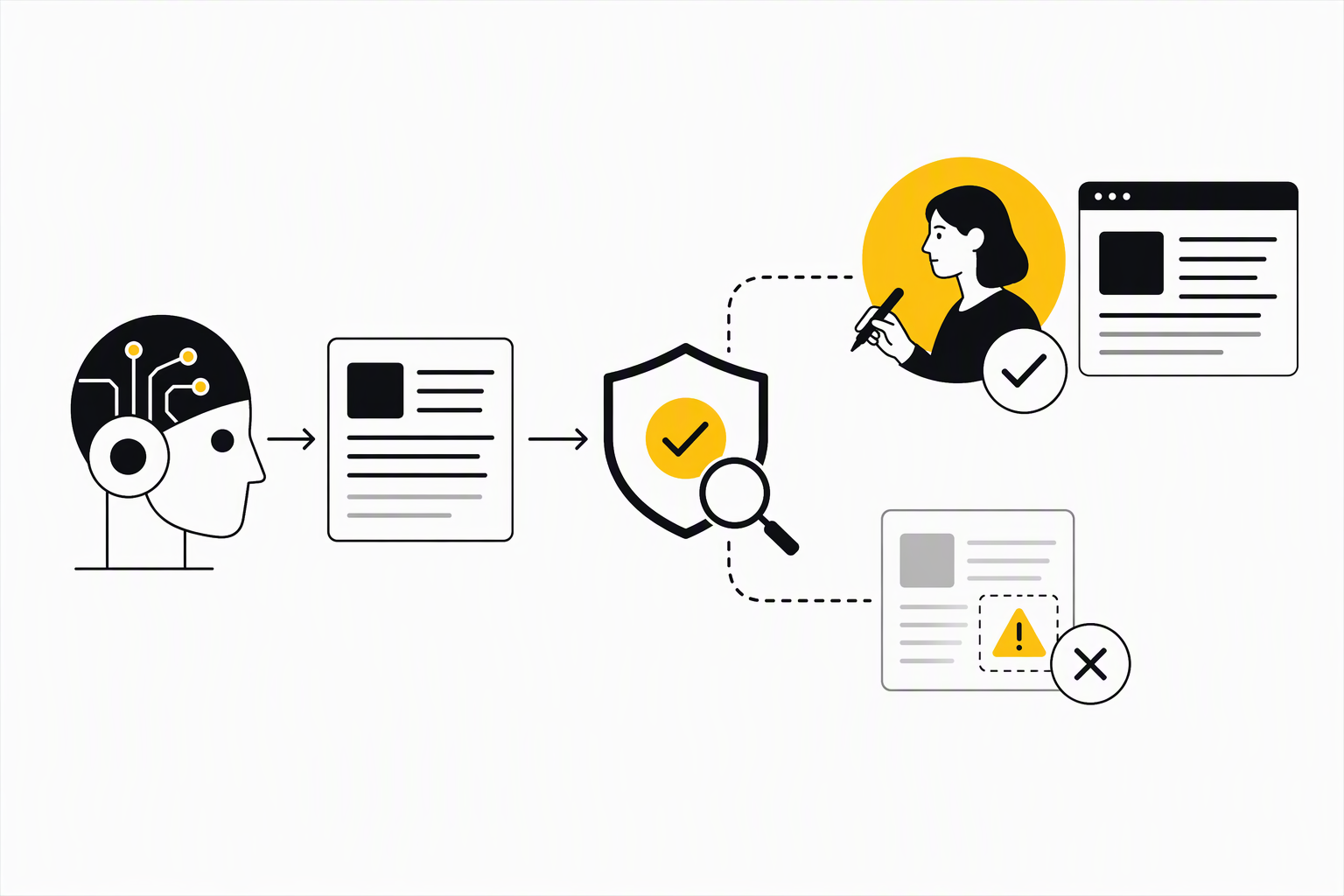
Human-in-the-loop governance keeps AI driven SEO safe and effective by defining what AI can draft, what humans must verify, and what cannot be published without evidence.
Set three review gates (and do not skip them)
- Intent gate: confirm the page answers the same job-to-be-done as the top results (format, depth, and angle).
- Accuracy gate: verify factual claims, definitions, and steps against primary sources or your own documentation.
- Value gate: ensure the page includes something non-generic: an example, a checklist, a template, a decision rule, or a workflow.
An editorial checklist that catches thin content fast
- E-E-A-T signals: named author, role/credentials if relevant, “how we did it” steps, and clear update date for time-sensitive topics.
- Duplication scan: check internal overlap and rewrite sections that mirror existing pages.
- Claim hygiene: remove any stat you cannot cite, replace with a mechanism or criterion.
- Originality requirement: at least one unique element per page (example, template, mini-audit, or decision tree).
Risk-based AI usage rules (copy/paste policy)
| Content type | AI allowed to draft? | Human required? | Why |
|---|---|---|---|
| Definitions, how-to steps | Yes, with sources | Yes, verify steps | Procedural errors break trust quickly |
| Health, finance, legal topics | Only with strict constraints | Yes, SME sign-off | High harm if wrong |
| Company policies, pricing, guarantees | No | Yes, owner approval | Must be exact and current |
| Meta descriptions, title variants | Yes | Light review | Low risk, easy to test |
We initially assumed the biggest risk was “AI tone,” but editorial reviews showed the real risk was unverified specificity, like naming a standard, feature, or requirement incorrectly. A simple accuracy gate fixed most issues without slowing the team down.
Free and Freemium AI SEO Toolkit - Build a Stack Without Enterprise Software
A low-cost AI driven SEO stack is realistic if you cover six jobs: research, clustering, brief drafting, on-page checks, schema, and reporting.
Tool categories and practical combos
- Search performance and indexing: Google Search Console (free), GA4 (free).
- Crawling: Screaming Frog SEO Spider (freemium/paid) or a limited crawl alternative. Start small if your site is large.
- AI drafting and synthesis: a general LLM for clustering, briefs, and outline variants. Keep your prompts templated and store them.
- Keyword expansion: Google SERP manual review plus a freemium keyword tool; validate with GSC whenever possible.
- Schema: a schema generator and validator. Use Google’s tool for validation: Rich Results Test.
- Collaboration: Google Sheets and a doc template library for briefs and refresh logs.
Minimum viable stack (what to use if you are starting this month)
- GSC + GA4 for baseline and outcomes.
- A crawler for technical and internal linking checks.
- An LLM for clustering, briefs, and first drafts.
- A schema validator to reduce rich result errors.
Prompt templates (so results are repeatable)
- Intent classifier: “Given these queries and the top ranking page types, label intent and recommended page format. Return as a table with one format per cluster.”
- Brief builder: “Create an outline that answers the query in the first paragraph, includes a checklist, and suggests internal links based on these existing URLs.”
- Refresh assistant: “Identify sections likely outdated based on current SERP headings and propose additions, removals, and a rewritten intro.”
For vendor selection later, a helpful benchmark is whether a tool improves a specific step output you already track (brief time, refresh throughput, internal links added) instead of offering a vague “AI score.” If you are evaluating agencies rather than tools, this list of top search engine optimization companies can help you compare process and transparency.
How to Measure AI Driven SEO - KPIs Beyond Rankings in a Zero-Click World
Measurement for ai driven seo should connect each page’s intent to a primary outcome (conversion or assisted value) and a visibility outcome (impressions, CTR, and citation-style signals).
Use a 3-layer KPI model
- Layer 1: Visibility: impressions by page and query cluster, average position, presence in rich results where applicable.
- Layer 2: Engagement: organic CTR, scroll depth or engaged sessions (GA4), internal click-through to money pages.
- Layer 3: Business impact: conversions from organic, assisted conversions (where your model allows), pipeline events or qualified leads.
Track the “CTR gap” to detect AI answer effects
When impressions rise but clicks do not, the page may be visible but losing clicks to on-SERP answers (snippets, AI Overviews, knowledge panels). The practical workflow is:
- In GSC, export page-level clicks, impressions, CTR for the last 28 days vs previous 28 days.
- Flag pages where impressions increase and CTR decreases.
- For those pages, rewrite the intro to answer faster, add a clearer table/checklist, and tighten titles to match the exact query language.
Measure content quality with “proof of work” fields
To keep AI driven SEO honest, add 3 columns to your content tracker: source links used, original elements added (template, example, screenshot), and reviewer name. When we tested this simple logging approach, drafts became easier to approve because reviewers could see what was verified and what was editorial.
How to monitor AI visibility without pretending it is perfect
- Brand and key page mentions: periodic manual checks in major assistants for your highest-value topics.
- Referral traffic: watch GA4 referrals from known answer engines where available.
- Snippet ownership: track featured snippet presence for question-led pages.
| Page intent | Primary KPI | Secondary KPI | Best optimization lever |
|---|---|---|---|
| How-to guide | Organic engaged sessions | Snippet impressions | Answer-first steps + HowTo formatting when valid |
| Comparison page | Leads or trials | Internal clicks to product/service page | Decision criteria table + clear conclusions |
| Service/category page | Qualified form submits | Branded search lift | Proof, process, and internal linking depth |
FAQ
If you want a second set of eyes on your first ai driven seo cycle, Freeways can help with a lightweight audit and a 30-day pilot plan that turns your current data into a prioritized, human-reviewed execution backlog.

Written by Joyce Ng.

High-Volume SEO Keywords: A Gold Mine or a Money Pit?
Learn keywords and SEO with a practical keyword research workflow, search intent examples, prioritization criteria, and a content mapping template.

Online Marketing SEO: Revenue Engine or Expensive Busywork?
Run online marketing search engine optimization in 2026 with a practical workflow, examples, and a 90-day KPI cadence that ties SEO to revenue.

AI Search Statistics 2026: Clicks, Conversions & Brand Visibility
AI Overviews hit 2.5B users, but top-ranking CTR fell 58%. Explore 2026 AI search statistics plus Freeways’ test of 216 brands across 5 AI platforms.