
Search Optimisation Agency Guide, Pricing, Scorecard, And What To Expect In 90 Days

A search optimisation agency should be judged on measurable outcomes (qualified traffic, leads, and revenue), not rankings alone, and this guide shows exactly how to compare providers and what to expect in the first 90 days.
- Use a KPI-to-deliverable map so your agency is accountable for business outcomes, not vanity metrics.
- Match pricing model to your risk tolerance and scope, then validate deliverables with a written 30-60-90 day plan.
- Score agencies with a weighted rubric that tests proof, strategy quality, and reporting access before you sign.
What a search optimisation agency actually does and what outcomes to hold them accountable for
A search optimisation agency earns its fee by diagnosing what blocks growth, executing fixes across multiple SEO levers, and reporting impact against agreed KPIs.
Scope checklist you can put in the contract
- Technical: crawlability, indexing, site architecture, speed, structured data, internal linking, redirects, canonicals.
- Content: keyword and intent research, content briefs, on-page optimization, content refreshes, topical coverage, conversion alignment.
- Authority: digital PR and link earning, link cleanup when needed, citation consistency (especially for location-based brands).
- Local: Google Business Profile optimization, local landing pages, reviews process, NAP consistency, map pack tracking. (If local matters, align on local search engine optimization deliverables.)
- Analytics: measurement plan, dashboards, Search Console monitoring, GA4 events and conversions, annotations, monthly insights.
KPI mapping that ties work to revenue
Ask the agency to map each workstream to a KPI you can verify in tools you own. A practical mapping looks like this:
- Indexing and crawl health: coverage errors trending down, important templates indexed consistently (Google Search Console).
- Demand capture: non-branded organic clicks and impressions growing in priority topic clusters (Search Console).
- Lead quality: organic conversion rate and assisted conversions (GA4), plus lead-to-opportunity in your CRM.
- Commercial page performance: organic entrances to product/service pages and conversion paths (GA4 exploration reports).
In our experience working with service businesses, the fastest way to expose weak strategy is to ask for a one-page KPI tree that starts at revenue and traces back to the exact pages, queries, and technical dependencies that influence it.
Minimum tool access you should insist on
- Google Search Console access at least at “Full” or “Owner” level for the property.
- GA4 access with conversions defined and documented.
- A shared technical audit log (spreadsheet or ticket system) with status, owner, and shipped date.
- A rank tracker is optional, but a search visibility view inside Search Console is not.
SEO agency pricing in 2026, typical ranges, pricing models, and what drives cost
SEO pricing in 2026 usually falls into three buying models, and your total cost is driven more by scope and execution capacity than by industry labels.
Typical pricing models and realistic ranges
- Monthly retainer: commonly used for ongoing execution and iteration; typical market ranges are highly variable by region and scope, but many buyers will see US$1,500 to $10,000+ per month for small to mid-sized programs.
- Project or audit + roadmap: best for a reset or internal team enablement; often US$3,000 to $25,000+ depending on site size and complexity.
- Performance-based components: sometimes layered in (bonuses tied to milestones); treat with caution unless measurement is airtight and incentives align with qualified conversions.
Important: these are broad buying benchmarks, not a promise of what any specific provider charges. Always ask for a line-item scope and time allocation.
Cost-driver checklist you can use in discovery calls
- Site size and complexity: number of indexable URLs, multiple languages, faceted navigation, CMS limitations.
- Technical debt: legacy redirects, duplicated templates, thin parameter pages, poor internal linking.
- Content production needs: new pages vs refreshes, SME interview requirements, compliance review.
- Authority gap: how far your backlink and brand mention profile trails the current top results.
- Local footprint: number of locations and need for location pages and citations.
- Velocity expectations: how many fixes and pages can realistically ship per month with your dev and approval process.
Deliverables by budget level (use as a reality check)
- Starter scope: technical audit, prioritized roadmap, 2 to 4 content briefs or refreshes monthly, basic reporting.
- Growth scope: ongoing technical seo implementation support, consistent content production, internal linking system, digital PR or link earning, conversion alignment.
- Competitive scope: full editorial calendar, programmatic or template scaling where appropriate, continuous technical monitoring, proactive PR and partnerships, and deeper analytics tied to revenue.
We initially assumed content volume was the main cost driver, but repeated audits showed engineering constraints and approval bottlenecks often dictate both timeline and budget more than writing does.
The agency shortlist scorecard, how to compare reviews, proof, strategy quality, and reporting
A buyer-ready scorecard makes a search optimisation agency comparison objective by weighting proof, strategy, execution maturity, and measurement access.
Weighted scorecard (100 points)
- Strategy quality (30): clear diagnosis, prioritization logic, and a plan tied to your KPIs.
- Proof and relevance (25): examples in your business model (B2B, ecommerce, local), plus before-and-after artifacts (redacted is fine).
- Execution system (20): ticketing, QA, content workflow, stakeholder management, dev collaboration.
- Reporting and transparency (15): Search Console + GA4 access, monthly narrative insights, change log, and forecast assumptions.
- Commercials and risk controls (10): contract terms, cancellation, IP ownership, and clarity on what is not included.
How to validate reviews and case claims without overinvesting time
- Ask for 2 artifacts: a sample monthly report and a sample technical backlog. These reveal maturity faster than testimonials.
- Check review patterns: look for specifics (deliverables, cadence, communication), not generic praise.
- Verify access discipline: if the agency resists giving you tool access, treat it as a governance risk.
- Run a “one page strategy test”: ask them to explain the top 5 actions they would take in the first 30 days and why.
Shortlist workflow (fast and practical)
- Build a list of 5 to 8 candidates, including at least one reference list such as top search engine optimization companies.
- Do a 20 minute site review: indexing basics, content depth on money pages, and obvious technical issues.
- Use the scorecard to narrow to 2 or 3 finalists.
- Request a written 30-60-90 day plan with assumptions and dependencies.
What you should receive in the first 30 60 90 days, deliverables, KPIs, and contract red flags
A strong 30-60-90 day onboarding plan reduces wasted spend by sequencing diagnosis, quick wins, and scalable execution in a way your team can actually ship.
Days 1 to 30 (diagnose and de-risk)
- Access and baselines: Search Console, GA4, CMS, rank tracker if used, call tracking, CRM definitions for qualified leads.
- Audit pack: technical audit, content and intent gap review, internal linking snapshot, competitor SERP review.
- Roadmap: prioritized backlog with impact estimate, effort, owner, and dependencies.
- KPIs to track: indexing errors, crawl stats, top queries/pages baseline, organic conversions baseline.
Days 31 to 60 (ship fixes and publish)
- Technical implementation: highest impact fixes first (indexation, duplication, core templates, internal links).
- Content execution: content refreshes on existing money pages, then new pages for high-intent gaps.
- Measurement: conversion events validated, reporting template finalized, annotations for shipped work.
Days 61 to 90 (scale what works)
- Content system: editorial cadence, briefs, QA checklist, internal linking rules.
- Authority plan: digital PR targets, linkable assets, outreach process, brand mention monitoring.
- Business reporting: monthly insight report linking work shipped to KPI movement and next priorities.
After running audits where rankings rose but revenue did not, the pattern was clear: the missing piece was usually conversion intent alignment on service pages and tracking that separated leads from qualified leads.
Contract and reporting red flags that kill ROI
- Guaranteed rankings or vague “we’ll build links” promises without quality controls.
- No change log or refusal to share what was implemented and when.
- Opaque reporting that hides Search Console and GA4 access behind screenshots.
- Locked-in ownership where you do not own content, accounts, or landing pages if you leave.
- Misaligned incentives focused on traffic volume while you buy qualified conversions.
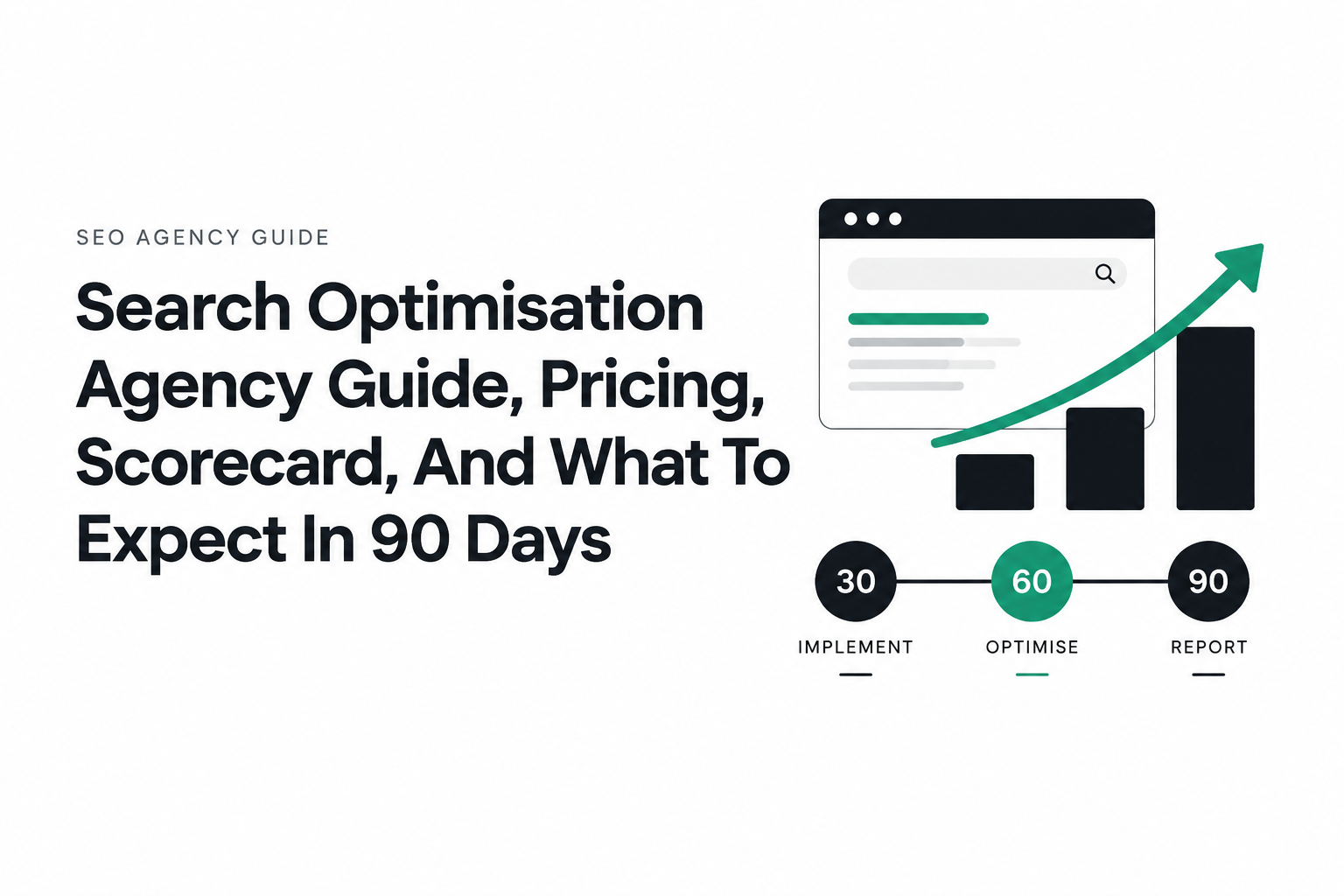
SEO is not being phased out, what to ask about AI Overviews, AEO, and GEO deliverables
SEO remains durable in the AI answer era when your search optimisation agency can translate “visibility” into concrete assets like structured data, entity clarity, and answer-ready pages.
Buyer questions that force concrete AI-era deliverables
- Schema and eligibility: “Which schema types will you implement on our key templates, and how will you validate them?” (Ask for validation workflow using tools like Google’s Rich Results Test: Rich Results Test.)
- Entity and topical coverage: “How will you build a topic map that covers definitions, comparisons, and use-cases around our core services?”
- Snippet and answer targeting: “Which pages will you rewrite to answer the query in the first 1 to 2 sentences, and how will you test performance?”
- Citation and trust signals: “What is your plan for earning mentions and links that support our brand as a source?”
- Measurement: “How will you track changes in impressions and clicks for query groups that trigger AI features in Search Console?”
What good answer-ready content looks like in practice
- A page section that states the recommendation in one sentence, followed by a checklist, table, or step-by-step method.
- Clear definitions only where needed, supported by screenshots or tool exports in reporting.
- Updated pages that keep the URL stable so earned signals compound over time.
A reliable search optimisation agency will also explain how they integrate classic seo marketing fundamentals with these deliverables, rather than treating AI visibility as a separate channel.
| Buying decision | What to request | What “good” looks like | Common warning sign |
|---|---|---|---|
| Scope fit | Written scope across technical, content, authority, local, analytics | Backlog with owners, dates, and dependencies | Vague “ongoing SEO” bundle |
| Proof | 2 to 3 relevant examples + artifacts | Before/after pages, roadmap, reporting sample | Only rankings screenshots |
| Reporting | Search Console + GA4 access and monthly narrative | Change log and KPI commentary tied to work shipped | PDF-only reports without tool access |
| Pricing | Model + line-item deliverables and hours | Clear inclusions/exclusions, revision limits, dev support terms | Lock-in contract with unclear outputs |
| AI-era readiness | Schema plan, entity coverage, answer-ready sections | Validated markup, query-group monitoring, content refresh cadence | “We optimize for AI” with no deliverables |
FAQ on choosing an SEO partner
If you want a decision-ready plan, Freeways Agency can walk you through a fit call and provide a written 30-60-90 day roadmap with a pricing range tied to your scope, whether you need technical fixes, content execution, local growth, or full-funnel measurement.

Written by Joyce Ng.

AI Search Statistics 2026: Clicks, Conversions & Brand Visibility
AI Overviews hit 2.5B users, but top-ranking CTR fell 58%. Explore 2026 AI search statistics plus Freeways’ test of 216 brands across 5 AI platforms.
Hiring an SEO Company? Here’s What to Check Before You Sign
Compare an SEO marketing company by deliverables, pricing, proof, timelines, and red flags before signing a contract.
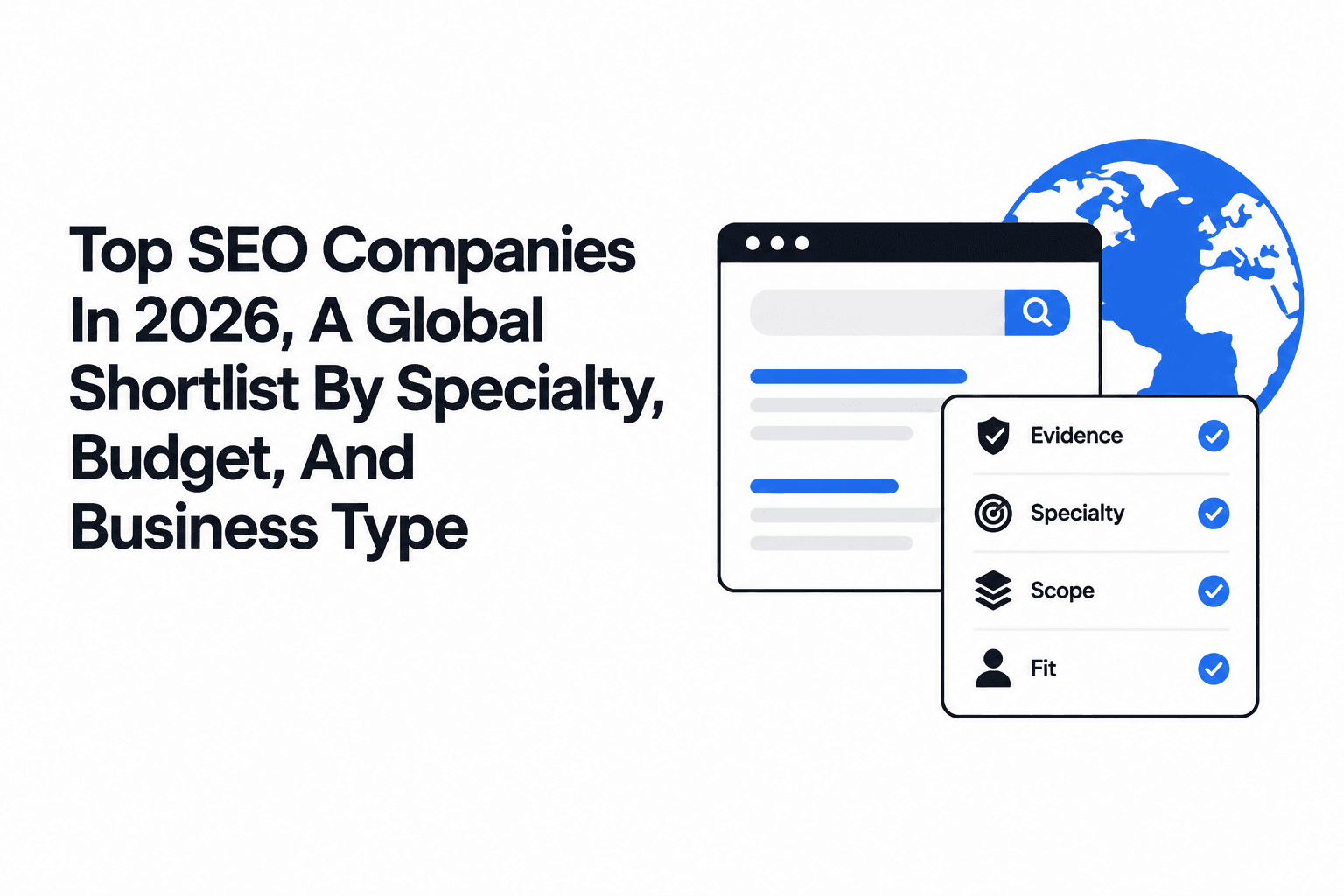
Top SEO Companies In 2026, A Global Shortlist By Specialty, Budget, And Business Type
Compare seo top companies by specialty, budget, proof, deliverables, and business fit before choosing an agency for 2026.