
Best SEO AI Tool In 2026, A Practical Shortlist By Budget And Use Case

The best seo ai tool in 2026 depends on the job you need done: Surfer is strong for content optimization, Ahrefs and Semrush cover broader research and technical workflows, and specialist visibility platforms are better for tracking how brands appear in AI-generated answers. A reliable choice starts with a consistent evaluation framework rather than a vendor feature list. This shortlist compares practical use cases, free access, integrations, limitations, and quality-control requirements so you can build a lean stack for content, technical SEO, and AI visibility.
- Choose tools by workflow first: content optimization, technical monitoring, or AI visibility require different data and controls.
- Free tools can validate demand, indexing, and performance, but they rarely replace a full audit, content brief platform, or visibility tracker.
- A small team usually needs one research platform, Google Search Console, an optimization workflow, and a documented human review process.
How We Evaluated Each SEO AI Tool
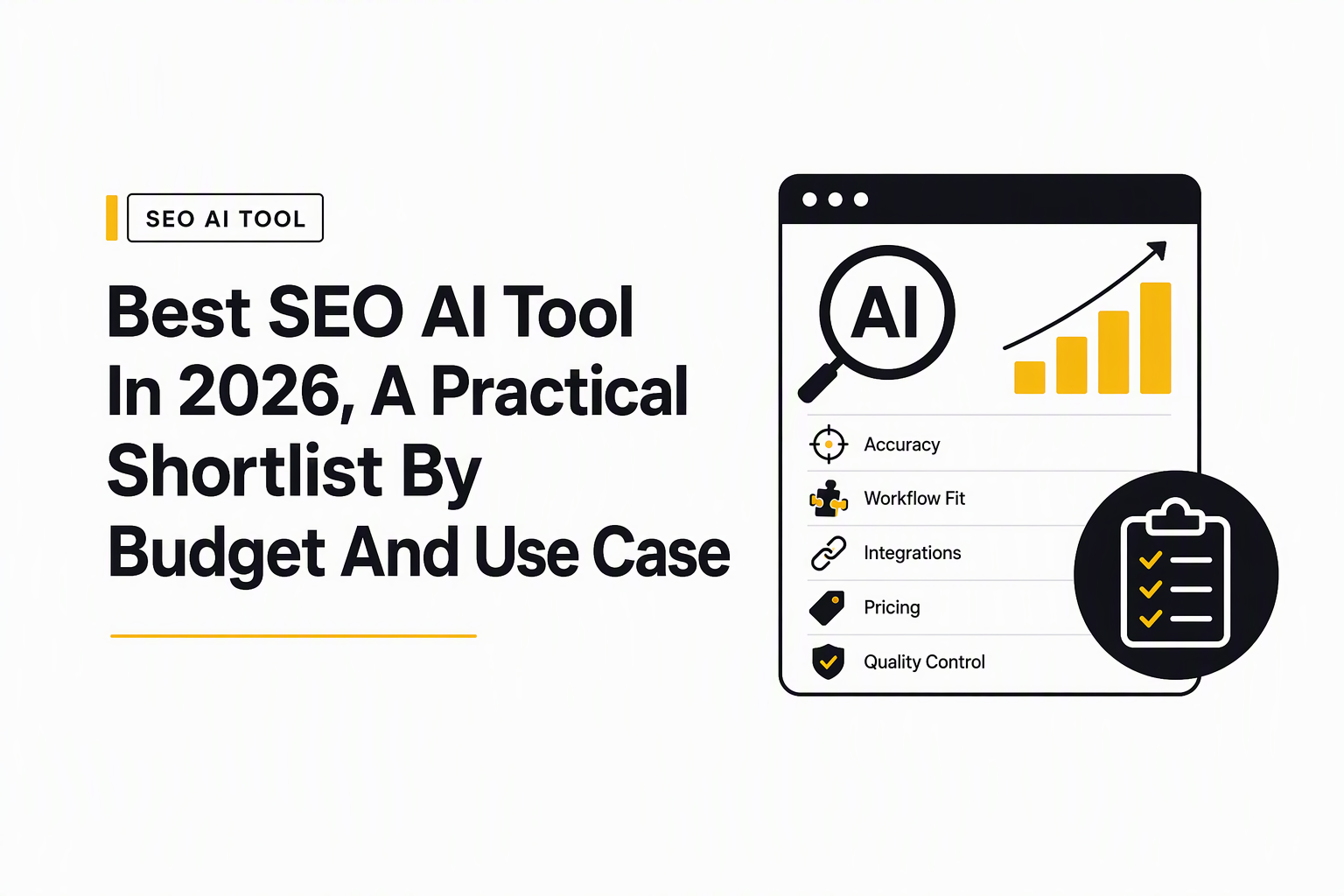
The best SEO AI tool should improve a defined workflow while keeping accuracy, editorial judgment, and measurement under human control. I evaluated each category against six criteria rather than treating a long feature list as proof of usefulness.
1. SEO accuracy and source quality
First, check whether recommendations are based on crawl data, search results, keyword data, or generic language-model output. A content tool that suggests entities from current competing pages is materially different from an AI writer that produces fluent text without validating search intent. For technical work, inspect whether the platform identifies affected URLs, evidence, priority, and a recommended verification step.
2. Workflow fit and output quality
Measure the time from input to usable output. A good workflow should turn a query into a brief, turn a brief into a draft, and turn the published page into a measurable item in Search Console. Useful outputs include an actionable content outline, a prioritized issue list, page-level recommendations, and export options that editors or developers can actually use.
3. Integrations and data ownership
Prioritize connections to Google Search Console, Google Analytics 4, crawlers, CMS platforms, spreadsheets, and reporting tools. Confirm whether data can be exported, how often it refreshes, and whether user permissions support separate writers, editors, analysts, and developers. A tool that cannot fit the existing publishing process often creates more administration than value.
4. AI visibility and answer monitoring
AI visibility requires more than tracking traditional rankings. Assess whether a platform records the exact prompt, model, country, language, device or search setting, cited sources, competitors mentioned, and refresh date. Without those fields, changes in an AI answer are difficult to reproduce or explain.
5. Pricing, access, and limits
Compare the number of projects, tracked keywords or prompts, crawl credits, seats, historical data, and export rights rather than comparing monthly prices alone. Free access is useful for testing a workflow, but usage caps can make a tool unsuitable for recurring production work.
6. Quality control requirements
Every AI-assisted recommendation needs a review rule. For content, verify claims, sources, search intent, internal links, and originality. For technical SEO, reproduce issues in the source, rendered page, or Search Console before implementation. For AI visibility, save the prompt and response so a team can distinguish a real trend from a one-off answer.
My practical test is simple: run one representative task from start to finish, record the time saved, and list every correction a specialist had to make. That correction log is often more useful than a polished product demo.
Best SEO AI Tools Compared At A Glance
The strongest SEO AI tools serve different users, so the shortlist should be matched to the primary task rather than ranked as one universal winner.
Shortlist by operating need
Surfer is a practical choice for teams that need content briefs, on-page guidance, and repeatable optimization checks. Ahrefs suits teams that prioritize keyword research, link analysis, competitor discovery, and content opportunities. Semrush is a broader choice for organizations that want keyword, technical, competitive, and reporting functions in one ecosystem.
AI writing assistants can accelerate outlining, rewriting, classification, and first drafts, but they should not be treated as independent SEO systems. They need validated inputs from search and site data. Google Search Console remains essential for measuring impressions, clicks, queries, and indexed page performance after publication. Specialist AI visibility trackers are more suitable when the goal is to monitor citations and brand inclusion across generative answers.
Free access varies significantly. Google Search Console and Google Analytics 4 are free for property owners, while many commercial platforms provide trials, restricted accounts, or limited credits. Check the current provider pricing page before purchase because seats, projects, historical data, and AI prompt allowances can change.
Decision rule
Select the tool that produces the clearest next action for the person responsible for implementation. A writer needs a brief and evidence-backed optimization guidance. A developer needs reproducible URLs, issue severity, and validation criteria. A marketing lead needs trend reporting, business segmentation, and an explanation of what changed.
The Best SEO AI Tool For Content And On-Page Optimization
Surfer is a strong content-focused option, while Ahrefs, Semrush, and general AI generators become more useful when research depth, competitive analysis, or drafting flexibility matters more than page-level guidance.
Surfer for structured content optimization
Surfer is best suited to teams publishing many pages around known search themes. Its value comes from combining a brief, competitor-informed recommendations, content structure, and on-page checks in one workflow. Use it when editors want a shared baseline for headings, topical coverage, and page completeness without asking every writer to become a technical SEO specialist.
The limitation is that optimization scores are not a substitute for judgment. A page can satisfy a tool's recommendations and still have the wrong intent, weak evidence, poor differentiation, or an awkward reader experience. Set a rule that editorial usefulness outranks a target score.
Ahrefs for research-led briefs
Ahrefs is a better fit when content planning depends on keyword opportunities, competing pages, backlinks, and parent topics. Its research can help a strategist decide whether a page should target a specific query, support an existing topic, or be rejected because the opportunity is weak. Pair its data with a separate drafting and editorial review process.
Semrush for broader marketing operations
Semrush works well for teams that want content research alongside technical audits, competitor monitoring, rank tracking, and reporting. The broader environment can reduce tool switching, especially when a manager needs to connect a content recommendation with site issues or competitor movements. The tradeoff is complexity: smaller teams should define a narrow weekly workflow before opening every module.
AI generators for drafting support
General AI generators are useful for turning an approved brief into alternative outlines, FAQ drafts, title variations, schema drafts, or content refresh suggestions. They are less reliable for unsupervised factual research, product claims, medical or financial guidance, and final SEO decisions. Teams should require source links, claim verification, human editing, and a check against the live search results.
For a practical ai for seo workflow, start with search data, create the brief, use AI for controlled production tasks, and validate the published page in Search Console. I have found that separating research, drafting, and approval prevents the common mistake of asking one model to invent the strategy and approve its own output.
The Best SEO AI Tool For Technical SEO And Performance Monitoring
Technical SEO requires a crawler, first-party performance data, and a verification loop, so no single SEO AI tool should be trusted to diagnose every issue automatically.
Use automated audits for discovery
Crawlers are useful for finding status-code errors, redirect chains, canonical inconsistencies, duplicate titles, missing directives, broken links, and indexability patterns. AI-assisted summaries can help prioritize findings, but the underlying crawl should remain available. A recommendation is actionable only when it identifies the affected URL, observed condition, likely impact, and a test for the fix.
Connect audits to first-party data
Search Console adds evidence about impressions, clicks, queries, indexing reports, and page experience signals. Google Analytics 4 adds engagement and conversion context. Use both carefully: a crawler can show that a page is technically accessible, while Search Console can show whether Google is actually exposing it for relevant queries.
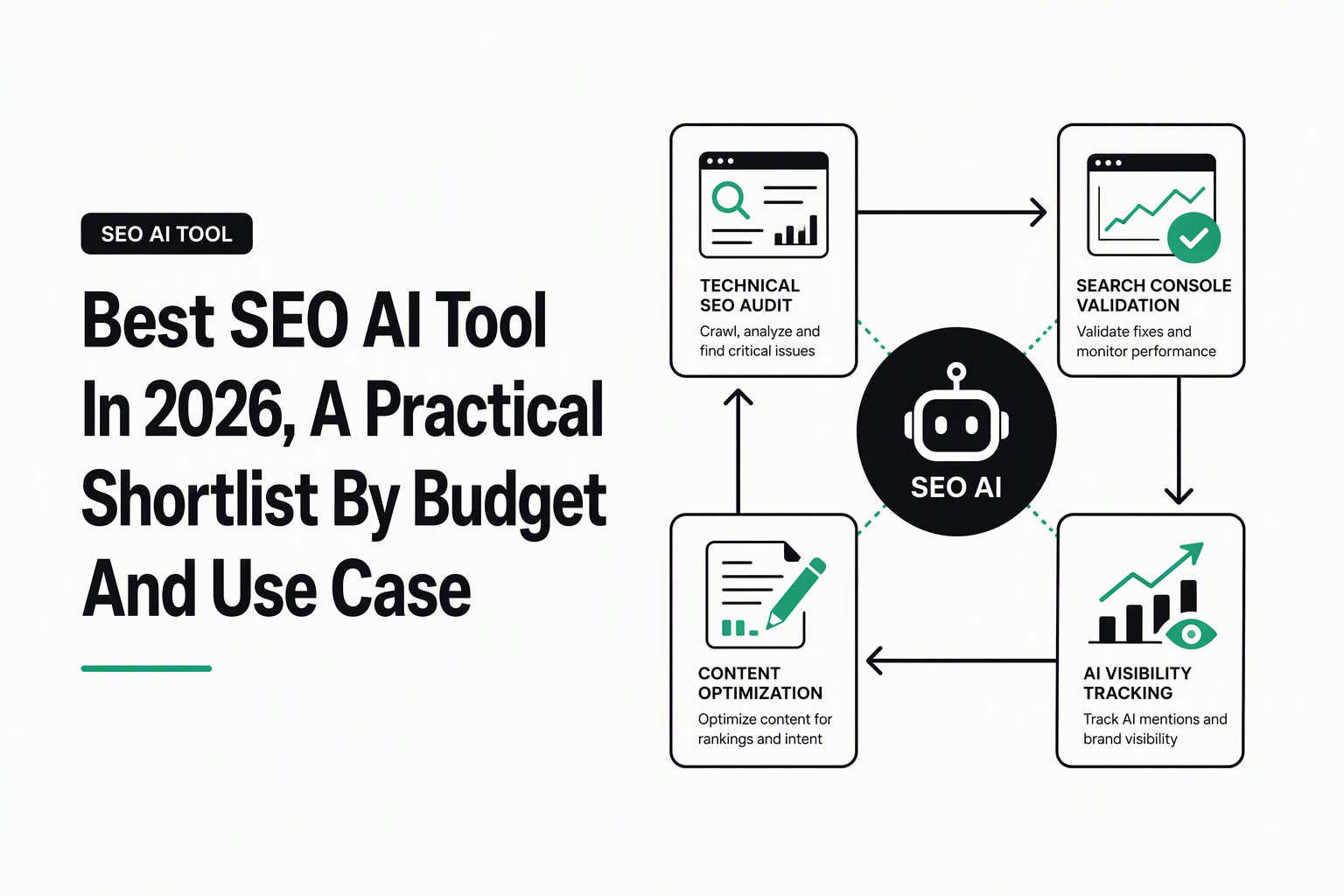
Apply a four-step validation loop
Use this sequence for every significant issue:
- Detect: find the pattern through a crawl, Search Console, analytics, or log data.
- Prioritize: score the issue by affected pages, business value, severity, and implementation effort.
- Implement: document the change and assign it to the appropriate developer, editor, or platform owner.
- Validate: recrawl the affected URLs and check subsequent performance or indexing evidence.
CMS compatibility is also decisive. Confirm whether a tool can export recommendations, connect with the publishing platform, or create tickets in the system the team already uses. An elegant audit that remains in a dashboard is less valuable than a simpler report that gets resolved.
For teams comparing ai powered seo platforms, ask whether AI is explaining evidence or merely rewriting it. The former supports decisions; the latter can conceal uncertainty behind confident language.
Free SEO AI Tools That Can Support A Real Workflow
Free SEO tools can support a real brief-to-draft-to-validation process, but they work best as connected components rather than a complete commercial platform.
A lean free workflow
Start with Google Search Console to identify queries, pages with declining clicks, impressions without clicks, and indexing anomalies. Use Google Trends for directional interest and seasonality, then inspect current search results manually to understand intent and page types. A free AI assistant can help cluster queries, turn notes into an outline, create title options, or identify unanswered questions from a supplied source set.
Draft from the approved outline and require the assistant to mark uncertain claims instead of filling gaps. Before publishing, check the page against the search intent, add relevant internal links, verify factual statements, and review the title, headings, structured data, and accessibility. After publication, use Search Console to monitor impressions, clicks, queries, and indexing status.
Free access limitations
Free products commonly limit projects, daily requests, crawl depth, historical reporting, exports, seats, or tracked terms. Search Console also provides first-party search performance rather than a complete competitor database. Trends indicates relative interest, not guaranteed traffic volume. A free AI assistant can produce fast language, but it does not independently confirm that claims are accurate or that recommendations reflect current search behavior.
When to upgrade
Upgrade when manual work becomes the bottleneck. Practical triggers include recurring content production, multiple sites, regular technical crawls, a need for historical competitor data, or a requirement to monitor AI answers across prompts and regions. Keep the free tools for validation even after upgrading because first-party data remains essential.
The Best Tools For AI Visibility And GEO Tracking
AI visibility tools are most useful when they reproduce the same prompts, regions, models, and citation checks over time.
Use a standardized prompt set
Create a prompt library based on four intent groups: category discovery, problem research, product comparison, and brand-specific questions. Record the exact wording, language, country, model or search setting, date, and target audience. A change in any of these variables can alter the answer, so uncontrolled checks are not reliable trend data.
Track citations, not only mentions
Measure whether the brand appears, whether it is described accurately, which URLs are cited, which competitors are included, and whether the cited page supports the claim. A mention without a citation may have less practical value than a trusted reference that sends qualified users to a relevant page.
Set reporting criteria
A useful report should include prompt coverage, visibility rate, citation frequency, source-page distribution, competitor presence, answer accuracy, and refresh cadence. Label each observation as new, retained, lost, or changed. Keep screenshots or response captures for important prompts because generative answers can change between checks.
Teams that want to improve ai visibility should improve the source pages first: answer the question directly, define terms clearly, support claims with evidence, and make important information easy to extract. Tracking without improving the cited material creates a dashboard rather than a visibility program.
Choose Your SEO AI Tool Stack By Budget And Team Size
The right SEO AI tool stack should match the team's publishing volume, technical capacity, and need for measurement rather than maximize the number of subscriptions.
Starter stack for one person or a small team
Use Search Console, Analytics, Google Trends, a spreadsheet, a general AI assistant, and one focused paid platform only if content or research volume justifies it. Map the tasks clearly: Search Console for performance, Trends for direction, the paid platform for briefs or research, AI for controlled drafting tasks, and a human reviewer for approval. This structure limits duplicated tools and makes free access useful.
Growth stack for an in-house marketing team
Add a commercial research and technical platform, a content optimization workflow, scheduled crawls, CMS integration, and a shared dashboard. Assign ownership by task: strategist for keyword and intent decisions, writer for draft quality, editor for evidence and brand standards, developer for technical fixes, and analyst for measurement. Add AI visibility tracking when generative answers influence the buying journey or when branded searches are strategically important.
Agency stack for multiple sites
Agencies need project separation, permissions, exports, recurring crawls, standardized templates, and client-ready reporting. Choose one primary data environment where possible, then add specialist tools only when they answer a question the core platform cannot. A documented QA checklist should cover search intent, factual accuracy, originality, internal links, technical implementation, and post-publication measurement.
Four-week rollout path
- Week one: define business goals, select representative pages, document current tools, and create baseline metrics.
- Week two: run one content workflow and one technical audit, recording time, corrections, and implementation blockers.
- Week three: connect Search Console and analytics, establish owners, and create the prompt library for AI visibility checks.
- Week four: review outputs, remove redundant subscriptions, finalize QA rules, and schedule recurring reporting.
Use use chat gpt for seo only within that controlled process. The goal is not maximum automation; it is a repeatable system in which each recommendation has evidence, an owner, and a way to confirm the result. For measuring broader search visibility, combine first-party performance data with documented content and technical changes.
| Tool or category | Ideal user | Primary use case | Free access | Integrations | Strength | Key limitation |
|---|---|---|---|---|---|---|
| Surfer | Content teams | Briefs and on-page optimization | Usually limited trial or restricted access | Content and publishing workflows vary | Repeatable editorial guidance | Scores do not replace judgment |
| Ahrefs | SEO strategists | Keywords, links, competitors, content opportunities | Selected free tools and limited access | Exports and reporting workflows | Research depth | Not a complete drafting or AI visibility system |
| Semrush | Marketing teams and agencies | Research, audits, tracking, and reporting | Limited free account or trial options | Broad platform and reporting connections | Wide operational coverage | Can be complex for small teams |
| Google Search Console | All site owners | Search performance and indexing evidence | Free | Google ecosystem and exports | First-party search data | Limited competitor and content-planning data |
| AI visibility tracker | Brands monitoring generative answers | Prompts, citations, and competitor inclusion | Often limited trial or credits | Reporting and prompt workflows vary | Repeatable AI answer monitoring | Results depend on prompt and model coverage |
SEO AI Tool FAQs
Freeways Agency helps teams plan and implement SEO strategy, content SEO, and technical SEO without managing the entire tool stack alone. If you need help selecting an seo ai tool, connecting it to your workflow, or building an AI visibility measurement process, discuss your site, goals, and preferred level of support with Freeways Agency.

Written by Joyce Ng.

SEO For Company Website, A 90-Day Plan With Page Templates You Can Copy
SEO for company website made actionable: architecture, 30/60/90-day SOP, page templates, free tools, and KPIs to track measurable lead growth.

Your Best SEO Pages May Still Be Invisible to AI. Here’s How to Fix That in 2026
Learn artificial intelligence seo in 2026 with a practical workflow, the 30% rule, and KPIs for rankings plus AI citations and visibility.

AI Driven SEO in 2026 - A Practical Playbook From Strategy to Measurement
Learn ai driven seo in 2026 with a practical audit-to-measurement playbook, low-cost tools, governance checks, and KPIs for zero-click search.