
Higher SEO Meaning And How To Get It, A Measurable 30 60 90 Day Plan

Higher SEO means increasing qualified organic visibility that leads to the actions you care about, not just “ranking higher” for a single keyword, and you can measure it with a simple chain of KPIs from impressions to conversions.
- Chase the right “higher SEO” metric first: impressions (coverage) → clicks (CTR) → conversions (value), in that order.
- Use Google Search Console patterns (impressions, position, CTR, indexing) to pick the one lever most likely to move next.
- Run a 30/60/90-day workflow that verifies progress after each change so you do less guesswork and more measurable improvement.

What Higher SEO Means, And Which Metric You Should Chase First
Higher SEO is higher qualified visibility in organic search, measured by how many relevant searches you appear in, how often you earn the click, and what users do after they land.
Beginners get stuck because “higher” feels like a single goal, but search performance has multiple moving parts. If you chase the wrong one first, you can spend weeks rewriting content when the real blocker is indexing, cannibalization, or snippets that do not earn clicks.
A simple KPI hierarchy for “higher” that avoids vanity rankings
Use this hierarchy to decide what to improve first. The rule is: fix the earliest broken link in the chain.
- Visibility (Impressions): You are eligible to show. If impressions are flat or near zero, the work is often coverage, intent targeting, or indexability.
- Competitiveness (Average position): You are showing, but not high enough to win many clicks. This is usually content depth, internal linking, and topical authority.
- Attractiveness (CTR): You are ranking, but users are not clicking. This is usually title, snippet, rich-result eligibility, or mismatched intent.
- Value (Conversions and assisted conversions): You are getting visits, but not business value. This is usually landing page clarity, offer alignment, or query-to-page mapping.
Map common goals to the metric you should chase first
This quick mapping keeps you from optimizing the wrong thing.
- “I want more traffic.” Start with impressions and indexing coverage, then CTR.
- “I want more leads or sales.” Start with query intent match and conversion rate on your top organic landing pages, then scale impressions.
- “My rankings dropped.” Start with indexing changes, manual actions, and page-level comparisons in Search Console, then content updates.
A definition you can actually use in reports
In weekly reporting, define higher SEO like this: “More clicks from queries we want, to pages we want, with stable or improving average position and CTR, resulting in measurable actions.” That makes it hard for the team to hide behind a single ranking screenshot.
Diagnose Why Your SEO Isn’t Getting Higher Using Search Console Signals
Search Console can tell you which lever to pull next by comparing impressions, position, CTR, and indexing behavior at the query and page level.
If you only look at average position sitewide, you blur together pages that need totally different fixes. Instead, run a repeatable diagnostic that ends with one clear hypothesis per page.
The 4-signal diagnostic workflow (15 to 30 minutes)
- Start in Performance (Search results) and set the date range to “Last 28 days” vs “Previous 28 days.”
- Filter to a single page (Pages tab → select a URL) so you do not mix causes across URLs.
- Check the query mix (Queries tab) to see whether the page is being shown for the right intent.
- Validate coverage (Indexing → Pages) to confirm the URL is indexed and not excluded by canonical, noindex, or “Discovered currently not indexed.”
Interpretation guide (what each pattern usually means)
- Impressions down, position stable: Demand changed, seasonality, or you lost eligibility (indexing, duplication, or intent drift). Check Indexing and query relevance first.
- Impressions up, CTR down, position stable: You are showing for broader queries, but snippet is not winning clicks. Work on titles, meta descriptions for consistency, and on-page answers that improve snippets.
- Position worse, impressions worse: Competitive loss or relevance loss. Refresh content, strengthen internal links, and ensure the page answers the query more directly than alternatives.
- High impressions, low CTR, average position 1 to 5: Snippet problem or SERP feature competition. Consider rewriting the title for clarity and adding FAQ-like on-page sections that match “People also ask” intents.
- Low impressions, decent CTR: The page resonates when shown, but it is not eligible often. Expand topic coverage, add supporting content, and build internal links.
A beginner-friendly way to pick “the right lever”
Use this decision rule: if a page is not indexed, do not optimize copy yet. If the page is indexed and has impressions, prioritize CTR when average position is already strong, and prioritize on-page content when average position is weak.
In our experience working with small service businesses, the fastest “unlock” often comes from finding pages that are indexed and getting impressions but have a CTR gap, because you can improve clicks without waiting for major ranking movement.
What to check in Indexing before you touch content
- URL is Indexed (URL Inspection).
- Google-selected canonical is the page you intended.
- No “noindex” tag, and the page is not blocked by robots.txt.
- Sitemap includes the URL and is processing without errors.
A 30 60 90 Day Plan To Get Higher SEO With Sequenced Priorities
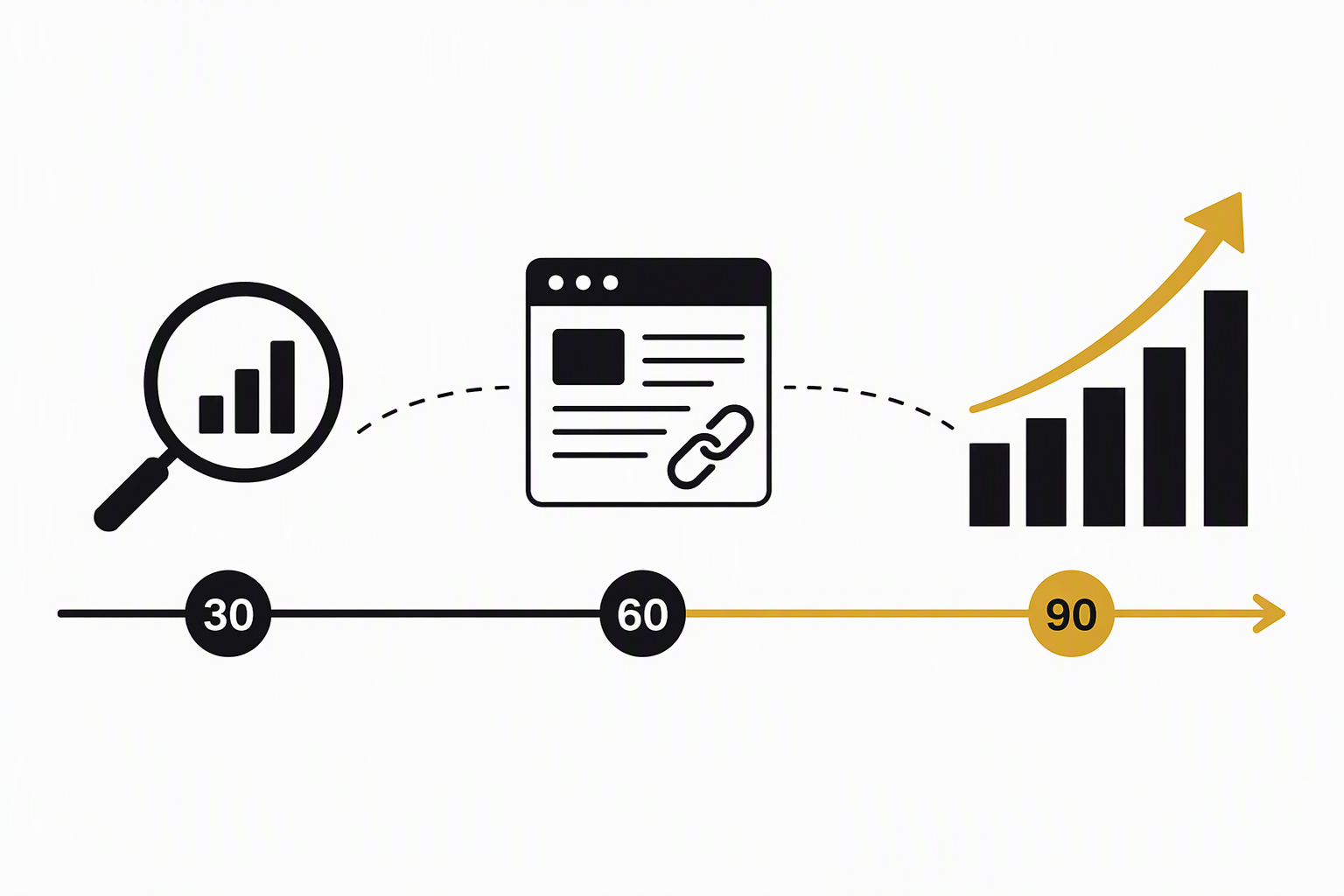
A 30/60/90-day SEO plan works when it sequences prerequisites first, then high-leverage page improvements, then scalable expansion once results are verified.
The biggest mistake is trying to do everything at once. You want a plan where each week has a measurable deliverable and a “verify in Search Console” step so you can confirm the change actually moved the metric you intended.
Days 1 to 30: Fix eligibility and measurement first
- Baseline KPIs: Record last 28-day clicks, impressions, CTR, and average position for your top 10 pages (by clicks) and top 10 pages (by impressions).
- Indexing sanity check: Confirm key pages are indexed and canonicalized correctly.
- Query-to-page mapping: For each top page, list 1 primary query intent and 3 to 5 close variants you actually want to win.
- Pick 5 priority URLs: Choose pages with either (a) high impressions + low CTR or (b) decent impressions + average position 6 to 20.
Days 31 to 60: Improve one page at a time and verify
- Run the one-URL checklist (provided later) on your 5 priority URLs.
- Internal linking sprint: Add 3 to 10 relevant internal links into each priority page from related pages, using descriptive anchors.
- Snippet rewrites: Update titles to match intent and clarify the benefit; update on-page intro to answer the query directly so snippets improve.
- Verify: Use Search Console “Performance → Pages → URL” and compare “last 7 days” vs previous 7, then re-check at 14 and 28 days.
Days 61 to 90: Scale what worked and expand coverage
- Turn winners into templates: If CTR lifts happened after a title pattern change, apply that pattern across similar pages.
- Build supporting pages: Create 3 to 6 supporting articles or service subpages that answer narrower questions, and link them to the priority pages.
- Refresh and consolidate: Merge overlapping pages that compete for the same intent and redirect weaker duplicates.
- Verify again: Re-run the same baseline spreadsheet to confirm clicks rose for the same or better conversion intent.
What surprised our team was how often a “higher SEO” project accelerates in the 60 to 90 day window after internal links and intent-focused rewrites, even when early ranking movement looks small, because click gains compound across many queries.
On Page And Content Improvements That Move Rankings And CTR Fast
On-page changes move higher SEO fastest when they improve intent match, make the answer scannable for snippets, and strengthen internal linking to the exact URL you want to rank.
You do not need to rewrite everything. You need to fix the parts that control relevance and click behavior: the page’s promise (title), the page’s immediate answer (intro), and the page’s structure (headings, internal links, and entity clarity).
The one-URL checklist (use on your top pages first)
- Intent match in the first 100 words: State who the page is for and what problem it solves in plain language.
- Primary topic coverage: Answer the main question fully, then cover 4 to 7 related sub-questions users commonly ask.
- Scannable structure: Use clear H2 and H3 headings that mirror real query phrasing.
- Unique angle: Add a process, checklist, comparison, or example that is not generic.
- Internal links: Link to and from related pages so Google sees the relationship and users can navigate deeper.
- Snippet helpers: Include short definition paragraphs, steps, and lists that can be lifted into AI Overviews and featured snippets.
- Freshness cues: Update dates, screenshots, and references when the topic changes.
Title and snippet patterns that raise CTR without clickbait
- Be specific: “30/60/90-day plan” usually outperforms “ultimate guide” because users know what they get.
- Match the job-to-be-done: If the query is “meaning,” lead with “meaning” or “definition” and then “how to.”
- Align with the SERP: If top results are lists, a long essay title can underperform. If top results are definitions, a tactical title can win.
Internal links that help rankings (simple rules)
- Link from pages that already get impressions and clicks to the page you want to push.
- Use anchors that describe the destination, not “click here.”
- Keep the path short: a priority page should be reachable within a few clicks from your main navigation or hub content.
If you want to go deeper on meaning, topical coverage, and how Google connects concepts across pages, the practical approach behind semantic SEO is the most helpful mental model for beginners because it shifts your focus from one keyword to satisfying a cluster of related intents.
Technical SEO Basics That Block Higher Rankings If You Ignore Them
Technical basics determine whether Google can crawl, render, and index your pages reliably, and no amount of copywriting will deliver higher SEO if those prerequisites fail.
Technical SEO does not need to be mysterious. You can cover 80 percent of common blockers with a small set of checks that you repeat whenever you publish, redesign, or migrate.
The “must-pass” technical checklist (prerequisites)
- Indexability: Page returns 200 status, is not blocked by robots.txt, and does not have a noindex tag.
- Canonical correctness: Each page points to itself (or the correct canonical), and Google agrees in URL Inspection.
- Sitemap hygiene: XML sitemap contains canonical URLs you want indexed and excludes redirects and noindex pages.
- Redirect logic: One hop redirects where possible, avoid chains.
- Core performance basics: Page loads reliably on mobile, images are compressed, and heavy scripts are controlled.
Practical checks you can run with free tools
- Search Console URL Inspection: Confirms indexing, canonical, and render status.
- Search Console Pages report: Spots “Crawled currently not indexed” and canonical issues at scale.
- PageSpeed Insights: Highlights major performance bottlenecks and render-blocking resources. PageSpeed Insights
- Robots.txt tester: Confirms important folders are not accidentally blocked.
Where beginners lose weeks (and how to avoid it)
- Publishing duplicates: Similar pages targeting the same intent split signals. Consolidate or differentiate.
- Incorrect canonicals after redesigns: Templates sometimes set canonicals to the homepage or a category page.
- Thin location pages: If you create many near-identical pages, indexing and quality signals can suffer.
After running technical audits across many sites, the pattern was clear: fixing canonical and indexing mismatches often unlocks higher SEO faster than “more content,” because you stop sending mixed signals about which URL should rank.
For a practical framework and real fix examples, bookmark website technical SEO and use it as your repeatable pre-publish checklist.
SEO In 2026 Is It Still Worth It, What It’s Called Now, And How To Learn It
SEO is still worth it in 2026 when you treat it as demand capture plus content that can be cited by AI systems, because organic visibility now includes classic blue links, rich results, and AI-generated summaries that quote pages.
The label changes, but the job stays consistent: publish the best answer, make it technically accessible, and align it to real user intent. Many teams now talk about “search experience,” “organic growth,” or “content-led acquisition,” but the measurable mechanics remain impressions, clicks, and outcomes.
What SEO is called now (and what to focus on anyway)
- Search experience optimization: Emphasizes UX, speed, and helpfulness.
- Entity-based optimization: Emphasizes clear topics, consistent naming, and relationships between concepts. Learn the basics via entity SEO.
- Content systems: Emphasizes updating, consolidating, and building internal link structures.
A credible learning path you can follow (without guessing)
- Week 1 to 2: Learn how Search Console reports map to actions (Performance, Indexing, Enhancements if applicable).
- Week 3 to 4: Practice on-page rewrites on 3 URLs and measure CTR and clicks changes over 28 days.
- Month 2: Learn technical basics and run a simple audit, then fix the top 5 issues.
- Month 3: Build a small topic cluster and link it together, then track impressions growth for the cluster.
How to know you are learning “real” SEO, not hype
- You can explain the difference between traffic and outcomes, and you measure both.
- You can diagnose a page using Search Console without relying on rank trackers alone.
- You understand the relationship between content relevance and crawl/indexing prerequisites.
If you need a refresher on definitions and where SEO sits inside organic growth, this explainer on organic search vs. search engine optimization helps you avoid common planning mistakes.
| Goal | Primary KPI to improve first | Where to check in Search Console | Typical first action |
|---|---|---|---|
| More relevant visibility | Impressions | Performance → Pages / Queries | Publish or expand intent-matching sections; improve internal links |
| More clicks from current rankings | CTR | Performance → compare CTR by page | Rewrite titles, tighten intros, add scannable answers |
| Better rankings for target terms | Average position (page-level) | Performance → filter to URL | Deepen coverage; consolidate cannibalizing pages |
| More leads or sales | Conversions (analytics) + assisted clicks | Search Console + analytics tool | Align page to offer; improve above-the-fold clarity |
| Fix “not showing up” pages | Indexing status | Indexing → Pages; URL Inspection | Fix noindex/robots/canonical/sitemap issues |
FAQ
If you use the workflow above and want a second set of eyes on what to do next, Freeways can review your current SEO performance and help you turn the highest-impact issues into a prioritized audit and roadmap.

Written by Joyce Ng.

Online Marketing SEO: Revenue Engine or Expensive Busywork?
Run online marketing search engine optimization in 2026 with a practical workflow, examples, and a 90-day KPI cadence that ties SEO to revenue.

Stop Playing SEO Roulette: Your First 30 Days, Mapped Out
Learn marketing online seo in 2026 with a beginner framework, free tools, a 30-day plan, and simple KPIs to track organic progress.

High-Volume SEO Keywords: A Gold Mine or a Money Pit?
Learn keywords and SEO with a practical keyword research workflow, search intent examples, prioritization criteria, and a content mapping template.