
Stop Playing SEO Roulette: Your First 30 Days, Mapped Out

Marketing online seo in 2026 means using search-focused content, technical hygiene, and credibility signals to earn measurable organic visibility from Google and other search experiences, then improving it with a simple reporting loop.
- In 2026, SEO success is about being crawled, indexed, and selected across SERP features and AI answers, not just “ranking #1.”
- Use a beginner execution system (the 3-3-3 framework) to balance content, intent coverage, and authority signals.
- A 30-day plan can deliver early measurable signals (indexing, impressions, better queries, technical fixes) even before big traffic arrives.
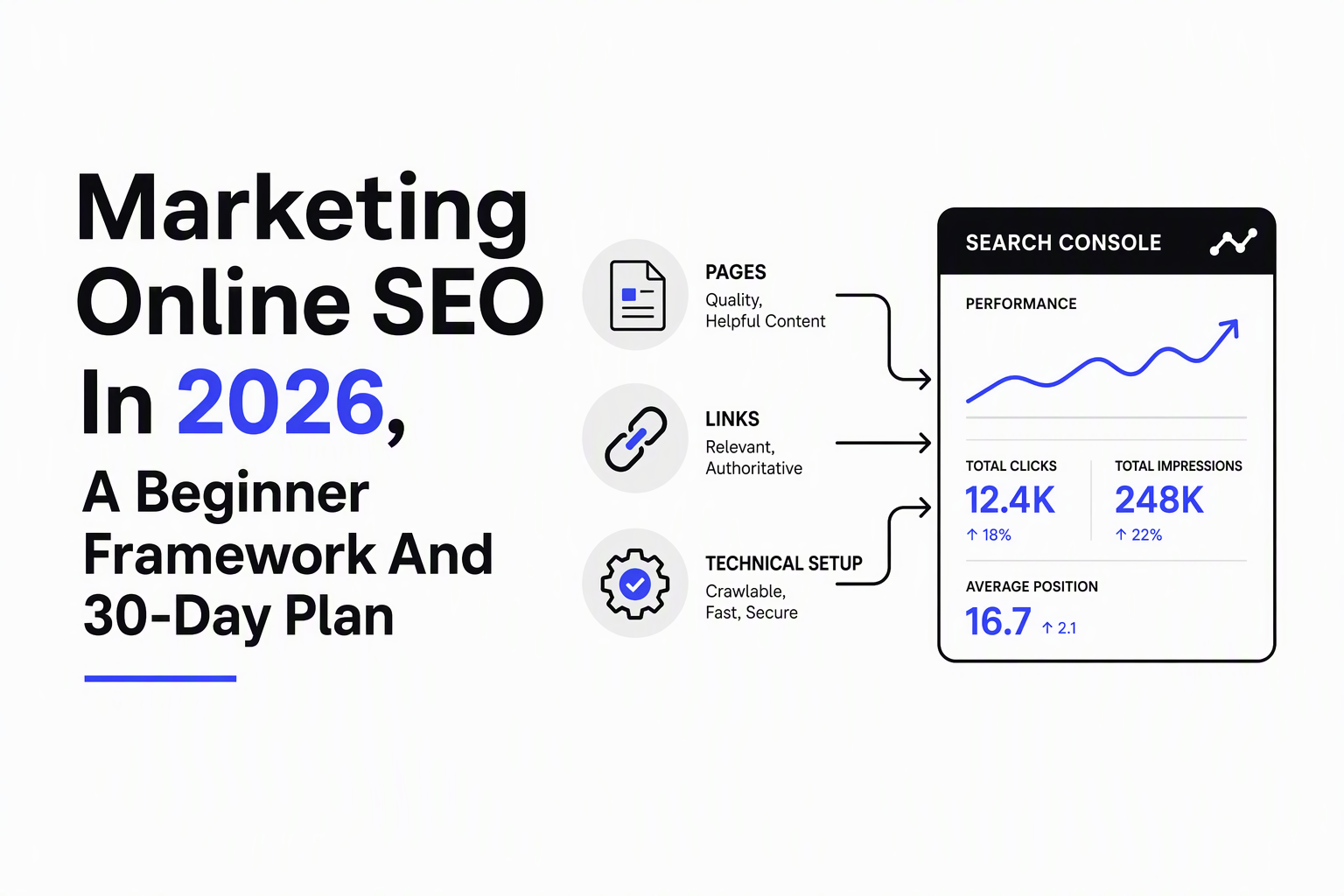
Marketing Online SEO, Defined For 2026
Marketing online SEO in 2026 is the practice of making your pages easy to discover, easy to understand, and trustworthy enough that search engines and AI-powered search surfaces can confidently show them to the right people.
The problem for beginners is that “SEO” gets explained like a bag of tricks. In practice, SEO is a marketing channel with inputs you control (site structure, pages, content, and proof) and outputs you measure (indexation, impressions, clicks, leads). If you can tie inputs to outputs on a weekly cadence, you can make progress without guessing.
Where SEO fits inside digital marketing
Think of SEO as the organic demand capture layer. Paid ads can create demand quickly, social can distribute, email can retain, but SEO turns existing search demand into consistent traffic. In a typical digital mix, SEO connects directly to:
- Positioning: what you want to be known for, expressed as topics and landing pages.
- Conversion: page experience, messaging, and lead capture.
- Measurement: how you know what content works and what to fix next.
What outcomes to expect (and what not to expect)
Early SEO outcomes are often “quiet” but measurable. In the first 30 days, realistic wins look like:
- More pages indexed (Search Console confirmation).
- Impressions rising for a small set of queries.
- Better alignment between a page and the queries it shows up for.
- Technical issues removed that block crawling or indexation.
What not to expect: predictable ranking jumps on competitive keywords in a few weeks. When I review new sites, the biggest drag is rarely a missing “SEO trick”; it is usually unclear intent (page tries to target too many things) plus weak internal linking (Google cannot tell what matters).
A plain-language definition of “good SEO”
A page has “good SEO” when three conditions are true:
- Accessible: Google can crawl it and render it without errors.
- Understandable: the page communicates one primary intent with supporting subtopics.
- Justified: the site has enough credibility signals for that topic (expertise, references, consistent coverage, and external mentions over time).
How Search Engines Work, The Only Parts You Need To Know
Search engines work in four steps you can influence: crawling, indexing, ranking, and how results are presented on the search results page.
Beginners often optimize for ranking while skipping the earlier gates. If a page is not crawled or not indexed, “ranking” is irrelevant.
Crawling - getting discovered
Crawling is how Google finds your URLs. Your practical levers:
- Internal links from important pages (home, category/service pages) to new pages.
- Sitemaps submitted in Google Search Console.
- Clean status codes (avoid chains of redirects, repeated 404s for important URLs).
My quick diagnostic: if a new post is published and still not discovered after a week, the issue is often internal linking, not content quality.
Indexing - being eligible to rank
Indexing means Google decided your page is worth storing and showing in results. Indexing can fail because of:
- Noindex tags applied accidentally.
- Duplicate content that Google considers redundant.
- Thin pages with little unique value compared to what is already indexed.
Use the URL Inspection tool in Search Console to check “Crawled” vs “Indexed.” That one screen removes a lot of SEO anxiety.
Ranking - matching intent and quality signals
Ranking is where most “SEO advice” lives, but the simplest model is: Google tries to satisfy the searcher’s intent with the best available options. In 2026, ranking is also influenced by:
- Topical coverage (does your site consistently publish on the subject, not just one page?).
- Page usefulness (clear structure, scannable answers, updated info).
- Authority signals (mentions, links, brand searches, consistent citations).
SERP features in 2026 that can reduce clicks
SERP features can satisfy the query without a click, so SEO measurement has to include visibility, not just traffic. Watch for:
- AI answers and summaries that pull from multiple pages.
- Featured snippets and “People also ask” that absorb attention.
- Local packs for service queries (map-based results).
This is why search visibility becomes a better early KPI than “rank position” for a single keyword.
The 3-3-3 Rule For Marketing, Translated Into An SEO Execution Framework
A practical way to make marketing online seo manageable is to split the work into three groups of three actions: content, intent, and authority.
The pain point this solves is overwhelm. Beginners bounce between keyword tools, plugins, and random fixes. A framework forces you to ship the small set of actions that move the needle.
The 3-3-3 framework for SEO
Use this as your weekly checklist. If you do nothing else, do these nine things consistently.
3 content actions (make something worth indexing)
- Publish 1 primary page per week (a guide, service page, or category page) that targets one clear intent.
- Add 2 supporting sections that answer related questions (definitions, steps, pricing factors, comparisons).
- Refresh 1 existing page with clearer structure, updated examples, and internal links.
3 intent actions (match what people actually search for)
- Map one page to one intent: informational, commercial, local, or navigational.
- Write the “first answer” paragraph: a self-contained 1 to 2 sentence answer that can stand alone in snippets.
- Build a mini topic cluster: 1 main page plus 2 to 4 closely related posts that link back.
3 authority actions (give Google a reason to trust you)
- Strengthen internal linking: link from high-authority pages to new or important pages.
- Earn 1 credible mention: partner pages, supplier listings, associations, event pages, or genuine PR.
- Add proof elements: author info, references, original screenshots, process steps, and clear contact details.
In my own workflows, the authority actions are the most skipped because they feel “external.” But they are also the difference between pages that hover in position 8 to 15 and pages that break into the top results over time.
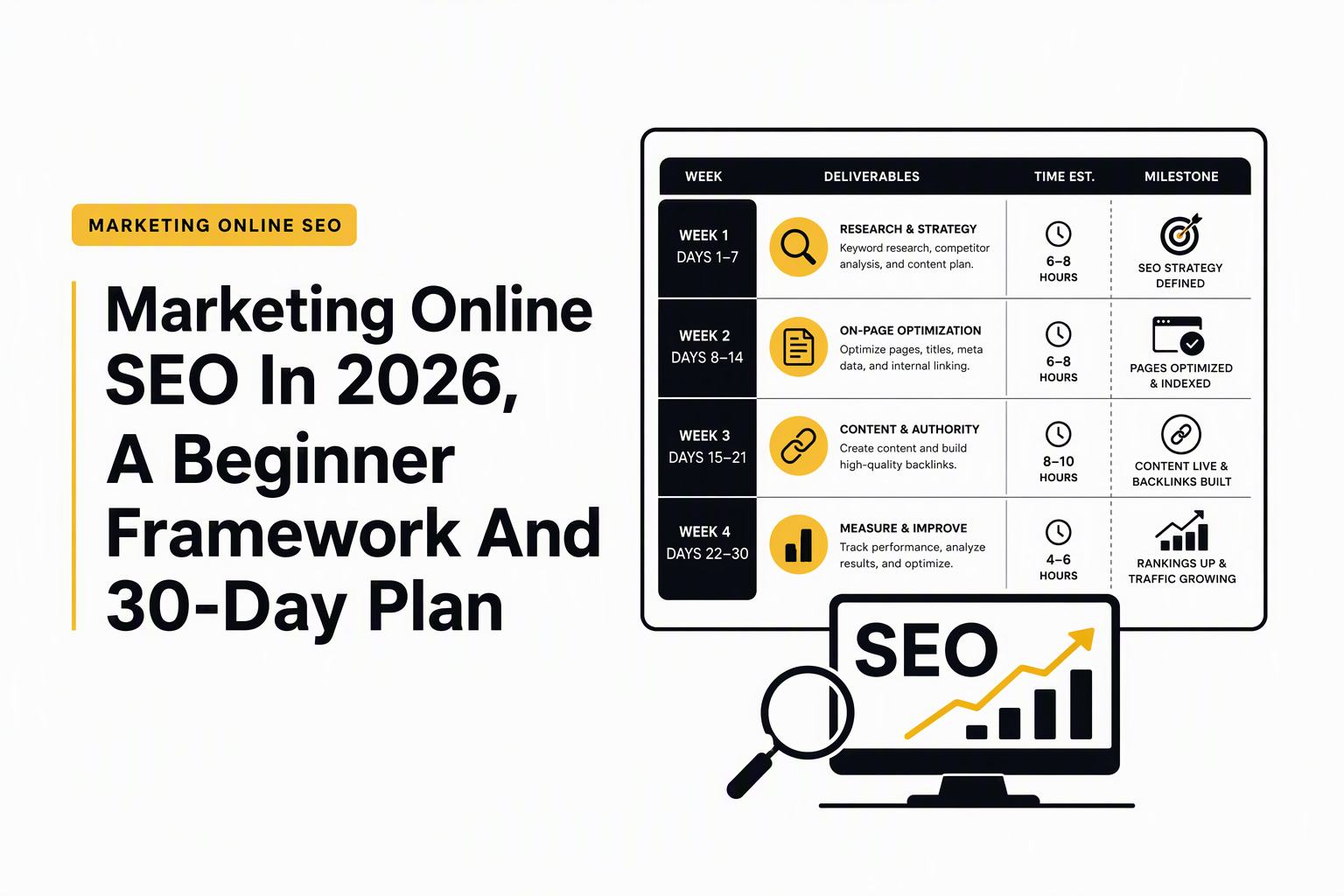
A Beginner-Proof 30-Day SEO Plan, Week By Week With Deliverables
A beginner-proof 30-day marketing online seo plan focuses on shipping four weekly deliverables: technical setup, keyword and page mapping, publishing, and a feedback loop in Search Console.
Below is a schedule that assumes 4 to 6 hours per week. If you have only 2 hours, keep the deliverables but reduce the content scope.
Week 1 (4 to 6 hours) - setup and baseline
- Deliverable 1: Google Search Console verified and sitemap submitted.
- Deliverable 2: GA4 installed (optional but helpful).
- Deliverable 3: Baseline report saved (impressions, clicks, indexed pages).
Checklist:
- Open Search Console and confirm “Coverage” and “Sitemaps” show no critical errors.
- Pick 1 conversion action to track (form submit, call click, checkout start).
- Create a simple spreadsheet with columns: URL, page intent, target query, publish date, last updated, impressions, clicks.
Week 2 (4 to 6 hours) - pick topics you can actually win
- Deliverable 1: 10 to 20 keyword list grouped into 3 topics.
- Deliverable 2: 1 page map (one URL per intent).
- Deliverable 3: Outline for your first “pillar” style guide (main page) and 2 supporting posts.
Beginner criteria for keyword selection (no paid tools needed):
- Business relevance: can this query lead to your product or service later?
- Specificity: longer, clearer queries are easier early (for example “how to audit on-page SEO for a service page”).
- SERP reality check: if page 1 is dominated by mega brands, narrow your angle.
When I do this with new sites, I limit the first month to one topic where we can publish multiple pages that interlink. Scattered topics create scattered signals.
Week 3 (5 to 7 hours) - publish and internally link
- Deliverable 1: Publish the main guide page.
- Deliverable 2: Publish 1 supporting post.
- Deliverable 3: Add 5 to 10 internal links across relevant pages.
On-page template you can reuse:
- H1 = intent + outcome (not clever branding).
- First paragraph = direct answer in 1 to 2 sentences.
- H2s = the steps, checklist, and decision criteria.
- Include 1 example (screenshot, short scenario, or mini walkthrough).
- End with next step (download, contact, related guide).
If you want a deeper system, keep this in mind while you write: on page seo is mostly about clarity and structure, not sprinkling keywords.
Week 4 (4 to 6 hours) - iterate using real query data
- Deliverable 1: Identify 5 queries you are getting impressions for (even if clicks are low).
- Deliverable 2: Update 2 pages to better match those queries (add a section, clarify headings, improve internal links).
- Deliverable 3: Fix 3 technical or UX issues that show up in audits (slow templates, broken links, missing titles).
Milestones to look for by day 30:
- New URLs discovered and indexed.
- Impressions appearing for long-tail queries.
- One page becoming a clear “winner” for impressions that you can expand.
Free SEO Toolkit And Workflow, Research To Reporting Without Paid Software
A complete marketing online seo workflow can be run with free tools if you standardize your process: research, publish, audit, track, and report.
The consequence of skipping a workflow is wasted effort. Without a repeatable SOP, you cannot tell whether a content update helped, or whether Google simply had not indexed you yet.
Free tool stack (end-to-end)
- Google Search Console: indexing checks, queries, impressions, clicks.
- Google Trends: seasonality and topic direction (Google Trends).
- Chrome + SERP review: manual intent analysis (what types of pages rank).
- PageSpeed Insights: core performance checks (PageSpeed Insights).
- A spreadsheet: keyword list, content calendar, and weekly reporting.
A repeatable SOP you can copy
- Research: pick 1 topic, list 10 to 20 queries, group by intent.
- Plan: assign 1 target query per URL, write a short outline with H2s as questions.
- Publish: ship one page, then add internal links from older related pages.
- Request indexing (selectively): in Search Console for key pages only, not every URL.
- Track weekly: for each target URL, record impressions, clicks, and top queries.
- Improve: update sections that underperform, add missing sub-answers, strengthen internal linking.
Beginner reporting loop (15 minutes per week)
- Check 1: Are important pages indexed?
- Check 2: Which queries are rising in impressions?
- Check 3: Which pages have impressions but low CTR? Improve the snippet match: title, intro, and headings.
For a fuller explanation of the broader system, see seo marketing and how it connects indexing, ranking, and measurement.
Is SEO Still Worth It In 2026, A Decision Framework
SEO is still worth it in 2026 when your customers use search to evaluate options and you can commit to consistent publishing and improvements for at least 3 to 6 months.
The biggest risk is misfit: some businesses need demand creation, not demand capture, or they need leads tomorrow. Use this decision tree to decide quickly.
A simple decision tree
- If you need leads in days: prioritize paid search, partnerships, outbound, or marketplaces; do SEO in parallel as a compounding asset.
- If your product is new and no one searches for it: prioritize content that creates category understanding (educational), then target adjacent problems people already search for.
- If your offer is local: local SEO and reviews can outperform national content early.
- If you have high margins and long sales cycles: SEO can be a strong ROI channel because one page can influence many deals over time.
Timeline expectations (realistic)
- 0 to 30 days: technical setup, indexing, early impressions.
- 30 to 90 days: clearer winners, some long-tail clicks, better topic association.
- 3 to 6 months: meaningful traffic patterns, more stable rankings, compounding internal links.
If you want a structured monthly cadence, this guide on search engine optimization lays out a repeatable strategy you can run every month.
How To Measure SEO Marketing Success Without Overthinking It
The simplest way to measure marketing online seo success is to track indexation, impressions, clicks, and conversions per landing page on a weekly cadence.
Beginners often drown in dashboards. You do not need 40 KPIs to make good decisions. You need a few that map to the search engine lifecycle and your business outcome.
The only KPIs most beginners need
- Indexation rate: how many important pages are indexed (Search Console).
- Impressions: proof your pages are being considered for queries.
- Clicks: proof your snippet and intent match are strong enough to earn visits.
- Conversions from organic: proof SEO is creating business value (GA4 or your CRM).
How to set realistic benchmarks without making up numbers
Because every niche differs, the best benchmark is your own baseline. Do this:
- Record week-1 impressions and clicks per target URL.
- After week 4, compare change in impressions and the number of queries each page appears for.
- Prioritize pages that gained impressions but not clicks, because they are closest to a CTR improvement win.
A lightweight weekly report template
- What we shipped: pages published, pages updated, internal links added.
- What changed: indexed pages, top queries, impressions and clicks for top 5 URLs.
- What we do next: 2 content actions, 1 technical fix, 1 authority action.
When I run SEO check-ins, the most useful habit is writing down the “next hypothesis” in one sentence, for example: “If we add a comparison section and clarify the first answer paragraph, CTR should improve for queries that already show impressions.” That turns SEO from hope into an experiment.
| SEO activity | What you do | What you measure (free) | When it usually shows up |
|---|---|---|---|
| Technical setup | GSC, sitemap, fix crawl blockers | Indexed pages, crawl errors | Days to weeks |
| On-page improvements | Clear intent, headings, internal links | Impressions, CTR, query relevance | 2 to 8 weeks |
| Content cluster | Main page + supporting posts | More queries per topic, rising impressions | 4 to 12 weeks |
| Authority building | Mentions, citations, partnerships | Brand searches, referral mentions, improved stability | 1 to 6+ months |
FAQ
If you want a fast reality check on your current marketing online seo setup, Freeways Agency can run a light website SEO check and a 15-minute starter consult to validate your first 30-day plan and the KPIs you should track next.

Written by Joyce Ng.

Online Marketing SEO: Revenue Engine or Expensive Busywork?
Run online marketing search engine optimization in 2026 with a practical workflow, examples, and a 90-day KPI cadence that ties SEO to revenue.

High-Volume SEO Keywords: A Gold Mine or a Money Pit?
Learn keywords and SEO with a practical keyword research workflow, search intent examples, prioritization criteria, and a content mapping template.
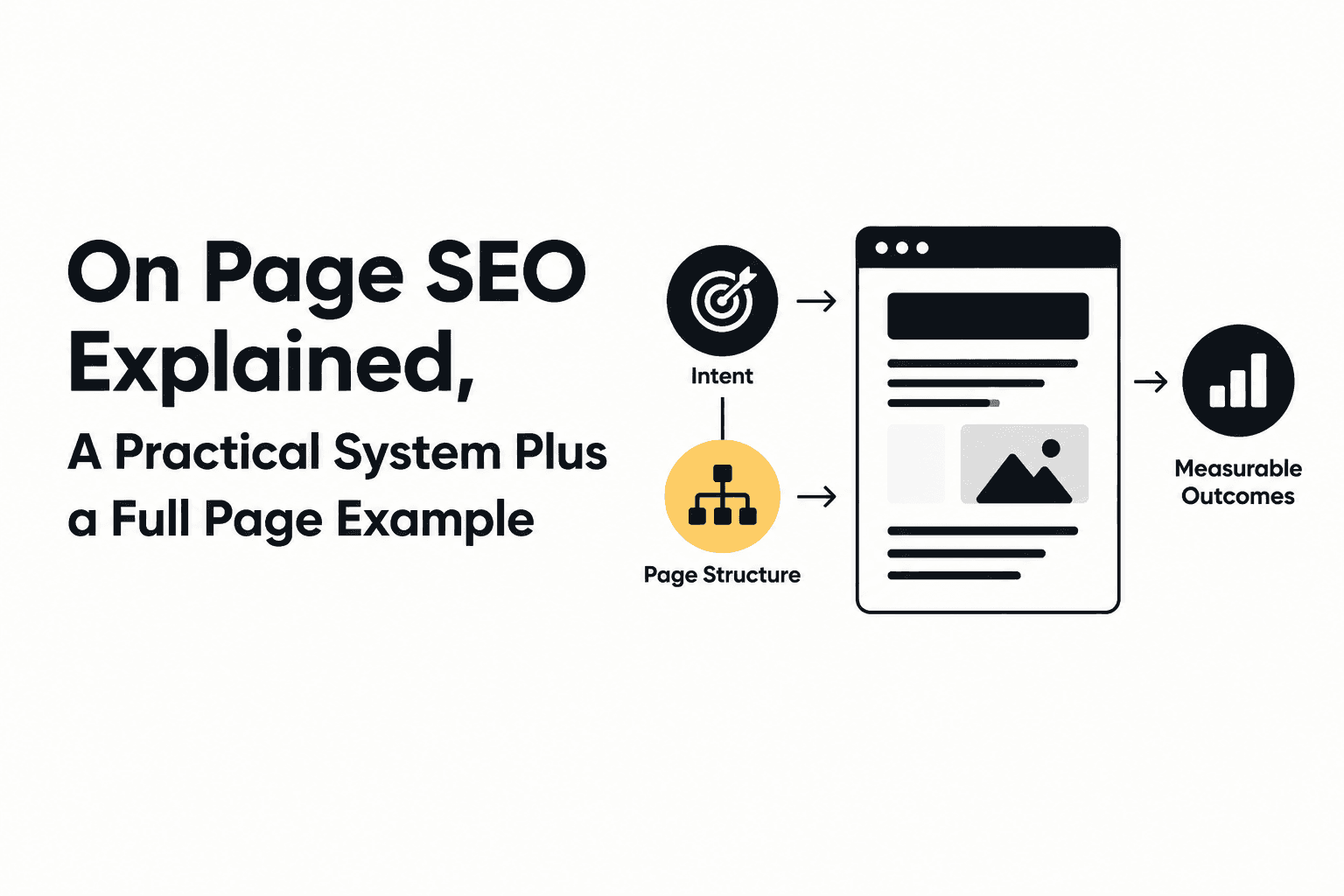
On Page SEO Explained, A Practical System Plus a Full Page Example
Learn on page seo with a simple 4-part system, a before/after page example, and a copy/paste checklist you can use on any URL.