
Internet Marketing SEO Feels Like a Maze? Here’s Your 90-Day Way Out

Internet marketing SEO in 2026 is the practice of using organic search to attract qualified visitors and convert them into leads or sales, using a measurable system that connects content, technical health, and brand signals to real business outcomes.
- Internet marketing SEO works best when you map it to your full online mix (content, PPC, social, email, and conversion), not as an isolated “blogging” task.
- Beginners should prioritize three pillars in order: on-page clarity for search intent, technical accessibility for crawling and indexing, and off-page credibility signals.
- A simple 30/60/90-day plan plus Google Search Console reporting is enough to start, detect issues early, and prove whether SEO is moving the needle.
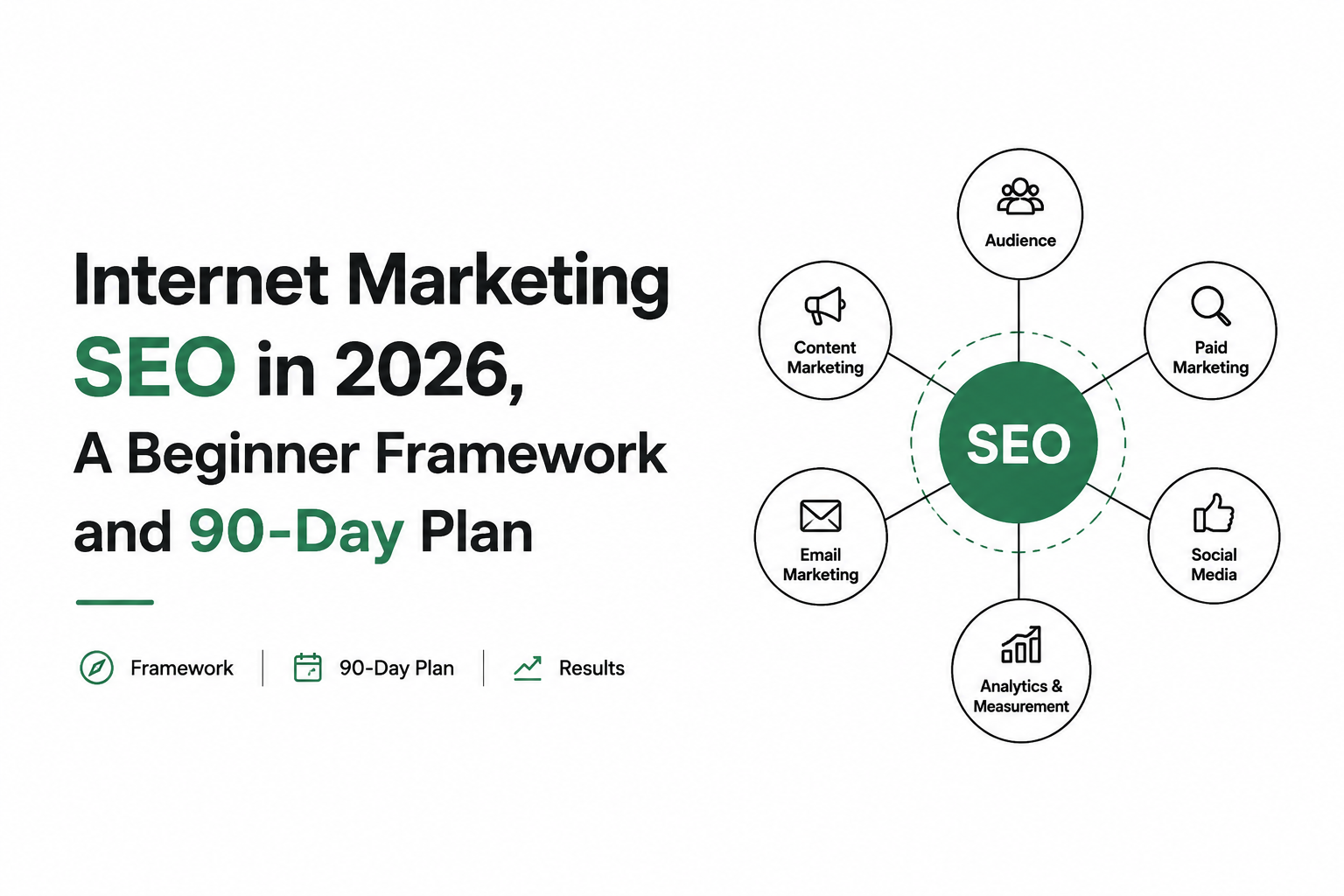
Internet Marketing SEO Explained, What It Is and Where It Fits
Internet marketing SEO is a coordinated set of actions that earns visibility in search results and then turns that visibility into measurable business value through pages that answer needs and convert.
The confusion I see most often is that people treat SEO as “write articles and wait.” In practice, internet marketing SEO sits inside your broader online marketing system and should be planned alongside paid traffic, social distribution, and conversion optimization.
Plain-English definition you can use internally
- SEO is how you earn visits from search engines without paying per click.
- Internet marketing is how you attract, nurture, and convert audiences online across multiple channels.
- Internet marketing SEO is the SEO portion of internet marketing that is built to support business goals, not just rankings.
Where SEO fits compared to other channels
| Channel | What it is best for | What it struggles with | How SEO supports it (and vice versa) |
|---|---|---|---|
| SEO | Capturing existing demand, compounding traffic over time | Slower feedback loop than ads | PPC data reveals high-converting queries; email and social amplify content to earn links and mentions |
| PPC | Fast testing, predictable volume | Stops when budget stops | SEO builds lower-cost traffic over time; PPC can fill gaps while SEO ramps |
| Social | Reach and community, top-of-mind awareness | Intent is often low and fleeting | Social drives early attention to new pages, which can lead to natural links and branded searches |
| Nurture and retention, promoting offers | Needs list growth | SEO grows list via lead magnets and resources; email drives returning visits and engagement | |
| Conversion (CRO) | Turning visitors into leads and customers | Needs steady traffic to test | SEO brings qualified visitors; CRO increases the value of every SEO session |
A simple outcomes map (so SEO doesn’t become “vanity rankings”)
- Visibility: impressions in Search Console for the topics you want to own.
- Qualified traffic: clicks from queries that match your product or service intent.
- Action: leads, sign-ups, calls, demos, or purchases attributed to landing pages.
If you want a deeper walkthrough of how to operationalize search engine optimization into repeatable cycles, that monthly cadence is the easiest way to keep SEO from becoming a one-time project.
How SEO Actually Works in 2026, From Crawl to Rank to Revenue
SEO results in 2026 come from helping search engines reliably crawl and understand your pages, then proving those pages satisfy real intent better than alternatives.
The crawl, index, rank loop (what beginners should remember)
- Crawl: Google discovers URLs via links and sitemaps and fetches them.
- Index: Google stores and processes content it deems eligible.
- Rank: Google chooses which indexed pages to show for a query, based on relevance and quality signals.
- Earn: Your page converts that visibility into a click, then into a lead or sale.
Modern SERP realities that change the beginner playbook
- Not every query behaves the same. Some are informational, some are comparison-driven, some are local, and some are transactional. Your page format needs to match the query format.
- “Ranking” is not one position. Results can vary by device, location, and personalization signals. Measure in Search Console by query and page, not by a single “keyword rank.”
- Answer extraction matters. Featured snippets and AI-generated summaries often pull from clear, structured passages. That pushes you toward short definitions, checklists, and direct answers inside the content.
What this means in practice for internet marketing SEO
Internet marketing SEO in 2026 is less about publishing volume and more about publishing the right page type for the right query, then removing friction between discovery and conversion. When I audit a new site, I usually find the biggest “hidden win” is not a new article, it is fixing pages that already get impressions but fail to convert because the content does not match intent or the page is hard to use.
A quick diagnostic you can run today (no tools beyond GSC)
- Open Google Search Console.
- Go to Performance → Search results.
- Sort Pages by impressions.
- Click a high-impression page, then view Queries for that page.
- If the queries are “how to” but the page is a sales page, or the queries are “pricing” but the page is purely educational, you have an intent mismatch.
Fixing that mismatch is often the fastest early improvement because you are working with existing visibility instead of starting from zero.
The 3 Pillars You Must Get Right, On-Page, Technical, Off-Page
Internet marketing SEO succeeds when on-page relevance, technical accessibility, and off-page credibility reinforce each other instead of competing for your time.
Pillar 1: On-page relevance (what the page says and how clearly it answers)
On-page work is where beginners should spend the most effort first because it directly controls relevance and conversion.
- One page, one primary job. Decide the page’s goal: educate, compare, or convert.
- Answer-first structure. Put the core answer near the top, then expand with steps, examples, and FAQs.
- Entity clarity. Name the product, service, location, audience, and constraints explicitly so the page is unambiguous.
- Internal links. Link to the next logical step so users and crawlers can navigate your “topic cluster.”
If you need a practical system for improving pages, start with on page seo and apply the same checklist to your top 5 pages by impressions.
Pillar 2: Technical SEO (whether search engines can access and trust what you publish)
Technical SEO for beginners is mostly about removing blockers so crawling and indexing can happen consistently.
- Sitemaps: maintain an XML sitemap that includes canonical, indexable URLs.
- Canonicalization: avoid duplicate versions of the same page competing (HTTP vs HTTPS, trailing slash, parameters).
- Core Web Vitals: treat performance as a usability requirement, not a trophy metric.
- Robots and noindex: ensure you are not accidentally blocking important pages.
Pillar 3: Off-page signals (why anyone should trust and reference you)
Off-page SEO is about earning signals of credibility, most commonly links and brand mentions, by being genuinely useful and discoverable outside your site.
- Foundational citations: consistent business info across major directories (especially if you serve local markets).
- Partner links: suppliers, integrations, associations, and testimonials can produce legitimate, relevant links.
- PR-style assets: a data summary, calculator, template, or benchmark that others reference.
I have found that off-page work becomes far easier when your on-page pages are already strong, because outreach is simpler when you can point to a page that clearly solves a problem.
DIY 30 60 90-Day Internet Marketing SEO Plan With Google Search Console Steps
A 30/60/90-day plan for internet marketing SEO gives you a realistic sequence: fix visibility blockers first, then publish or upgrade pages, then build authority and improve conversions.
Before day 1: set up your measurement baseline
- Create a Google Search Console property (Domain property if possible).
- Verify ownership via DNS or your preferred method.
- Connect Google Analytics (if you use it) so you can tie landing pages to actions.
Days 1-30: make the site crawlable, indexable, and clear
Days 1-30 are about removing technical confusion and clarifying your most important pages, because you cannot optimize what Google cannot reliably process.
- Submit your sitemap in GSC: Indexing → Sitemaps → enter sitemap URL → Submit.
- Check coverage: Indexing → Pages → review “Why pages aren’t indexed.” Prioritize errors and exclusions that affect key pages.
- Inspect key URLs: use the top search bar URL Inspection for your homepage, main service pages, and top blog posts. Confirm “URL is on Google.” If not, review reasons and request indexing after fixes.
- Fix duplicates: review canonical issues flagged in Pages and align internal links to the canonical version.
- Upgrade 3 pages you already have (fastest wins): choose pages with impressions but low clicks in Performance. Improve titles, introductions, and sections to match the query intent.
Days 31-60: build a small, focused content set (not a content flood)
Days 31-60 are for publishing a handful of pages that cover a topic end-to-end, with internal links that make the relationship obvious.
- Pick one primary theme: for example, “SEO service for [industry]” or “how [audience] solves [problem].”
- Draft 4 supporting pages: 2 informational guides, 1 comparison page, 1 glossary or FAQ page.
- Implement internal linking: every supporting page links to the main page and at least one sibling page.
- Add conversion points: simple CTAs, contact forms, or lead magnets aligned with the page intent.
- In GSC, use Performance → Search results → filter by Page after publishing. Track impressions growth as Google discovers the pages.
- Use Enhancements reports if available for your setup (for example, structured data items) and fix warnings that apply to key templates.
Days 61-90: earn credibility and improve click-through and conversions
Days 61-90 are when you start making your strongest pages more competitive, using off-page efforts and iterative improvements based on query data.
- Link earning list: identify 20 realistic link opportunities (partners, directories, associations, podcasts, local press, niche communities).
- Refresh top pages: update intros, add missing sections, and add a concise “summary” block that can be extracted into snippets.
- CTR improvements in GSC: in Performance, filter by query with high impressions and low CTR. Adjust title tags and above-the-fold copy to better match the query language.
- Track brand lift: watch for growth in branded queries in Performance → Queries.
Print-friendly 90-day checklist
- GSC verified and sitemap submitted
- Top 10 URLs inspected and indexing confirmed
- Indexing exclusions reviewed and prioritized
- 3 existing pages upgraded based on query intent
- 1 topic hub page planned and published
- 4 supporting pages published with internal links
- Basic conversion points added to top landing pages
- 20 link opportunities identified and started
- Queries with high impressions and low CTR improved
- Monthly GSC report exported and reviewed
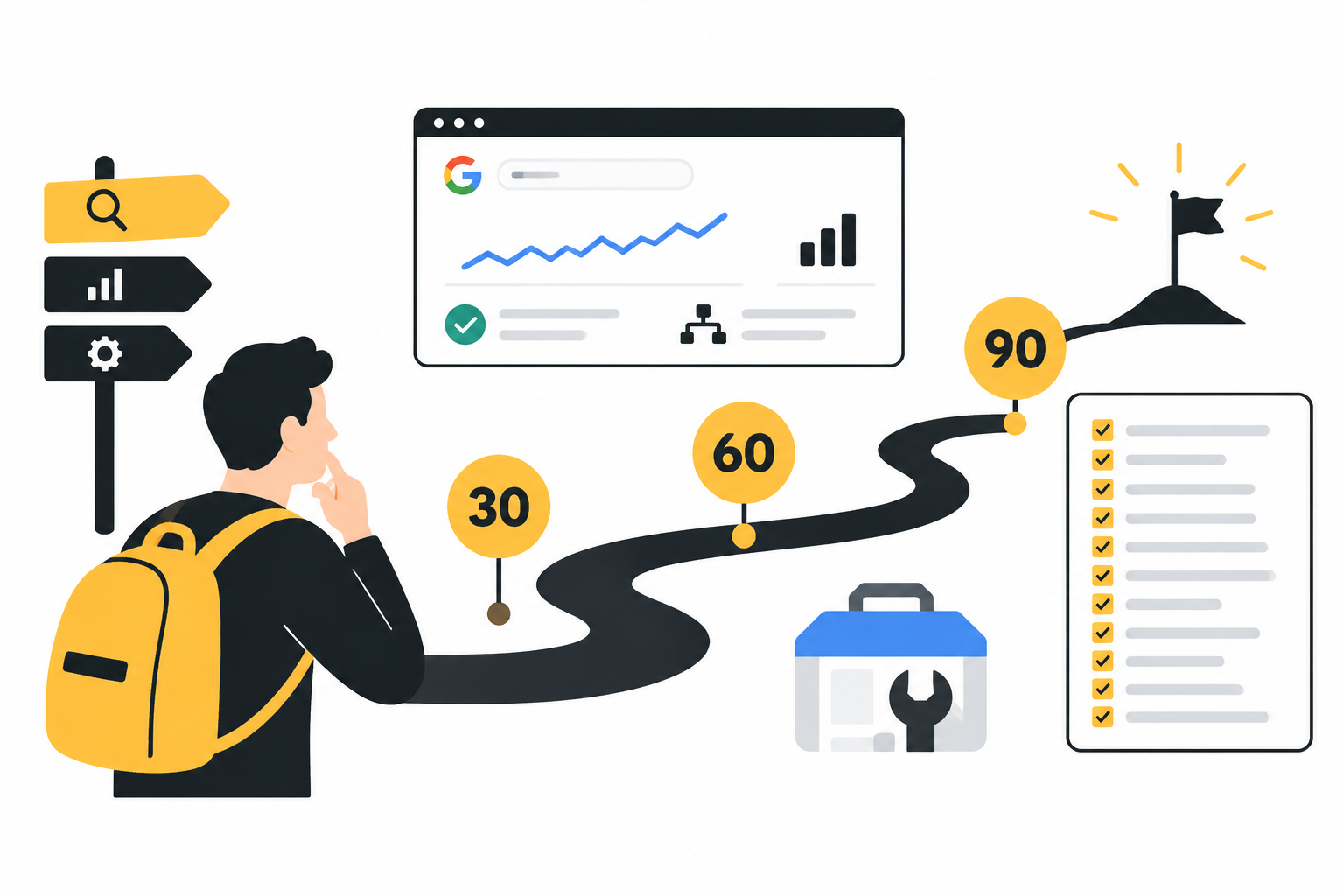
SEO Measurement and Channel Integration, Turn Traffic Into Leads and Sales
SEO measurement in 2026 should connect Search Console visibility metrics to on-site actions so you can decide what to fix, what to publish next, and what to promote in other channels.
What to track in Google Search Console (minimum viable dashboard)
- Impressions: are you showing up for the right themes?
- Clicks: are you earning visits from those impressions?
- CTR: is the snippet compelling for the intent?
- Average position: treat as directional, not absolute.
- Top pages and top queries: where is demand clustering?
What to track on-site (so SEO ties to revenue)
- Primary conversion: form submits, calls, purchases, demo requests.
- Micro-conversions: email signups, PDF downloads, time on key pages.
- Landing page conversion rate: for your top SEO entry pages.
Three integration scenarios that work (with concrete handoffs)
- PPC to SEO: run ads for 2 to 5 weeks on a small set of queries, then use the highest-converting queries to shape your SEO page headings and sections. This reduces guesswork about intent language.
- SEO to email: add a lead magnet to your top informational pages, then use a 3-email nurture sequence that points back to comparison and service pages.
- Social to SEO: when you publish a new guide, post 3 different angles over two weeks. The goal is not direct conversion, it is to increase early discovery, engagement, and the chance of secondary sharing and linking.
For beginners, I recommend a monthly rhythm: export a GSC report, pick 3 pages to improve, publish 1 new page, and do 5 outreach touches. That cadence is simple enough to sustain, which is what makes it compound.
If you want a broader system view, seo marketing is the closest “end-to-end” model: indexed content plus measurement plus iteration.
Is SEO Still Worth It in 2026 and Should You Get Certified
SEO is still worth it in 2026 when you have a real audience need, a clear offer, and the ability to maintain a steady improvement loop for at least 90 days.
A quick decision framework (use this before you invest heavily)
- Worth it now if your customers search for solutions you provide, you can publish helpful pages, and you can track conversions.
- Worth it later if your site is brand-new with no clear positioning or your offer is not yet validated. Use PPC or direct outreach first, then scale SEO.
- Not a fit if demand is extremely low or your sales cycle depends mostly on outbound relationships, and you cannot create content people actually search for.
Certifications: helpful for structure, not a substitute for practice
Certifications can help you learn terminology and workflows, but internet marketing SEO skill comes from shipping pages, diagnosing issues, and iterating based on Search Console data. If you want a structured path, pick one curriculum, follow it for 4 to 6 weeks, and pair every lesson with a real change on your site.
When it makes sense to hire help
- You are blocked by technical issues you cannot confidently fix.
- You have content, but it is not getting indexed or it is getting impressions without clicks.
- You need a repeatable execution system across on-page, technical, and off-page work.
If you are evaluating providers, this guide on choosing an seo marketing company outlines what to check before signing. If you want to understand deliverables and timelines, this search engine optimization service guide is a practical reference.
| Timeframe | Main goal | What you do | What you measure |
|---|---|---|---|
| 0-30 days | Fix crawl and indexing basics | Sitemap, URL inspection, resolve exclusions, upgrade 3 existing pages | Indexed pages, impressions on key URLs |
| 31-60 days | Publish focused content set | 1 hub + 4 supporting pages, internal links, basic CRO | Impressions by page, query coverage |
| 61-90 days | Increase competitiveness | Outreach, CTR improvements, refresh pages based on query data | Clicks, CTR, leads from organic landing pages |
FAQ
If you want the 90-day checklist in a downloadable format and would like a light baseline review of your site’s current SEO health, Freeways Agency can help you prioritize what to fix first and how to execute the on-page, technical, and off-page work without guesswork.

Written by Joyce Ng.

SEO Website Step by Step, The Beginner Workflow to Get Indexed and Start Ranking
Learn a beginner-friendly seo website workflow to get indexed, fix issues, publish content, earn links, and track results with a 30/60/90-day plan.

Search Visibility Explained, How It Works and How to Measure It in Google Search Console
Learn what search visibility means, how tools calculate it, and how to measure search visibility in Google Search Console with a simple spreadsheet.

Search Engine Optimization Service Guide For 2026, Pricing, Deliverables, And What To Expect In 90 Days
Choose a search engine optimization service in 2026 with scoped pricing, deliverables, a 90-day checklist, and a fast vendor scorecard.