
Search Engine Optimization in 2026, A Practical Strategy You Can Run Every Month

Search engine optimization in 2026 works best as a repeatable monthly operating system: diagnose what Google can index, build pages that satisfy intent, reinforce internal architecture, earn trust signals, and measure decisions with Search Console and analytics.
- Run SEO as a monthly cycle with clear checkpoints: indexability first, then relevance, then architecture and authority, then measurement.
- Use Google Search Console to prioritize fixes by impact: pages not indexed, wrong canonical, crawl anomalies, and query-to-page mismatches.
- Track outcomes with decision rules (not vanity metrics): clicks and qualified conversions by page group, plus indexing and snippet changes after updates.
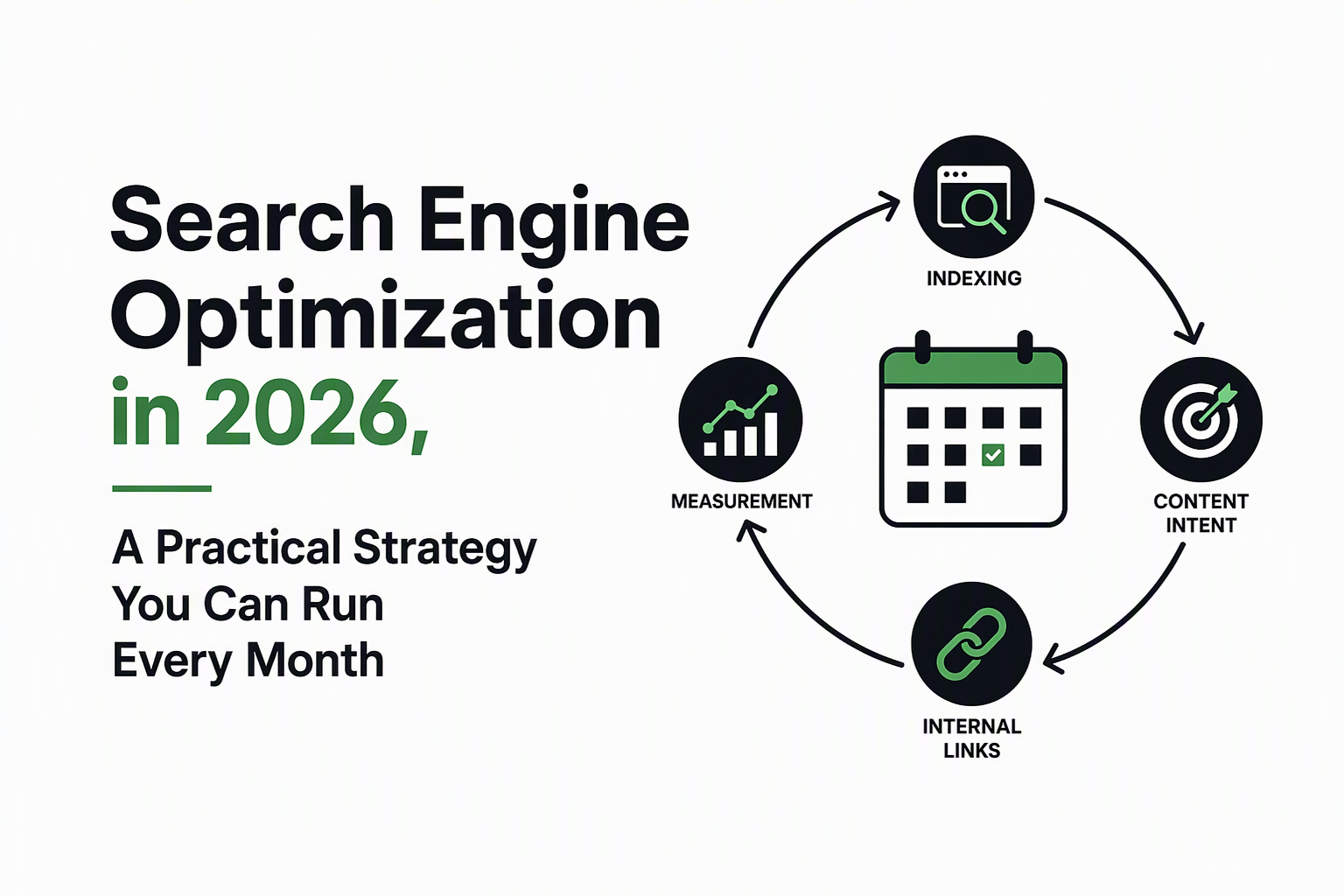
The 2026 SEO strategy framework that holds up month after month
A durable 2026 SEO system ties technical health, intent-led content, internal linking, and measurement into one loop you can run every month without reinventing the plan.
Why “publish more content” fails in 2026 SERPs
- Indexability is the gate: if Google cannot crawl or chooses not to index, nothing else matters.
- AI and snippet features are extractive: they lift passages that answer clearly, which rewards pages with crisp structure and direct answers.
- Intent drift is costly: ranking loss often comes from being “about the topic” but not satisfying the dominant intent Google is rewarding for that query.
The monthly loop (run it in this order)
- Control what can rank (crawl and index): eliminate blockers, consolidate duplicates, and clarify canonicals.
- Build relevance that wins clicks: map queries to the right page, then rewrite titles, headings, and above-the-fold answers for the current SERP.
- Strengthen internal architecture: add internal links that reflect topic relationships and concentrate authority on priority pages.
- Earn and defend trust: improve content credibility, update staleness, and support key claims with reputable references when appropriate.
- Measure, decide, and log changes: ship updates weekly, review performance monthly, and keep a simple change log so you can attribute outcomes.
What I use as a practical cadence
I plan the month as two “fix weeks” and two “growth weeks”: first I remove indexability and rendering issues, then I update priority pages for intent and snippets, and only then I expand content. This sequencing reduces the common waste of producing new pages while older, higher-potential URLs remain under-indexed or misaligned.
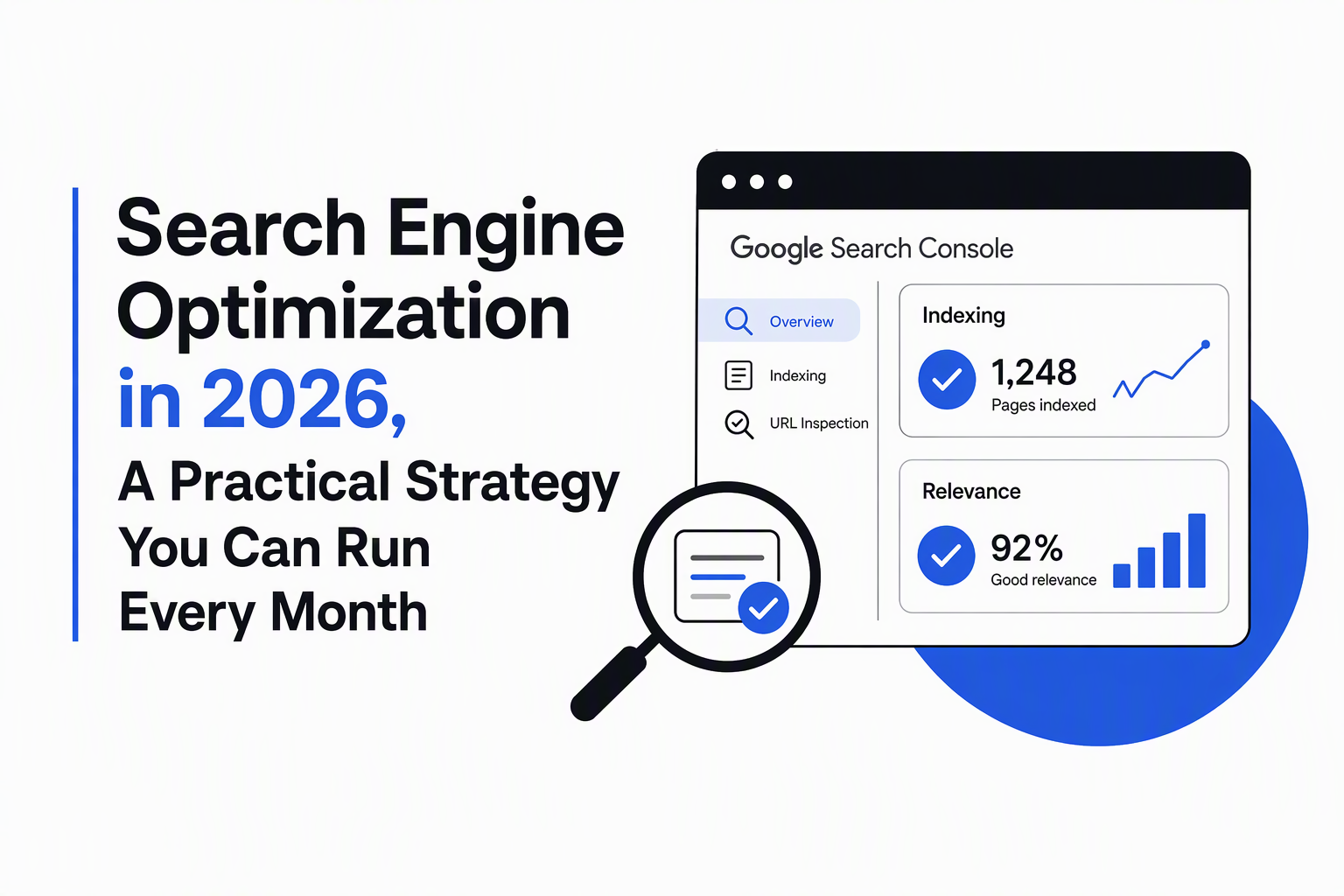
Foundation first, crawl, index, and control what can rank
Search engine optimization stalls when crawling and indexing signals conflict, so the fastest wins usually come from removing blockers and consolidating duplicates before writing anything new.
High-impact checks in Google Search Console (GSC)
- Pages not indexed: open “Page indexing” and sort by the largest URL counts, then sample affected templates.
- Duplicate without user-selected canonical: decide whether to consolidate (canonical + internal links) or differentiate (unique content + self-canonical).
- Alternate page with proper canonical: confirm the canonical target is indexable and internally linked.
- Discovered, currently not indexed: check thin/duplicate patterns, crawl budget issues, and sitemap hygiene.
- Crawled, currently not indexed: investigate content value, duplication, and soft 404 patterns.
A practical “indexability control” checklist
- robots.txt: block only what you truly do not want crawled; avoid blocking pages you also want indexed.
- Meta robots: verify noindex is not applied sitewide via a template mistake.
- Canonicals: use self-referencing canonicals on indexable pages; avoid pointing to non-200 URLs.
- Sitemaps: include only canonical, 200-status URLs; remove parameter URLs and duplicates.
- Redirects: prefer a single hop; remove chains where possible.
- Status codes: fix soft 404s, 500s, and “OK but empty” pages.
Decision rules for duplicates and parameters (the part teams argue about)
- If two URLs serve the same intent (same product, same location, same informational answer), consolidate: pick one canonical URL, 301 the rest, and update internal links.
- If the intent differs (for example, “pricing” vs “features” vs “comparison”), keep separate pages and differentiate above the fold and in headings.
- If parameters create infinite crawl space (sorts, filters), block crawling for combinations that do not provide unique value, and ensure clean category URLs are the ones linked internally.
When to bring in deeper technical analysis
If you see persistent “Crawled, currently not indexed” on pages you believe are strong, it is time to inspect rendering, internal link discovery, and canonical conflicts. A focused technical SEO audit is usually more productive than rewriting the copy blindly.
Relevance that wins clicks, on-page, snippets, and content that matches intent
Pages win in 2026 when the primary intent is answered clearly in the first screen, then supported with scannable structure that helps snippets and AI features quote your content accurately.
Intent mapping you can do in under an hour per topic
- Pull the query set: in GSC Performance, filter by the page OR by query theme.
- Classify dominant intent: informational, commercial investigation, transactional, or navigational.
- Compare to the current SERP: note what formats dominate (lists, tools, templates, definitions, step-by-step guides).
- Assign one primary page: avoid having multiple URLs compete for the same intent unless you have a strong reason.
On-page checklist that influences snippets
- Title tag: describe the outcome, not just the topic; keep it readable and specific.
- H1: mirror the promise of the title and match the intent; do not treat H1 as a keyword dump.
- First 120 to 160 words: provide a direct answer and a quick “how to use this page.”
- Subheadings: phrase H2/H3 as questions or decisions people make (helps extractability).
- Media + alt text: use alt text to describe the image functionally, not to repeat keywords.
- Internal links: link to the next step, the proof, or the deeper explanation, not just “related posts.”
Two snippet patterns I optimize for most often
- Definition-plus-criteria: a one-sentence definition, then 3 to 5 criteria bullets.
- Step sequence: a short intro line, then numbered steps that match the query language.
Where to go deeper on page structure
If you want a reusable page editing system, the most actionable starting point is on-page SEO fundamentals with a consistent template for intros, headings, and supporting sections.
I have found that “content refreshes” work best when I rewrite the first screen and headings first, then decide whether the rest needs expansion. Updating the core answer often improves click-through and snippet alignment without adding length.
A minimum viable SEO tool stack mapped to each job
A lean tool stack beats a bloated one in search engine optimization because each tool should map to a specific job, owner, and decision it enables.
Tool-to-task mapping (free and common paid options)
| Job | Free / native tools | Common paid options | What you decide with it |
|---|---|---|---|
| Indexing and coverage triage | Google Search Console, site: queries (limited) | Screaming Frog, Sitebulb | Which templates block indexing, which duplicates to consolidate |
| Crawl diagnostics | GSC URL Inspection, server logs (if available) | Screaming Frog, log analyzers | Where bots spend time, where links are missing |
| Keyword and SERP research | Google SERP, GSC queries, Google Trends | Ahrefs, Semrush | Which intents dominate, which topics deserve a dedicated page |
| Content briefing and optimization | Docs/Sheets, SERP analysis | Surfer (optional), Clearscope (optional) | What sections and entities to include, how to structure answers |
| Rank and visibility monitoring | GSC Performance | AccuRanker, Ahrefs | Whether changes improved query coverage and average position trends |
| Reporting and decision dashboards | Looker Studio, GA4 | Supermetrics (connector) | Which page groups drive leads or revenue, what to update next |
My “minimal stack” recommendation for most teams
- Must-have: Google Search Console + analytics (GA4 or equivalent) + one crawler.
- Nice-to-have: a rank tracker if you manage many markets or categories.
- Optional: content scoring tools, but only if you already have strong intent mapping and editing discipline.
For measuring whether your work is actually increasing demand capture, use a clear definition of search visibility that you can tie back to page groups and conversions.
A practical search engine optimization example from draft to improved snippet
A repeatable on-page edit turns a vague draft into a snippet-ready page by clarifying the promise, answering intent immediately, and tightening internal links to supporting pages.
Before, common issues
- Title: “Search Engine Optimization Services” (generic, unclear outcome)
- H1: “SEO” (too broad)
- Intro: opens with background, delays the answer
- Headings: topic coverage without decisions (no “how,” “when,” “checklist”)
- Internal links: random, not aligned to next-step intent
After, snippet-oriented rewrite (template you can reuse)
- Title: “Search engine optimization in 2026, a monthly system for indexability, intent, and ROI”
- H1: “A monthly SEO system you can run in 90 minutes a week”
- First paragraph: one sentence that defines the system, then bullets for the monthly steps
- H2s: “Fix what blocks indexing,” “Match intent and improve snippets,” “Strengthen internal linking,” “Measure outcomes”
- Internal links: one link to deeper technical fixes, one to on-page editing, one to measurement
Expected SERP impact (what to watch for in GSC)
- Higher CTR without new rankings: improved title and snippet alignment can lift clicks at the same average position.
- More queries per page: better structure tends to expand long-tail coverage when headings mirror real sub-questions.
- Snippet and AI extraction: clearer “definition plus steps” passages are easier to quote.
If your organization is evaluating a provider for this type of work, compare deliverables and timelines in this search engine optimization service guide.
Measurement and ROI, what to track weekly and monthly (and what not to obsess over)
ROI-focused SEO measurement in 2026 centers on page-level outcomes and indexing health, not daily rank volatility.
Weekly checks (30 minutes)
- Indexing exceptions: scan GSC for spikes in “not indexed” reasons after releases or CMS changes.
- Top page movers: identify pages with the biggest click changes week-over-week and review the queries driving the shift.
- Change log review: note what shipped (title edits, internal links, redirects) so you can connect cause and effect later.
Monthly checks (the decision meeting)
- Page groups by intent: informational vs commercial pages; compare clicks, engagement, and conversions by group.
- Query-to-page fit: for each priority query set, confirm the right page is earning impressions and clicks.
- Snippet alignment: review top queries with high impressions but low CTR and test title and first-screen rewrites.
- Internal link coverage: ensure priority pages have fresh, relevant links from new and updated content.
What not to obsess over
- Single-keyword rank checks: use them as a diagnostic, not a KPI.
- Tool “content scores”: they can be helpful prompts, but intent satisfaction and clarity matter more.
- Raw traffic: focus on qualified clicks and conversions tied to the pages you invested in.
How AI SERP features change reporting
AI Overviews and richer snippets can reduce clicks on some informational queries, so I separate reporting into two lanes: pages built to capture demand (commercial intent) and pages built to earn visibility and trust (informational intent). The goal is not to “win every click,” but to ensure the pages that drive revenue are technically clean, clearly aligned to intent, and supported by an internal architecture that helps Google understand priority.
FAQ
If you want to implement this framework yourself, start with the indexability and intent steps above, then run the monthly loop for 30 days. If you would like a second set of eyes to validate priorities and remove blockers faster, Freeways Agency can help with a focused SEO roadmap and audit call grounded in Google Search Console and analytics.

Written by Joyce Ng.

Is Your Website an Open Book or a Black Box to AI?
Learn optimization artificial intelligence with a clear taxonomy, a weight-update example, a method selection matrix, and a measurable project workflow.
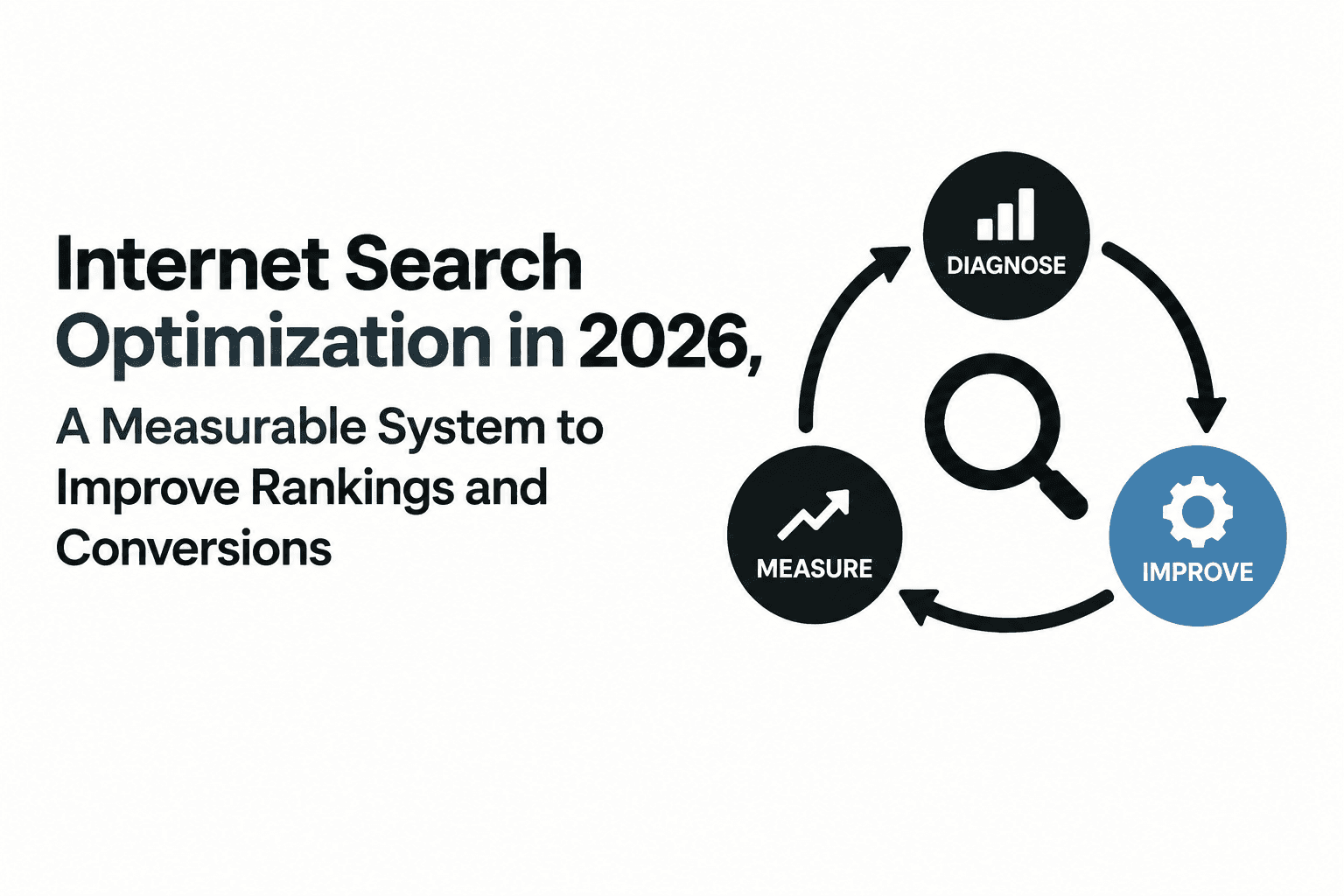
Internet Search Optimization in 2026, A Measurable System to Improve Rankings and Conversions
Run internet search optimization as a measurable loop: diagnose, prioritize, and track KPIs that improve rankings, CTR, and conversions.

AI For SEO Explained How To Use AI To Improve Search Visibility In 2026
Learn how ai for seo improves research, content, technical workflows, and AI discovery with a practical framework for better search visibility.