
Local Search Engine Optimization Explained, What It Is, Benefits, and a Simple Starter Plan

Local search engine optimization is the practical system for getting a nearby business to show up in Google Maps and the Local Pack for location-based searches like “dentist near me” or “plumber in District 1.” Unlike regular SEO that mainly competes in the blue organic links, local SEO competes on map visibility, proximity, and trust signals that live inside your Google Business Profile and the wider web.
- Local search engine optimization focuses on the Local Pack and Google Maps, where relevance, distance, and prominence decide who shows.
- You can’t control distance, but you can control relevance and prominence through your Google Business Profile, on-site local pages, citations, and reviews.
- Use a simple weekly plan and KPI tracker to measure ranking, calls, direction requests, and leads, not just “positions.”

What Local Search Engine Optimization Is, and Why It’s Different From “Regular” SEO
Local search engine optimization is the set of actions that increase a location-based business’s visibility in Google Maps and the Local Pack (the 3-map results) for searches with local intent.
Local Pack vs organic results, what you are actually trying to win
For many “near me” searches, the Local Pack appears above the traditional organic results on mobile and often captures the fastest actions: tap-to-call, directions, website clicks, and appointment bookings. That is why local search engine optimization is less about writing lots of blog posts and more about aligning location signals across your Google Business Profile (GBP), your website, and third-party directories.
Regular SEO still matters, but it is competing in a different result set. You can rank organically for “best dentist in Ho Chi Minh City” and still not show in the map results if your GBP is weak or inconsistent.
Quick comparison table, local SEO vs “regular” SEO
| Aspect | Local search engine optimization | Traditional SEO (organic) |
|---|---|---|
| Main placements | Google Maps + Local Pack | Organic blue links |
| Primary asset | Google Business Profile + local landing pages | Website content + backlinks |
| Strongest ranking levers | Relevance, distance, prominence; reviews and citations influence prominence | Content relevance, authority, technical quality |
| Conversion actions | Calls, direction requests, bookings from the map listing | Clicks to pages, form fills, assisted conversions |
| Best fit | Businesses serving customers in a defined area | Businesses selling nationally or competing mainly by content |
What you can expect if you implement the basics well
In practice, early wins usually show up as better engagement metrics in GBP (more calls, more direction requests) before you see dramatic rank movement for every keyword. In our experience working with service businesses, getting GBP categories, services, and location pages aligned often improves the quality of leads first, because Google starts matching you to more accurate searches.
How Local Results Actually Work in Google, Relevance Distance and Prominence
Google local results are primarily driven by relevance, distance, and prominence, and local search engine optimization focuses on the two you can influence most: relevance and prominence.
Relevance, distance, prominence explained in plain English
- Relevance: How well your business matches what the searcher asked for (categories, services, content, attributes).
- Distance: How close your verified location is to the searcher or the location in the query (you cannot “optimize” this, only choose where you operate).
- Prominence: How trusted and well-known your business appears online (reviews, mentions, citations, links, and overall authority).
What you can influence vs what you cannot
You can influence: GBP completeness and accuracy, category and service relevance, review volume and review content, citation consistency, local landing page quality, and linkable local signals (local partnerships, local press, industry associations).
You cannot directly influence: the searcher’s GPS location, the city center weighting for some queries, competitor proximity, or how Google chooses to blend organic and map signals on a given day.
Why “ranking checks” often confuse local SEO beginners
Local rank tracking changes depending on where the check is performed. A keyword can be #1 from one neighborhood and #6 from another. That is why serious local search engine optimization measurement usually uses:
- Grid tracking (rank by small geo points across your service area)
- GBP performance metrics (calls, direction requests, website clicks)
- Lead metrics (bookings, form fills, qualified calls)
We initially assumed “average rank” would predict leads, but grid patterns and GBP actions often explain performance better: you can dominate the neighborhoods that matter most and still have a mediocre city-wide average.
The Local Search Engine Optimization Fundamentals That Move Rankings
Local search engine optimization moves fastest when you treat it as four controllable levers: GBP relevance, on-site location relevance, citation consistency, and review-driven prominence.
1) Google Business Profile (GBP) fundamentals, actions mapped to KPIs
GBP is usually the highest leverage asset for Local Pack visibility. Focus on actions that change match quality and trust, then tie each one to a metric you can track.
- Choose the right primary category (not “closest”, but the most accurate core service).
KPI: improvement in impressions for “service” queries inside GBP Performance. - Add secondary categories only if you truly provide them.
KPI: increase in discovery searches, plus more calls from relevant queries. - Fill services/products with plain language that mirrors what customers ask for.
KPI: higher “website clicks” and “calls” after edits, measured week-over-week. - Publish photos regularly (real storefront, team, work examples).
KPI: photo views and engagement trend, plus conversion actions. - Use posts only when they support real offers or updates.
KPI: post interactions, but prioritize calls and bookings.
2) Local landing pages, what “good” looks like (and what to avoid)
Local pages help Google connect your website entity to specific services and locations, which supports relevance and prominence signals flowing into the map results.
Minimum elements for a service-area or location page:
- Clear service + location statement in the first 1 to 2 sentences
- Specific service details (pricing ranges if you can publish them, inclusions, process, turnaround)
- Proof: testimonials, before/after, certifications, case examples, FAQs
- NAP details where appropriate (Name, Address, Phone), consistent with GBP
- Embedded map only if it represents a real location (do not fake addresses)
Avoid: spinning dozens of near-identical “city pages” with swapped place names. Thin pages can hurt trust and rarely help long term.
If you want a deeper on-site foundation, start with website technical SEO basics first, because crawling, indexing, and page quality issues can prevent local improvements from sticking.
3) Citations and NAP consistency, the checklist that prevents trust leaks
Citations are third-party directory listings that repeat your business identity. In local search engine optimization, citations matter less for “link juice” and more for consistency and validation.
Citation consistency checklist:
- Business name matches GBP exactly (including suite formatting)
- Address matches official postal format
- Primary phone number is the same everywhere (avoid rotating tracking numbers in citations)
- Website URL is consistent (choose https, choose www or non-www)
- Business categories are not wildly inconsistent across top directories
KPI: number of corrected citations and reduction in duplicates. The business impact typically shows up as steadier map visibility across neighborhoods rather than instant jumps.
4) Reviews, how to build prominence without getting filtered
Reviews influence prominence and conversion at the same time. Google can filter suspicious patterns, so the safest approach is operational, not gimmicky.
- Ask at the right moment: immediately after the service is delivered, before issues cool down into silence.
KPI: review velocity (new reviews per week). - Use a consistent request script (SMS or email) and send it to all customers, not only happy ones.
KPI: request-to-review conversion rate. - Respond to reviews with service keywords naturally (no stuffing).
KPI: ratio of responded reviews; track call conversion improvements.
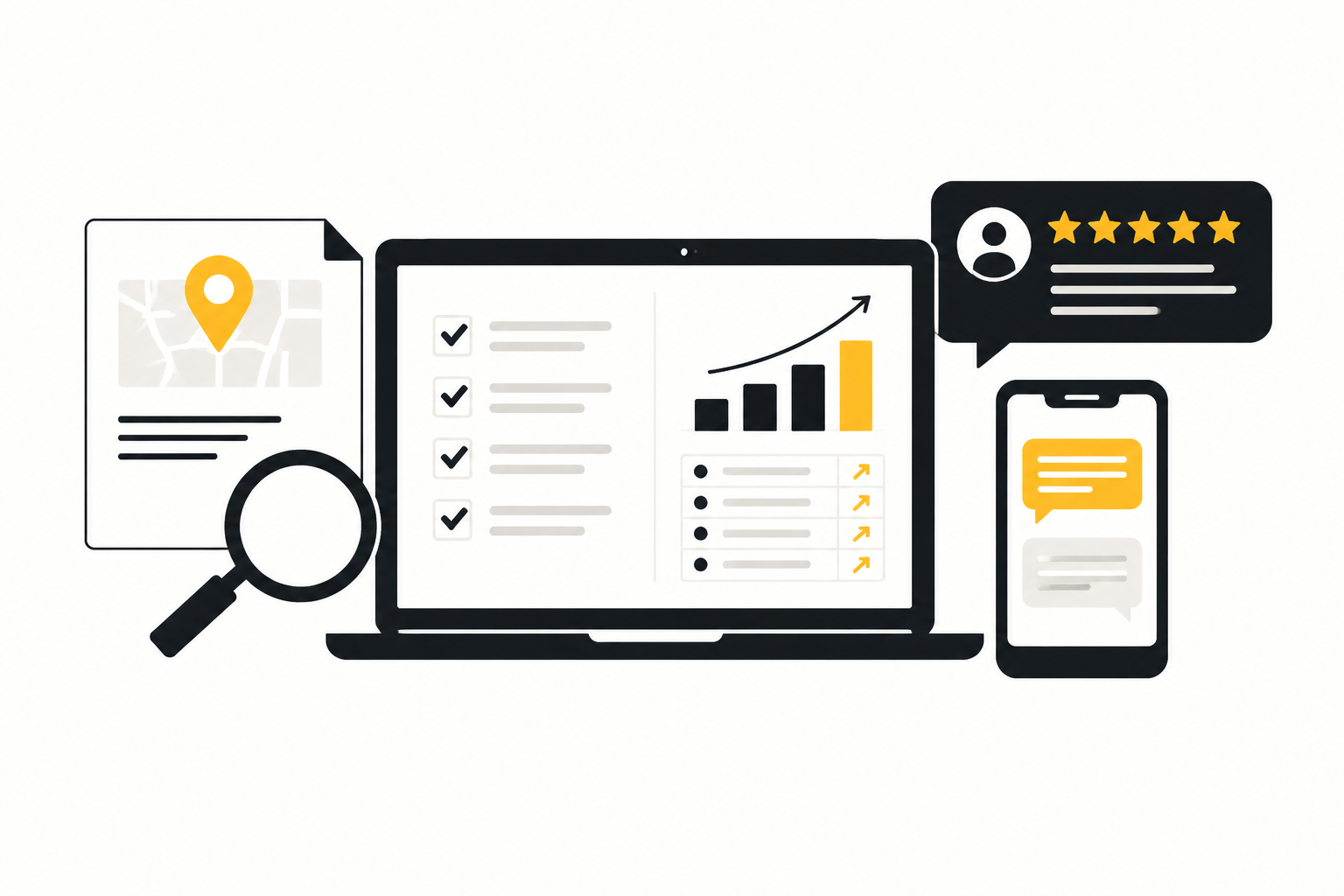
Copy-Paste Local SEO Template, Audit Checklist, Weekly Plan, KPI Tracker
A simple local search engine optimization system becomes manageable when you track the same small set of inputs and outcomes every week.
The copy-paste template (Sheets style)
Copy the structure below into Google Sheets. The goal is to tie one action to one measurable output, so you can keep what works and stop guessing.
Tab 1, Business info source of truth
- Business name: [exactly as in GBP]
- Address: [exact formatting]
- Phone: [primary number]
- Website: [canonical URL]
- Primary category: [GBP category]
- Secondary categories: [list]
- Service area: [cities/neighborhoods you actually serve]
Tab 2, GBP audit checklist
- Primary category correct (Yes/No)
- Services list complete (Yes/No)
- Attributes filled where applicable (Yes/No)
- Photos added in last 30 days (Yes/No)
- Business hours correct (Yes/No)
- Appointment URL set (Yes/No)
- Review request process documented (Yes/No)
Tab 3, Local page checklist (one row per page)
- URL
- Target service
- Target location
- First paragraph states service + location clearly (Yes/No)
- Proof elements present (Yes/No)
- Internal links to core service page (Yes/No)
- Last updated date
Tab 4, Citation tracker
- Directory name
- Listing URL
- Status: correct / needs update / duplicate
- NAP matches source of truth (Yes/No)
- Notes
Tab 5, Weekly KPI tracker (the only numbers most owners need)
- Week starting date
- GBP: calls
- GBP: direction requests
- GBP: website clicks
- Reviews: new reviews, average rating
- Leads: bookings/forms/qualified calls
- Top 3 target queries: grid visibility notes (up/down, neighborhoods)
How to use the template in 30 minutes
- Fill Tab 1 and treat it as the only “truth.”
- Run Tab 2 and fix the first 3 “No” items.
- Pick 1 local page from Tab 3 and upgrade it with proof and specificity.
- Fix 5 citations from Tab 4 (start with the biggest directories in your market).
- Log KPIs weekly in Tab 5 for at least 4 weeks before making big conclusions.
After running audits like this, the pattern was clear: businesses improve faster when they limit weekly changes to a small set of controllable inputs and measure GBP actions, not just rankings.
Local SEO Tools Stack by Budget and Business Type, Minimal Kit to Upgrade Path
A useful local search engine optimization toolkit starts with GBP reporting and basic listing hygiene, then upgrades to grid tracking and citation management when the business is ready to scale.
Minimal kit (free or close to free)
- Google Business Profile for performance insights and updates
- Google Search Console to see which queries drive clicks to local pages
- Google Analytics to connect visits to leads (forms, calls, bookings)
- A spreadsheet (the template above) for consistency and weekly discipline
Upgrade path (when paid tools become worth it)
- Grid rank tracking when you need neighborhood-level visibility and competitor comparisons
- Citation management when you have duplicates, multiple locations, or frequent data drift
- Review management workflows when volume is high and response time matters
Pick tools based on business type
- Single-location storefront: prioritize GBP hygiene and reviews before anything fancy.
- Service-area business: prioritize service and area relevance on-site, then grid tracking to see real coverage.
- Multi-location: prioritize data consistency, location page templates, and duplicate suppression.
If your team is also building broader topical authority beyond the map, semantic SEO and entity SEO become useful frameworks to keep your service and location signals unambiguous across the site.
Is Local SEO Still Worth It in 2026, A Simple Decision and ROI Framework
Local search engine optimization is still worth it in 2026 when your customers choose providers based on proximity and trust, and when a single additional booked job or appointment covers the ongoing effort.
A quick decision rubric (yes/no in 2 minutes)
- Yes if customers search “near me” or add city/neighborhood words before buying.
- Yes if you serve a defined area and can reliably handle more demand.
- Yes if your average job value is high enough that a few incremental leads per month matter.
- No or later if you are purely national with no physical or service-area relevance.
- No or later if you cannot operationally respond to calls/review requests consistently.
Simple ROI math you can do without guesswork
Use conservative inputs you already know:
- Incremental qualified calls per month from GBP: start with a small target like 10
- Close rate: for example, 20% (use your real number if known)
- Average profit per job: use profit, not revenue
ROI formula: (Incremental calls × close rate × profit per job) - monthly SEO cost.
Even if you avoid exact assumptions, tracking “calls, direction requests, and booked jobs” weekly will tell you quickly whether local search engine optimization is paying off for your market.
For readers also comparing broader channels, the distinction in organic search vs search engine optimization helps clarify what you should expect from local vs non-local efforts.
| Local SEO activity | Main ranking lever | Best KPI to track weekly |
|---|---|---|
| Fix GBP categories, services, attributes | Relevance | GBP calls, website clicks |
| Improve local service/location pages | Relevance + prominence | Organic clicks to local pages, leads |
| Clean up citations and duplicates | Prominence (validation) | # corrected listings, steadier grid coverage |
| Run a review request process | Prominence + conversion | New reviews/week, call-to-book rate |
FAQ
If you want the template in a ready-to-use format and a second opinion on your current setup, Freeways can share the checklist and walk you through a lightweight local SEO audit so you know exactly which fixes will move the needle first.

Written by Joyce Ng.

Online Marketing SEO: Revenue Engine or Expensive Busywork?
Run online marketing search engine optimization in 2026 with a practical workflow, examples, and a 90-day KPI cadence that ties SEO to revenue.

Stop Playing SEO Roulette: Your First 30 Days, Mapped Out
Learn marketing online seo in 2026 with a beginner framework, free tools, a 30-day plan, and simple KPIs to track organic progress.

High-Volume SEO Keywords: A Gold Mine or a Money Pit?
Learn keywords and SEO with a practical keyword research workflow, search intent examples, prioritization criteria, and a content mapping template.