
AI Based SEO in 2026, What It Is, Where It Works, and Where It Breaks

AI based seo in 2026 means using machine learning systems to scale specific SEO tasks (research, drafting, clustering, anomaly detection) while humans stay accountable for accuracy, intent, and brand trust.
- AI based seo works best as assistance (pattern-finding and speed), not as an autopilot for strategy or facts.
- A simple human-in-the-loop QA loop prevents the most common failures: wrong intent, hallucinated claims, and thin duplicate pages.
- Choose tools and vendors by measurable outputs (time saved, fewer errors, better coverage), not by impressive demos.
What AI Based SEO Means in 2026, Not Just “Using ChatGPT”
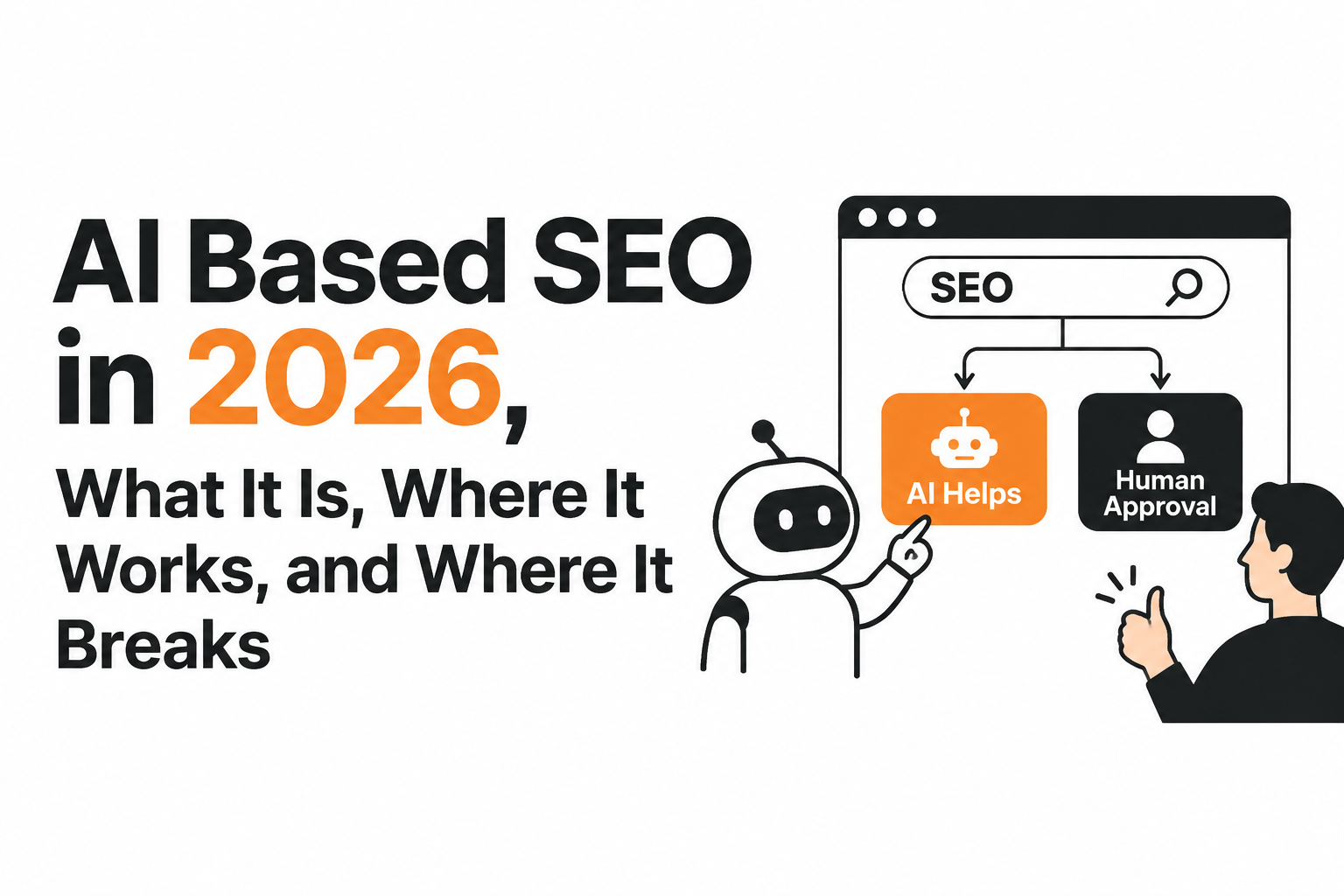
AI based seo is a workflow where AI assists with repeatable parts of search optimization, but humans set intent, verify claims, and approve what ships.
Assistance vs automation (the practical distinction)
- AI assistance: AI generates candidates (keywords, outlines, internal-link suggestions, draft sections, schema ideas). A human selects, edits, and validates.
- AI automation: AI publishes or deploys changes with minimal review (auto-generated pages, bulk rewrites, auto internal links at scale). This is where quality and brand risk spikes.
Common misconceptions that cause ranking regressions
- Misconception: “More content equals more traffic.” Reality: Unchecked generation often produces near-duplicate pages that compete with each other.
- Misconception: “AI is faster, so we can skip briefs.” Reality: If the brief does not lock search intent and scope, speed just produces wrong pages faster.
- Misconception: “Google penalizes AI content.” Reality: Google’s public guidance focuses on content quality and usefulness, not whether it was AI-assisted. See Google’s helpful content guidance.
A plain-language definition you can use internally
Working definition: AI based seo is “human-owned SEO strategy with AI-accelerated execution,” where every page still passes editorial and factual QA before publishing.
Where AI Helps Most Across the SEO Lifecycle
AI delivers the most value in SEO when it turns messy inputs (SERPs, logs, Search Console exports, competitor pages) into organized options a human can judge.
1) Research and planning (higher coverage, fewer blind spots)
- Use AI for: keyword clustering by intent, topic gap lists, SERP pattern summaries (formats, angles, dominant subtopics).
- Human checks: confirm commercial vs informational intent, remove clusters that do not match your product or audience, prioritize by business value.
- Concrete output: a one-page brief with (a) primary intent, (b) secondary questions, (c) required proof points, (d) internal link targets.
2) Content production (speed with guardrails)
- Use AI for: outline variants, first drafts of non-controversial sections, summarizing source notes, generating FAQ candidates from “People also ask” themes.
- Human checks: remove unsupported claims, align tone, add real examples, ensure the page answers the query early.
3) On-page optimization (consistency at scale)
- Use AI for: title tag options, meta description drafts, header hierarchy fixes, internal link opportunities based on topical similarity.
- Human checks: confirm the title reflects actual page content, avoid overpromising, keep headers aligned with intent.
4) Technical SEO and diagnostics (pattern detection)
- Use AI for: grouping crawl issues by root cause, drafting Jira tickets, spotting template-level duplication, summarizing log patterns.
- Human checks: validate with crawl data and server rules; do not let AI “guess” technical fixes.
5) Links and digital PR (idea generation, not outreach autopilot)
- Use AI for: prospect list enrichment, angle brainstorming, personalization drafts.
- Human checks: verify relevance manually, avoid spam footprints, keep outreach truthful and specific.
6) Reporting and insights (faster interpretation)
- Use AI for: anomaly summaries, “what changed” hypotheses, turning dashboards into narrative updates.
- Human checks: confirm hypotheses against releases, seasonality, and known site changes.
In practice, I’ve found the best AI wins come from compressing the “messy middle” of SEO, turning 200-row exports into a prioritized list a strategist can actually act on.
The Human-in-the-Loop Framework That Prevents AI SEO Mistakes
A reliable AI based seo process uses a repeatable QA loop that checks intent, evidence, originality, and page-level SEO before anything is published.
Step 1: Lock the search intent in a one-paragraph brief
- Input: target query, top 5 ranking pages, your product constraints.
- Decision: choose one dominant intent (educational, comparison, transactional, troubleshooting).
- Output: “This page is for [audience] who wants [outcome]. It must include [topics] and must not claim [things you cannot prove].”
Step 2: Generate, then constrain (outline first, draft second)
- AI task: produce 2 to 3 outline variants with H2/H3, each mapped to intent and subquestions.
- Human task: merge into one outline and add mandatory proof requirements (sources, screenshots, steps).
Step 3: Evidence and fact-check gate (non-negotiable)
- Rule: any claim that sounds like a statistic, policy, or tool behavior must be sourced or rewritten as a conditional.
- Checklist: names, numbers, pricing, dates, and definitions verified against primary sources.
Step 4: Originality and “page purpose” check
- Ask: “Would this page exist if we removed the keyword?” If not, it is probably thin.
- Fix: add a unique artifact: a rubric, a workflow, a QA checklist, a decision table, or a real example.
Step 5: SEO QA before publish (fast but structured)
- On-page: title reflects the main answer, headers match intent, internal links added where genuinely helpful.
- Technical: indexability, canonicals, schema where appropriate, image alt text, page speed basics.
- Post-publish: monitor indexing and query mix in Search Console.
I used to think the “AI risk” was mostly duplicate text, but the bigger operational risk I see is intent drift: the draft answers a different question than the one the page is supposed to win.
Risks, Limits, and How to Stay Aligned With Google’s Quality Expectations
AI based seo fails when teams publish unverified or unhelpful content at scale, because quality signals depend on usefulness, accuracy, and trust, not word count.
Risk 1: Hallucinations and silent factual errors
- What it looks like: confident-sounding tool claims, invented benchmarks, wrong feature descriptions.
- Safe principle: treat AI text as a draft that requires the same fact-checking as a junior writer.
Risk 2: Template-level duplication (near-copies across dozens of pages)
- What it looks like: city pages, service pages, or glossary entries that only swap a few nouns.
- Safe principle: each indexed page needs a distinct purpose, unique examples, and differentiated scope.
Risk 3: Weak E-E-A-T signals (especially in “your money, your life” adjacent topics)
- What it looks like: no author accountability, vague advice, no sources, no real-world constraints.
- Safe principle: add responsible authorship, cite primary documentation where relevant, and include operational detail (steps, decision criteria, caveats).
Risk 4: Over-optimization and spam patterns
- What it looks like: keyword-stuffed headings, auto-generated internal links, mass-produced pages.
- Safe principle: optimize for clarity and relevance first. If you would not put your brand name on it, do not publish it.
For teams that want an official reference point, Google’s spam policies are a useful backstop when you are deciding whether a scale tactic crosses the line: Google Search spam policies.
A Starter Workflow and Checklist You Can Run This Week
A week-one AI based seo workflow should produce one improved page and one new page, with measurable outputs you can review in Search Console.
Day 1: Pick a single query and define “done”
- Input: one target query, existing page (or competitor pages if net-new).
- Done means: the first paragraph answers the query directly; the page covers the top subquestions; claims are verified.
Day 2: Build a brief and outline (human locks intent)
- Output: 1-paragraph intent statement + H2/H3 outline + internal link targets.
Day 3: Draft with AI, then revise with a checklist
- AI output: draft sections mapped to each H2.
- Human edits checklist:
- Replace vague claims with specifics or remove them.
- Add at least one original artifact (table, rubric, checklist).
- Confirm each H2 answers what the heading promises.
Day 4: On-page and internal links
- Action: add 2 to 5 internal links where they reduce friction for the reader (definitions, next steps, deeper guides).
- Optional: add FAQ if the SERP shows question intent.
Day 5: Publish, then set lightweight success metrics
- Indexing: confirm the URL is indexable and requested for indexing if needed.
- Success metrics (week 1 to 2): impressions begin to appear for the target topic, and query mix matches intended intent (not random tangents).
- Success metrics (week 3 to 6): clicks trend upward and the page earns internal navigation paths (users continue to related pages).
If you want deeper frameworks beyond this starter loop, these guides may help: AI for SEO and AI powered SEO.
How to Choose AI SEO Tools and Vendors Without Getting Trapped by Demos
The safest way to choose AI tools for AI based seo is to score them on measurable workflow outputs, not on how good the demo text sounds.
Evaluation criteria (a simple scoring rubric)
- Workflow fit: Does it plug into your current process (briefs, drafts, tickets, reporting) without forcing a total reset?
- Control: Can you constrain outputs (style rules, sources, templates) and require approvals?
- Traceability: Can you see why a recommendation was made (inputs, sources, rules), or is it a black box?
- Quality guardrails: Does it help detect duplication, missing entities, or intent drift?
- Security: Clear data handling, access controls, and export options.
Red flags that show up after the trial
- “One-click content” promises with no QA layer.
- Recommendations that cannot be reproduced or explained.
- Tool outputs that look impressive but do not map to your KPIs (queries, clicks, indexation, conversions).
Questions to ask vendors (so you can compare apples to apples)
- What is the smallest workflow where teams see repeatable time savings?
- What is the approval process you recommend before publishing?
- How do you handle citations or source grounding for factual content?
- What does success look like in Search Console in the first 30 to 60 days?
For a broader view of tool selection by budget and use case, see best SEO AI tool. If you are evaluating partners instead of software, this overview of a search engine optimization service can help you sanity-check deliverables.
| SEO task | Where AI helps | Human must verify | “Ship it” acceptance check |
|---|---|---|---|
| Keyword clustering | Grouping by semantic similarity and SERP patterns | Intent labels and prioritization | Each cluster maps to one page purpose |
| Content drafting | First draft speed and structure options | Facts, claims, tone, originality | Evidence gate passed, intent matched |
| Technical triage | Summarizing crawl issues and patterns | Root cause and implementation details | Fix validated by crawl or logs |
| Reporting | Anomaly detection and narrative summaries | Causality and recommendations | Insights tie to known changes and KPIs |
Frequently asked questions
If you want a no-pressure way to assess your current ai based seo setup, Freeways Agency can share a free SEO plus AI readiness checklist and walk through quick wins and risk areas on a short call.

Written by Joyce Ng.
Keywords SEO Services, A Copy-Paste Keyword List and Buyer Checklist for 2026
Buy keywords seo services the smart way in 2026 with a copy-paste keyword list, mapping example, pricing bands, and a vendor scorecard.

Digital SEO Agency Buyer Guide For 2026 Pricing, Proof, And A Proposal Scorecard
Use this digital seo agency buyer guide to compare pricing by scope, verify proof, score proposals, and decide ROI with a simple break-even model.

Internet Marketing SEO Feels Like a Maze? Here’s Your 90-Day Way Out
Learn internet marketing seo in 2026 with a beginner framework, Google Search Console steps, and a practical 30/60/90-day plan to measure results.