
Your Brand Is an AI Search Ghost. Can This Framework Change That?

AI optimization is a measurable operating system for improving marketing performance with AI by tightening inputs (data and prompts), processes (workflows and evaluation), and outputs (visibility, rankings, and conversions) against explicit KPIs.
- Pick one primary outcome (AI answer visibility, rankings, or revenue) and lock guardrails so ai optimization does not become a vanity-metric project.
- Run a weekly Diagnose → Hypothesize → Test → Ship loop with minimum viable tests, decision thresholds, and a changelog you can audit.
- Improve what AI systems and search engines consume (entities, internal links, crawl signals, and extractable passages), then measure lift using cohorts and assisted attribution.
Define what you are optimizing for, AI visibility, rankings, or revenue
AI optimization only works when the team agrees on a single primary target metric and 2 to 4 guardrails that prevent “wins” from breaking the business.
Map outcomes to KPIs you can actually move in 30 days
Use this decision rule: if you cannot influence the metric through page-level or workflow changes within one sprint, it is not your primary KPI. In practice, I pick one “north star” per site or per cluster, because mixed targets create conflicting decisions (for example, chasing citations can reduce CTR if the answer is fully satisfied on-SERP).
- If the goal is AI answer visibility: primary KPI = weekly count of AI mentions/citations for a defined query set; secondary = share of queries where your brand/page is referenced.
- If the goal is rankings: primary KPI = impressions and average position for a tracked page group (Google Search Console); secondary = top 3/top 10 keyword count for that group.
- If the goal is revenue: primary KPI = organic assisted conversions and organic-influenced pipeline/revenue (depends on your analytics setup); secondary = qualified organic sessions to money pages.
Set guardrails before you ship changes
Guardrails are the metrics that must not degrade while you optimize. A simple set that works across most sites: (1) conversion rate on primary landing pages, (2) indexed pages count for the optimized template, (3) crawl errors, (4) brand search impressions. Write the guardrails into your weekly experiment doc, so every test has a clear “do not cross” line.
Define “done” with decision thresholds
Make decisions with thresholds, not vibes. Example thresholds I use: ship if a change improves the primary KPI for 2 consecutive weekly reads without tripping guardrails; roll back if a guardrail drops materially for a full week; extend the test if results are mixed and you have not controlled for seasonality (promotions, launches, holidays).
The AI optimization loop, diagnose, hypothesize, test, and ship weekly
AI optimization becomes repeatable when you treat it as a weekly experimentation cadence with a documented backlog, a small test design, and a changelog tied to measurable outcomes.
Use a 4-step loop with a minimum viable test
- Diagnose: pick a page group (5 to 20 URLs) and pull baseline: GSC impressions/clicks, top queries, crawl stats, and current internal link counts.
- Hypothesize: write a one-sentence mechanism, not a wish. Example: “Adding extractable answer blocks to the intro will increase AI citation likelihood for definition queries.”
- Test: implement the smallest change that can validate the mechanism. Keep scope tight: one template tweak, one content module, one internal linking pattern, or one technical fix.
- Ship: roll out to the full cohort only after the test cohort shows movement and guardrails hold.
What to log every week (so you can attribute later)
- Change ID: date, URLs affected, and the exact change (copy/paste the before and after snippet).
- Reason: hypothesis and the expected direction of impact.
- Readout: the primary KPI delta, guardrails, and a yes/no ship decision.
When I audit sites where “AI initiatives” failed, the missing piece is almost always the changelog. Without it, you cannot separate algorithm shifts from your own changes, and you end up freezing instead of iterating.
Tool categories that support the loop
- Measurement: Google Search Console, analytics (GA4 or equivalent), log file analysis if available.
- Workflow and QA: a ticketing system plus a shared experiment doc.
- Content evaluation: a rubric for direct relevance and extractability (more below), plus a crawler for technical checks.
Optimize inputs for ai optimization, data quality, content entities, and technical crawl signals
Input quality determines output quality because AI systems and search engines can only summarize, cite, and rank what they can parse, trust, and connect to entities.
Input checklist 1, data quality and governance
- Analytics hygiene: confirm key events, conversion definitions, and cross-domain tracking (if applicable) are consistent. If conversions are broken, every downstream ai optimization decision becomes noise.
- Query sets: define a stable list of priority queries per cluster and keep it fixed for at least one month so your AI mention tracking is comparable.
- Canonical truth: ensure one primary page answers each intent. Duplicate intent pages confuse both crawlers and summarizers.
Input checklist 2, entity clarity inside content
Entity clarity means a page explicitly names the concepts it is about, how they relate, and the constraints. Practical page edits that improve entity clarity:
- Add a “definition plus boundaries” passage: one to two sentences that state what the thing is and what it is not (useful for AI Overviews and assistants).
- Use consistent terminology: pick one primary term and keep synonyms as supporting phrases, not replacements.
- Document relationships: add short “depends on” lines (for example: “AI answer visibility depends on extractable passages and corroborating pages.”).
At this point it is also natural to connect your internal taxonomy to related concepts. If you need a broader decision guide, see optimization artificial intelligence.
Input checklist 3, technical crawl and index signals
- Indexability: verify robots directives, canonical tags, and noindex usage on the page group.
- Renderability: ensure the main content is not hidden behind client-side rendering issues that delay or block extraction.
- Internal discoverability: every priority page should be reachable within a reasonable click depth from a hub or nav path.
- Structured data (where accurate): add or fix schema only when it matches on-page content and can be validated.
Optimize outputs, content refresh, internal linking, and on-SERP or on-AI answer performance
Output optimization turns diagnosis into page-level actions that increase extractable relevance, strengthen internal evidence, and improve the way your pages perform when summarized on SERPs and in AI answers.
Page refresh actions that are measurable
- Rewrite the opening for direct relevance: add a self-contained answer in the first 1 to 2 sentences, then expand with constraints, steps, and definitions.
- Add “answer blocks”: short sections with a label plus 2 to 5 bullets (criteria, steps, thresholds). These are easy for assistants to lift accurately.
- Update stale claims: replace vague lines (“best practice is…”) with checklists, decision rules, or measurable thresholds.
Internal linking pattern that supports AI summarization
Internal linking is not just for PageRank flow, it also builds corroboration across related pages. Use a hub-and-spoke pattern:
- Hub: one page that defines the cluster and links to each supporting page with descriptive anchors.
- Spokes: each supporting page links back to the hub and laterally to 1 to 2 adjacent intents.
- Anchors: prefer intent-matching anchors (not “click here”), and avoid over-repeating the exact keyword.
If you are building an AI-forward SEO system, it helps to align the workflow with modern practices like ai powered seo and ai driven seo.
Measure lift with before-after cohorts
To avoid attributing site-wide movements to your changes, track cohorts. Example: pick 10 pages, change them, and keep 10 similar pages untouched for 2 to 4 weeks. Compare deltas in impressions, clicks, and conversions between the cohorts. This approach is simple, defensible, and makes ai optimization feel like engineering rather than guesswork.
The biggest gap, how to measure AI answer visibility and attribute impact
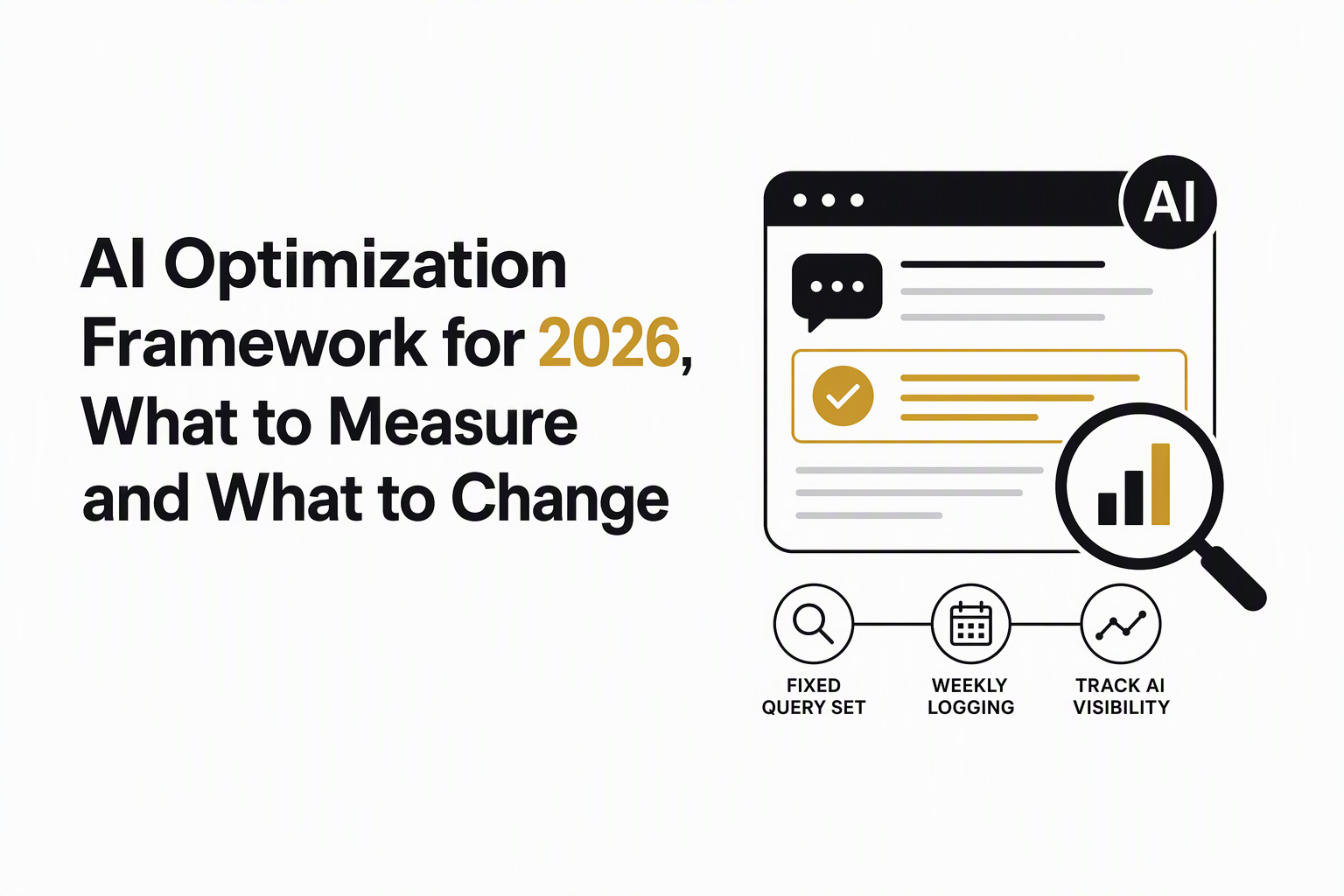
AI answer visibility is measurable when you track a fixed query set, record citations or mentions consistently, and connect those exposures to assisted conversions rather than last-click traffic.
Build an AI visibility tracker you can maintain
- Step 1, lock a query set: 20 to 50 queries that map to one cluster and include a mix of informational and commercial intent.
- Step 2, check the same engines: Google results (including AI Overviews if present), plus one assistant your audience uses.
- Step 3, record outcomes: URL cited, brand mentioned without URL, or no presence. Save the rendered answer text for auditability.
For a deeper definition and improvement levers, see ai visibility.
Attribute business impact beyond clicks
AI answers can reduce clicks while still increasing downstream demand, especially for brand and mid-funnel queries. Practical attribution steps that do not require new infrastructure:
- Use assisted conversion views: in your analytics, track organic as an assisting channel, not just last click.
- Track branded lift: monitor branded search impressions in GSC as a proxy for increased awareness driven by AI citations and summaries.
- Annotate changes: add annotations for content releases and template changes so you can match visibility shifts to deployment windows.
I have found that teams get better decisions when they treat AI mentions like impressions, not like direct-response clicks, because it forces a cleaner conversation about what the page is supposed to do.
Implementation plan, your first 14 days of AI optimization without new headcount
A two-week ai optimization rollout works when you timebox discovery, ship one technical fix and one content module, then establish a weekly reporting cadence.
Days 1 to 3, choose scope and baseline
- Select one cluster or 10 to 20 priority URLs.
- Pull baseline: GSC queries, impressions, clicks, and current top pages for the query set.
- Confirm tracking and conversions are reliable enough to act on.
Days 4 to 7, input hardening sprint
- Fix indexability and canonical issues for the page group.
- Add internal links from hub pages to spokes and vice versa.
- Standardize entity language in headings and the first 200 words.
Days 8 to 11, output sprint with one reusable module
- Add a direct-answer opening to each priority page.
- Insert one extractable module per page (steps, checklist, decision criteria, or thresholds).
- Refresh outdated sections that block comprehension or trust.
Days 12 to 14, launch reporting and the weekly loop
- Create a weekly dashboard: primary KPI, guardrails, and experiment log.
- Set a recurring review: decide ship, roll back, or extend for each test.
- Build the next backlog from the biggest gaps (low impressions, low AI mentions, poor conversion paths).
If you need a reference for what a complete engagement can include, this guide to a search engine optimization service can help you sanity-check deliverables and cadence.
| Optimization target | Primary KPI | Weekly actions to prioritize | Common failure mode |
|---|---|---|---|
| AI answer visibility | Mentions/citations across a fixed query set | Direct-answer openings, extractable blocks, entity clarity, corroborating internal links | Tracking random queries each week and calling it progress |
| Rankings and impressions | GSC impressions and average position for a page cohort | Title and heading alignment, internal linking improvements, crawl/index fixes, refresh stale sections | Changing too many things at once without a changelog |
| Revenue and pipeline | Organic assisted conversions and qualified sessions | Conversion path cleanup, intent-matched CTAs, content that pre-qualifies, measurement hygiene | Optimizing informational pages without a clear next step |
FAQ
If you want a structured audit instead of guesswork, Freeways Agency can review one priority page or cluster and deliver a two-week ai optimization sprint plan with clear KPIs, guardrails, and a weekly experiment cadence focused on SEO and AI-driven discovery.

Written by Joyce Ng.

AI For SEO Explained How To Use AI To Improve Search Visibility In 2026
Learn how ai for seo improves research, content, technical workflows, and AI discovery with a practical framework for better search visibility.

SEO Website Step by Step, The Beginner Workflow to Get Indexed and Start Ranking
Learn a beginner-friendly seo website workflow to get indexed, fix issues, publish content, earn links, and track results with a 30/60/90-day plan.

Search Visibility Explained, How It Works and How to Measure It in Google Search Console
Learn what search visibility means, how tools calculate it, and how to measure search visibility in Google Search Console with a simple spreadsheet.