
Internet Search Optimization in 2026, A Measurable System to Improve Rankings and Conversions

Internet search optimization is a repeatable operating system for improving crawlability, indexing, relevance, authority, and SERP performance using diagnostics and KPIs, not a loose set of SEO tasks.
- Define “optimized” as passing specific checks across crawling, indexing, relevance, quality, authority, and SERP outcomes.
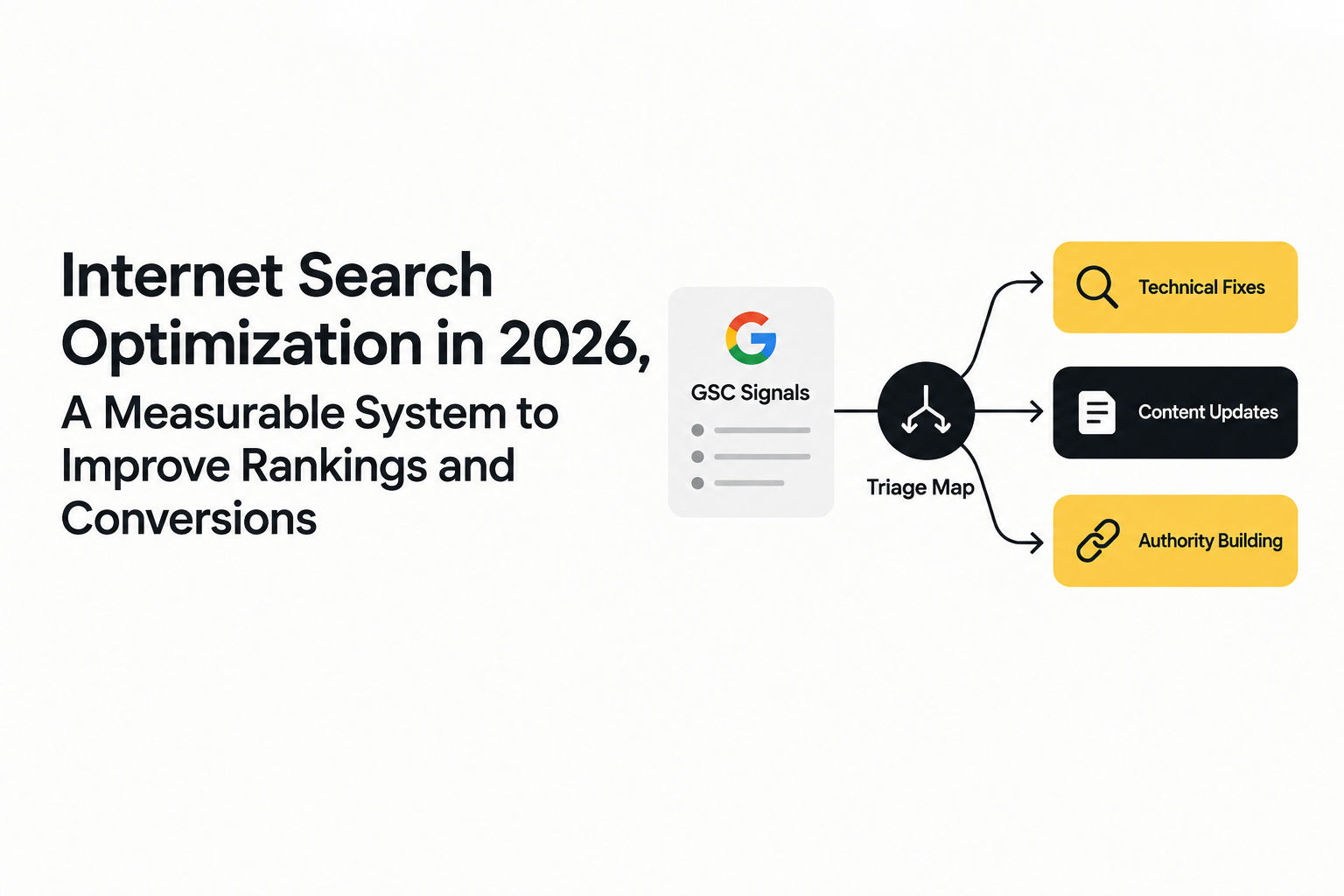
- Use a triage map (GSC patterns, logs, and SERP signals) to identify the constraint before you write or rebuild anything.
- Run a weekly impact scorecard and KPI set that links search visibility, CTR, conversions, and crawl/index health to revenue outcomes.
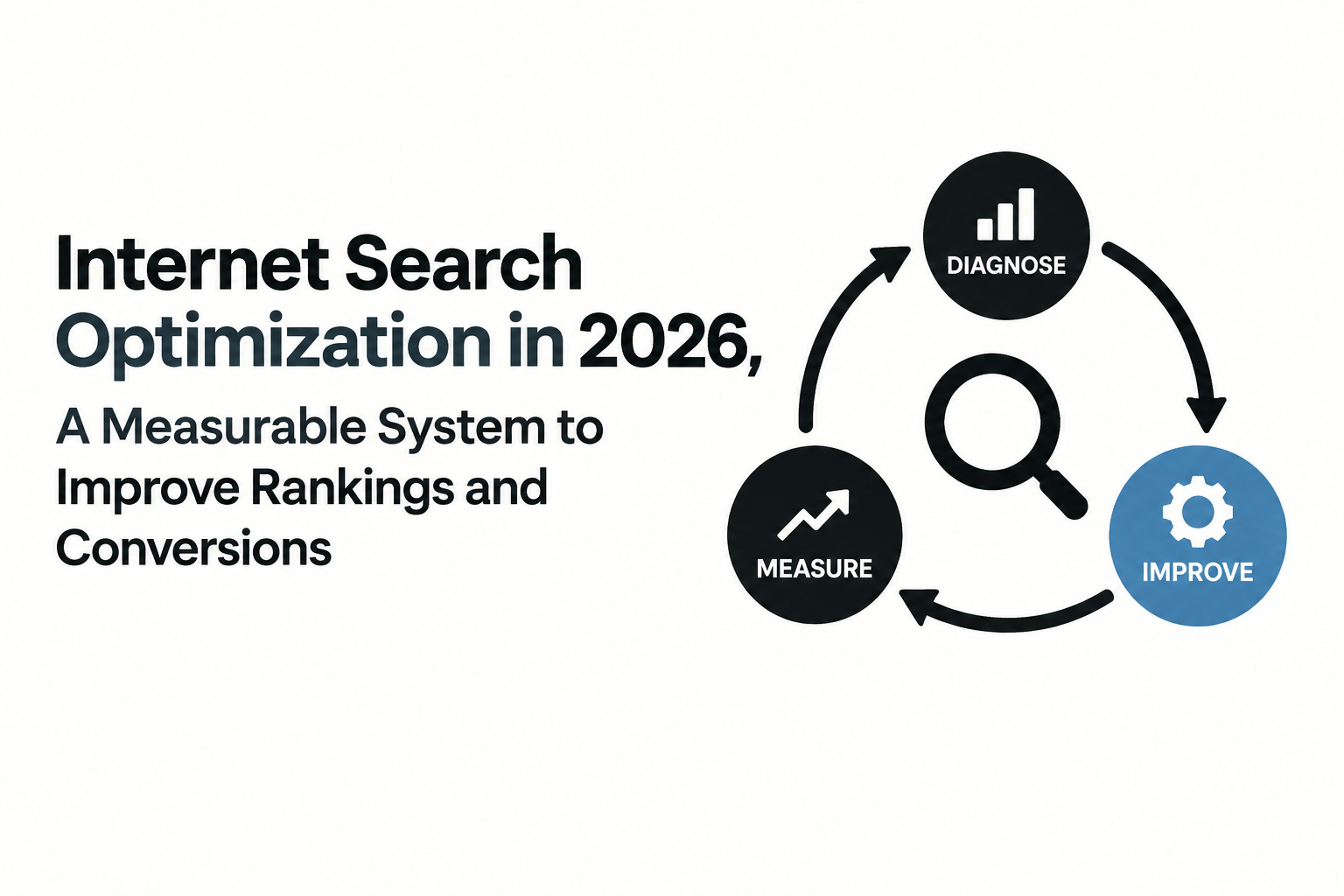
Define Internet Search Optimization as a System, Not a Checklist
Internet search optimization becomes operational when “optimized” means meeting explicit inputs and passing defined checks, not “we did some SEO.” In practice, I treat optimization as a system with (1) inputs you control, (2) constraints you diagnose, and (3) outcomes you measure weekly.
What “optimized” means in operational terms
For a given page or template, you can usually define “optimized” with pass-fail criteria across four layers:
- Accessibility: Googlebot can crawl the URL, render it, and discover it via internal links.
- Index eligibility: the canonical, robots, and duplication signals align so the page is index-worthy.
- Intent match: the page answers the query better than the current top results.
- Outcome: the snippet earns clicks and the page converts the right users.
If any layer fails, doing more content or more links often just amplifies the wrong thing.
Inputs, constraints, outcomes (the three-column reframing)
Use this structure to stop “random acts of SEO”:
- Inputs: technical hygiene (status codes, canonicals, sitemaps), information architecture, on-page content, internal links, external mentions, structured data, and snippet strategy.
- Constraints: crawl budget issues, canonicalization conflicts, rendering problems, query intent mismatch, thin or duplicated content, weak authority signals, or low CTR due to SERP features.
- Outcomes: impressions, clicks, CTR, qualified sessions, assisted conversions, and lead quality.
Two common failure patterns (and the “system” fix)
- Pattern 1: Shipping tasks without a constraint. Fix: require every ticket to state the measurable failure signal (example: “Valid but not indexed” rising for a directory, or CTR lagging peers).
- Pattern 2: Measuring only rankings. Fix: pair ranking checks with GSC query groups, CTR deltas, and conversion rates so optimization decisions are grounded in outcomes.
The 6-Part Optimization Loop That Drives Rankings and Demand
Internet search optimization works best as a closed loop where each cycle starts with diagnostics and ends with measurable movement in crawl/index signals, visibility, and conversions. The loop below is what I use to keep teams from bouncing between technical fixes, content, and links without a decision rule.
Step 1: Crawlability (can Google fetch and render?)
- Checks: robots.txt rules, response codes (200/3xx/4xx/5xx), blocked resources, JS rendering dependencies, pagination traps, faceted URLs.
- Diagnostics: GSC URL Inspection (crawl allowed, page fetch), server logs (Googlebot hits), and site crawl tools.
- Decision rule: if key templates show frequent 5xx/blocked resources, fix infra before content work.
Step 2: Indexing (should Google index the right version?)
- Checks: canonical tags, noindex usage, duplicate clusters, parameter handling, sitemap inclusion, internal link consistency to canonicals.
- Diagnostics: GSC Indexing reports, URL Inspection (canonical chosen by Google), and “site:” spot checks for duplicates.
- Decision rule: if “Duplicate, Google chose different canonical” grows on money pages, resolve canonical conflicts before link building.
Step 3: Relevance (does the page match the query intent?)
- Checks: primary intent type (definition, comparison, how-to, local service), entity coverage, topical depth relative to the top 5 results, internal anchor alignment.
- Diagnostics: SERP review for the query cluster, GSC query grouping, and content-to-SERP gap notes.
- Decision rule: if impressions exist but rankings stall at positions 8 to 20, relevance and structure are usually the constraint.
Step 4: Quality (is the content demonstrably useful?)
- Checks: clear “answer-first” sections, scannable headings, original examples, accurate claims, up-to-date specifics, and helpful supplementary content (FAQs, calculators, checklists).
- Diagnostics: on-page engagement patterns (time on page, scroll proxies), SERP “people also ask” overlap, and content audits for thin pages.
- Decision rule: if you rank but bounce and do not convert, improve task completion and clarity before chasing more keywords.
Step 5: Authority (do signals justify top-of-page placement?)
- Checks: internal link depth, topical hubs, earned mentions, brand queries, and link quality (relevance over volume).
- Diagnostics: backlink tools for referring domains and anchor patterns, plus internal link reports.
- Decision rule: if content is clearly best-in-class but caps at positions 4 to 10, authority is often the limiter.
Step 6: SERP performance (do you earn the click and the conversion?)
- Checks: title and snippet alignment to intent, rich result eligibility, page speed and UX blockers, conversion path friction.
- Diagnostics: GSC CTR by query and page, SERP feature presence (AI answers, snippets, videos), and conversion analytics.
- Decision rule: if you rank top 3 but CTR is below peers, rewrite titles and align above-the-fold to the query outcome.
Diagnose What’s Broken Using a Triage Map and Leading Indicators
Internet search optimization gets predictable when you diagnose the constraint using leading indicators before you commit to weeks of work. The triage map below is designed for weekly use with Google Search Console, basic analytics, and optionally server logs.
A practical triage map (decision tree)
- Are impressions falling across many pages? Check Coverage/Indexing changes, crawl errors, robots, canonicals, and sitewide template changes.
- Are impressions stable but clicks falling? Check CTR shifts, SERP feature changes, title rewrites, and competing pages cannibalizing queries.
- Are specific directories underperforming? Compare template-level signals: index rate, internal link depth, duplicate clusters, and content similarity.
- Are rankings stuck 8 to 20? Run a relevance gap review versus current top results and adjust structure, entities, and intent match.
- Are rankings improving but conversions flat? Audit the conversion path, offer clarity, and “above-the-fold” alignment to the query intent.
Leading indicators to watch (before outcomes move)
- Crawl signals: increased Googlebot hits on important templates, fewer 5xx and blocked resources.
- Indexing signals: higher share of “Indexed” pages for the directory, fewer canonical conflicts.
- Relevance signals: more impressions for the intended query set, fewer irrelevant queries, improved average position for a cluster.
- CTR signals: CTR gains on pages already ranking well (positions 1 to 5) after snippet changes.
How to use GSC patterns to isolate root cause
Three patterns show up repeatedly:
- Low impressions + low indexing usually indicates discovery or index eligibility (internal links, sitemaps, canonical/noindex issues).
- High impressions + low CTR usually indicates snippet mismatch, weak titles, or SERP feature competition.
- Decent CTR + low conversion usually indicates intent mismatch on the page, not an SEO problem.
In my audits, teams often start by rewriting content when the real problem is canonical duplication or internal links pointing to non-canonical URLs. The triage map prevents that by forcing a “which indicator is broken” answer first.
Prioritize Work With an Impact Scorecard Your Team Can Run Weekly
Prioritization makes internet search optimization sustainable because it turns an endless backlog into a weekly set of bets with explicit expected uplift and risk. A lightweight scorecard also makes stakeholder conversations easier: you can explain why a technical fix beats a new blog post this week.
The Impact Scorecard (5 factors, 1 weekly meeting)
Score each candidate item 1 to 5, then compute a weighted total.
- Business value (weight 3): will this affect revenue pages, high-intent queries, or conversion paths?
- Reach (weight 2): how many pages/templates/queries does it affect?
- Confidence (weight 2): do diagnostics clearly show this is the constraint?
- Effort (weight -2): engineering or content hours, coordination overhead.
- Risk (weight -1): chance of breaking indexing, cannibalization, or UX regressions.
Formula: (3V + 2R + 2C) - (2E + 1K). Highest score goes first.
Example scoring (so it is not theoretical)
- Fix canonical conflicts on service pages: V5 R3 C5 E2 K3 → (15+6+10)-(4+3)=24
- Rewrite titles on pages ranking positions 1 to 3 with low CTR: V4 R3 C4 E1 K1 → (12+6+8)-(2+1)=23
- Publish 5 new informational articles: V2 R2 C2 E4 K2 → (6+4+4)-(8+2)=4
The point is not the exact weights. The point is that work competes on the same scoreboard, and every item has to explain its “why now.”
Weekly operating rule to prevent churn
Cap active initiatives: one technical, one content/template, one SERP performance experiment. If you run more than three, measurement noise makes it hard to attribute outcomes, and internet search optimization turns into motion without learning.
Measure Internet Search Optimization With KPIs That Don’t Lie
KPIs for internet search optimization should connect leading technical signals to lagging business outcomes so you can tell whether you are improving discovery, rankings, and revenue, or just producing activity. The KPI set below is designed to be reviewed weekly and monthly without heavy data engineering.
Leading KPIs (weekly)
- Index rate by directory: indexed URLs divided by submitted or discovered URLs for the template you are scaling.
- Canonical alignment rate: share of inspected URLs where Google-selected canonical matches your intended canonical.
- Crawl error rate: count and trend of 5xx, soft 404, blocked resources impacting key templates.
- Query coverage for target clusters: impressions for the intended query set, not total impressions.
Outcome KPIs (monthly)
- Non-brand clicks and qualified sessions: tie GSC clicks to analytics landing pages and segment by intent.
- CTR by position bucket: compare CTR for positions 1 to 3 versus 4 to 10 to spot snippet opportunities.
- Conversions from organic landing pages: leads, trials, purchases, plus assisted conversions where relevant.
- Share of voice proxy: track impressions or visibility for a stable query set over time. If you need a deeper method, see search visibility.
A KPI wiring diagram (what each KPI tells you to do)
- Index rate down → review sitemaps, internal links, canonicals, duplication, and thin content.
- CTR down but position stable → rewrite titles/snippets, add structured data if appropriate, improve above-the-fold match.
- Clicks up but conversions flat → refine intent match, strengthen offer clarity, reduce friction in forms and flows.
I have found it useful to put these into one weekly dashboard so every change request maps to a KPI movement. If a task cannot point to a KPI it should move, it is usually not an optimization task yet.
Implement in 30 Days With a Lightweight Operating Rhythm
A 30-day internet search optimization rollout succeeds when roles, cadence, and deliverables are defined upfront so the team ships fixes and learns from the results each week. The plan below assumes you already have analytics and GSC access.
Week 1: Baseline, triage, and backlog hygiene
- Deliverables: KPI baseline, directory-level index rate snapshot, top query clusters, and a prioritized backlog draft.
- Workflow: run URL Inspection on representative pages per template, review indexing report trends, and collect 20 to 50 top queries per cluster.
- Meeting: 45 minutes, agree on the single biggest constraint and define success criteria.
Week 2: Fix the constraint with the highest confidence
- Typical work: canonical cleanup, internal link corrections to canonicals, sitemap refinement, or resolving crawl blockers.
- Definition of done: GSC inspection shows intended canonical, crawling allowed, and no blocking directives for target templates.
Week 3: Relevance and on-page execution for the pages that already have demand
- Target selection: pages with impressions but average position 6 to 20, or pages ranking top 5 with weak CTR.
- Implementation: restructure content to answer intent early, add missing entities, tighten internal anchors, and apply on page SEO checks (headings, internal links, clarity, and scannability).
Week 4: SERP performance experiments and reporting cadence
- Experiments: title rewrites on a small set (10 to 20 URLs), snippet alignment, structured data eligibility checks.
- Reporting: one-page summary of leading indicators and outcomes, plus next month’s top three bets.
Common failure modes (and how to avoid them)
- Shipping too many changes at once: cap initiatives so you can learn what moved the needle.
- Mixing intent types on one page: choose one primary job to be done per URL, then support it with secondary sections.
- No owner for measurement: assign one person to publish the weekly KPI snapshot every week, even when results are flat.
Where an execution partner fits (one practical mention)
If you want to operationalize the loop but your team is bandwidth-constrained, a structured search engine optimization service can provide the technical audit, content planning, on-page execution, and reporting cadence needed to keep the system running.
| Loop part | Primary diagnostic | Leading KPI | Typical fix |
|---|---|---|---|
| Crawlability | URL Inspection, logs | Crawl errors trend | Robots, rendering, server stability |
| Indexing | Indexing report, canonicals | Index rate by directory | Canonical cleanup, duplication control |
| Relevance | SERP review, query groups | Impressions for target queries | Intent match, entity coverage, structure |
| Quality | Content audit, engagement | Engaged sessions proxy | Answer-first sections, examples, UX clarity |
| Authority | Backlink + internal link analysis | Internal link depth, referring domains | Hub building, PR/mentions, internal links |
| SERP performance | GSC CTR by query/page | CTR by position bucket | Title/snippet tests, rich result eligibility |
FAQ
If you want help applying this internet search optimization loop to your site, Freeways Agency can run an optimization triage and deliver a 30-day roadmap with prioritized fixes, sprint-ready tasks, and KPI reporting so your team can execute with clear weekly decision rules. For deeper context on how we think about SEO marketing, you can review that system as well.

Written by Joyce Ng.

Is Your Website an Open Book or a Black Box to AI?
Learn optimization artificial intelligence with a clear taxonomy, a weight-update example, a method selection matrix, and a measurable project workflow.
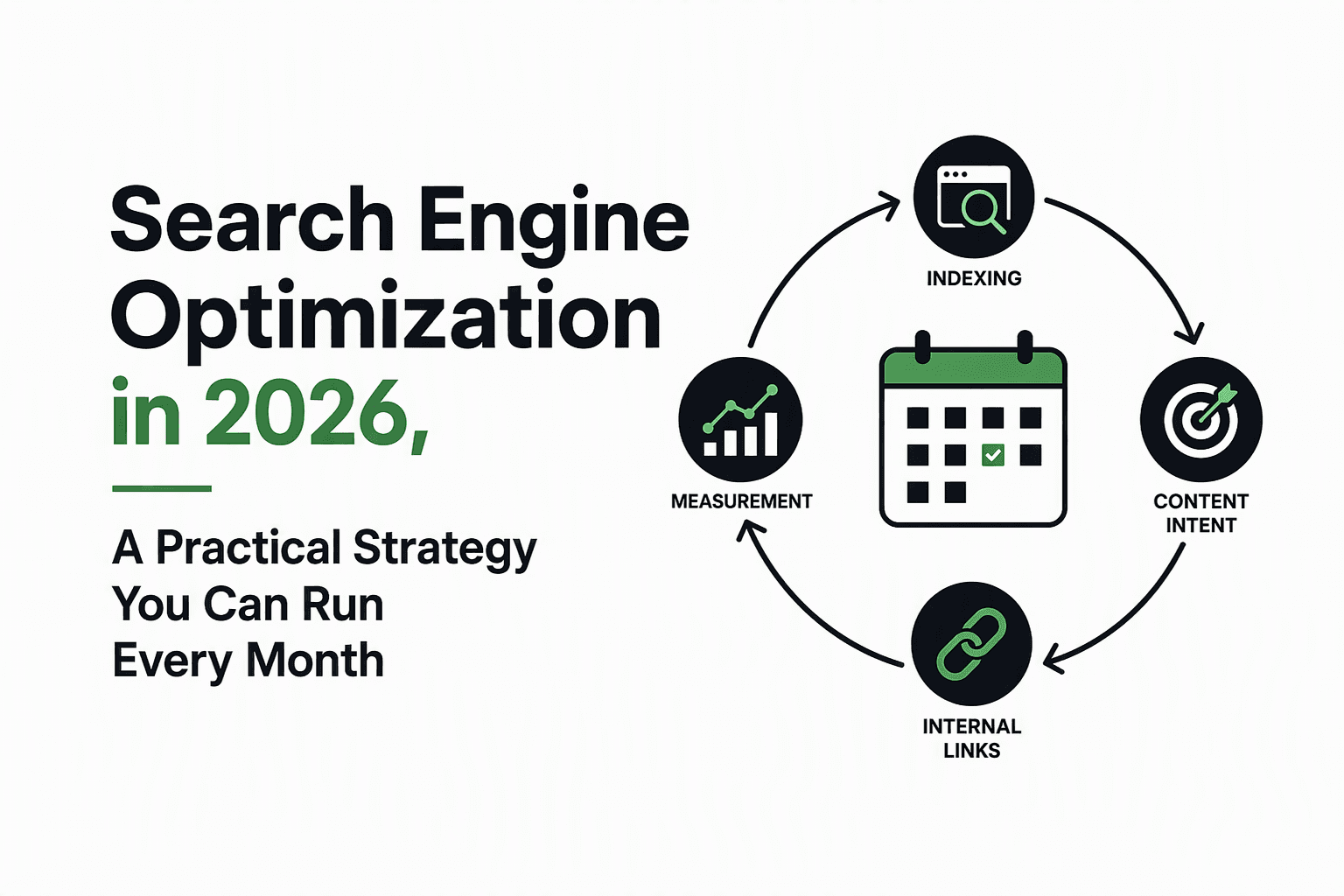
Search Engine Optimization in 2026, A Practical Strategy You Can Run Every Month
Run search engine optimization as a monthly system in 2026: fix indexability, build intent pages, strengthen links, and measure ROI in GSC.

AI For SEO Explained How To Use AI To Improve Search Visibility In 2026
Learn how ai for seo improves research, content, technical workflows, and AI discovery with a practical framework for better search visibility.