
SEO For Company Website, A 90-Day Plan With Page Templates You Can Copy

SEO for company website execution works best when it starts with information architecture that matches how buyers decide, then runs a 30/60/90-day operating system you can measure in Google Search Console and GA4.
- Build a company-site structure around “money pages” (service, location, industry, proof) and use internal links to move intent, not just PageRank.
- Run SEO as an SOP: audit, prioritize with impact-effort scoring, implement in sprints, and review the same 6 reports weekly.
- Copy page-type templates (URL, title, H1, sections, internal links) so your team publishes consistent pages that rank and convert.
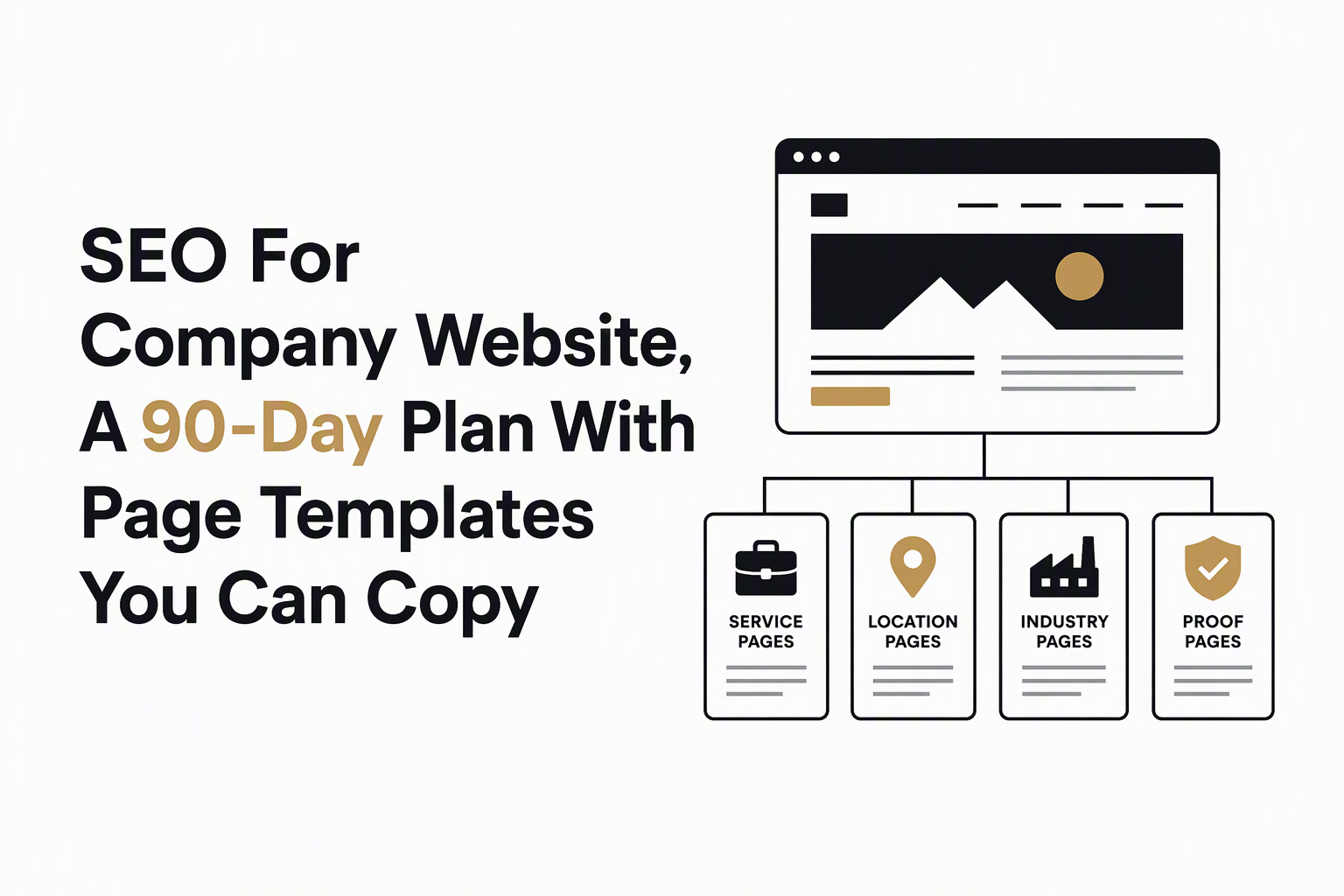
The company website SEO blueprint that actually converts
SEO for company website conversions improves fastest when your site’s page types mirror real buying paths: what you do, who you do it for, where you do it, and proof that you can deliver.
Decision-first information architecture (IA) for a company website
- Service pages (core offers): 1 page per distinct service with a clear scope boundary.
- Location pages (where you sell): only where you have real operations or sales coverage.
- Industry pages (who you serve): only for segments where your process, compliance, or outcomes differ.
- Proof pages: case studies, reviews/testimonials (if allowed), certifications, partner pages.
- Support pages: pricing approach, process, about, contact, comparison pages if relevant.
In practice, I treat the homepage like a routing layer, not a keyword target. The ranking and lead volume usually come from a small set of high-intent pages that are easy to crawl and internally linked from navigation, footer, and relevant body sections.
A simple “money-page” mapping rule that prevents thin content
Use this rule to decide whether a new page deserves to exist: a page must have (1) a distinct intent, (2) a distinct offer or constraint, and (3) a distinct proof set. If you cannot change at least two of those three, merge the content into an existing page and strengthen it instead.
Recommended URL structure (copy/paste patterns)
- /services/{service}/ (example: /services/technical-seo/)
- /locations/{city}/ (example: /locations/san-diego/)
- /industries/{industry}/ (example: /industries/saas/)
- /case-studies/{client-or-project}/
- /resources/ for supporting content, not for replacing money pages
Internal linking that matches the sales motion
For seo for company website performance, internal links should answer “what should a qualified buyer do next?” Build these links into your page sections, not only in headers and footers:
- Service → proof: each service page links to 2 to 4 case studies or proof pages that match the service.
- Service → industry/location: link only to the most relevant 3 to 6 (not all of them).
- Industry → services: link to the primary service and 1 to 2 supporting services.
- Location → services: link to the services you actually sell in that location.
Your 30-60-90 day SEO SOP, from audit to measurable lift
SEO for company website results become predictable when you define “done” for each sprint, prioritize by impact and effort, and ship changes weekly instead of planning endlessly.
Days 1-30: baseline, audit, and a prioritized backlog
Deliverables by day 30: (1) tracking setup verified, (2) crawl and indexation audit, (3) keyword-to-page map for money pages, (4) prioritized roadmap with owners.
- Tracking verification: GA4 installed, key events defined (form submit, call click, demo booking), Google Search Console (GSC) verified for domain, sitemap submitted.
- Indexation reality check: export indexed pages from GSC, compare to your actual page inventory; flag pages that should not be indexed (tag pages, internal search, duplicates).
- Crawl hygiene: confirm robots.txt, canonicals, redirect chains, 404s, and non-200 status codes.
- Information architecture gap list: missing services, missing industries, missing locations, missing proof.
- Keyword-to-page mapping: map one primary intent per page; avoid two pages targeting the same buyer intent.
If you need a beginner-friendly workflow for getting pages discovered and indexed, reference SEO website step by step and then return to the prioritization model below.
Impact-effort scoring (the prioritization method)
Use a 1 to 5 score for Impact and Effort, then sort by Impact ÷ Effort. Define Impact using business proxies you can observe without making up revenue numbers:
- Impact signals: page is a core service, page ranks on page 2-3 for relevant queries, page already gets impressions but low CTR, page has a conversion path.
- Effort signals: number of templates affected, engineering dependency, content production time, approval complexity.
Days 31-60: implement the high-leverage fixes and publish money pages
Definition of done by day 60: technical blockers resolved, navigation and internal linking updated, and at least 4 to 10 money pages improved or created based on your map.
- Technical fixes first: address indexation/canonical conflicts, broken internal links, redirect loops, and slow templates.
- On-page system: apply one repeatable checklist to every money page (see templates below). For deeper guidance, see on-page SEO.
- Build proof loops: publish or refresh case studies, add evidence sections, and link them from service pages.
- Conversion alignment: each money page has one primary CTA above the fold and one mid-page CTA after proof.
I have found that teams often over-invest in publishing supporting blog posts while the service pages remain vague. When we reverse that order and make the service pages specific, the site becomes easier to understand for both buyers and crawlers.
Days 61-90: expand coverage, measure lift, and lock the weekly operating rhythm
Definition of done by day 90: weekly reporting cadence running, content system in place, and an iteration backlog driven by query data and conversions.
- Query-to-section iteration: use GSC queries to add missing sections and FAQs directly onto money pages.
- Internal link expansion: add contextual links from resources and case studies into the exact service/location/industry pages they support.
- Snippet readiness: add concise definitions, lists, and “how it works” steps that can be extracted into AI answers and featured snippets.
- Prune or noindex: remove low-value indexed pages that dilute quality signals.
Copyable page models for service, location, industry, and case study pages
SEO for company website growth accelerates when your team uses standardized page models that include a unique angle, proof, and internal links instead of rewriting from scratch every time.
Template 1: Service page (primary revenue page)
- URL: /services/{service}/
- Title tag: {Service} for {Ideal Customer} | {Brand}
- H1: {Service} that drives {Outcome} for {Ideal Customer}
- Meta description: What’s included, timeline, and what success looks like for {Service}. See process, proof, and next steps.
Section outline:
- Above the fold: who it’s for, the core promise, primary CTA
- Problem and consequences (specific to buyer)
- What’s included (bullets, scope boundaries)
- Process (steps, expectations)
- Proof: 2 to 4 case studies, certifications, methodology notes
- FAQ: pricing model, timelines, what you need from the client
- Secondary CTA: book a call, request audit
Internal links to include: 2-4 relevant case studies, 1 industry page, 1-2 related services, contact/pricing.
Template 2: Location page (only where you actually sell/serve)
- URL: /locations/{city}/
- Title tag: {Service Category} in {City} | {Brand}
- H1: {Service Category} for {City} companies
- Meta description: Local coverage, how you work with {City} teams, and which services are most common.
Section outline:
- Coverage statement (remote/on-site, hours, response times if real)
- Top services in this location (links to service pages)
- Industry mix (links to 1-3 relevant industry pages)
- Proof from similar markets (case studies, testimonials if allowed)
- Local FAQ (contracts, meeting cadence, timelines)
Quality control: location pages must not be swapped-city duplicates. Add real details: regional constraints, examples of typical projects, or location-specific compliance where applicable.
Template 3: Industry page (segment-specific positioning)
- URL: /industries/{industry}/
- Title tag: {Service Category} for {Industry} | {Brand}
- H1: {Service Category} for {Industry} teams
Section outline:
- Industry context: what success looks like and the constraints
- Common challenges (3-5) and how you address them
- Recommended service package (links to services)
- Proof: case studies from the industry or adjacent
- FAQ: stakeholders, approvals, compliance, timelines
Template 4: Case study page (proof that supports rankings and sales)
- URL: /case-studies/{project}/
- Title tag: {Outcome} with {Service} for a {Industry} company | {Brand}
- H1: How we achieved {Outcome} for a {Industry} team
Section outline:
- Snapshot: client type, goal, constraints, timeline
- What we did (steps, not fluff)
- Evidence: what changed (screenshots encouraged)
- What we’d do next (iteration plan)
- Links back to: the primary service page + relevant industry/location pages
When I review company sites that “have case studies,” the missing piece is almost always internal linking back to the exact service page the case study proves. Fixing that simple connection often improves both conversion rate and topical clarity.
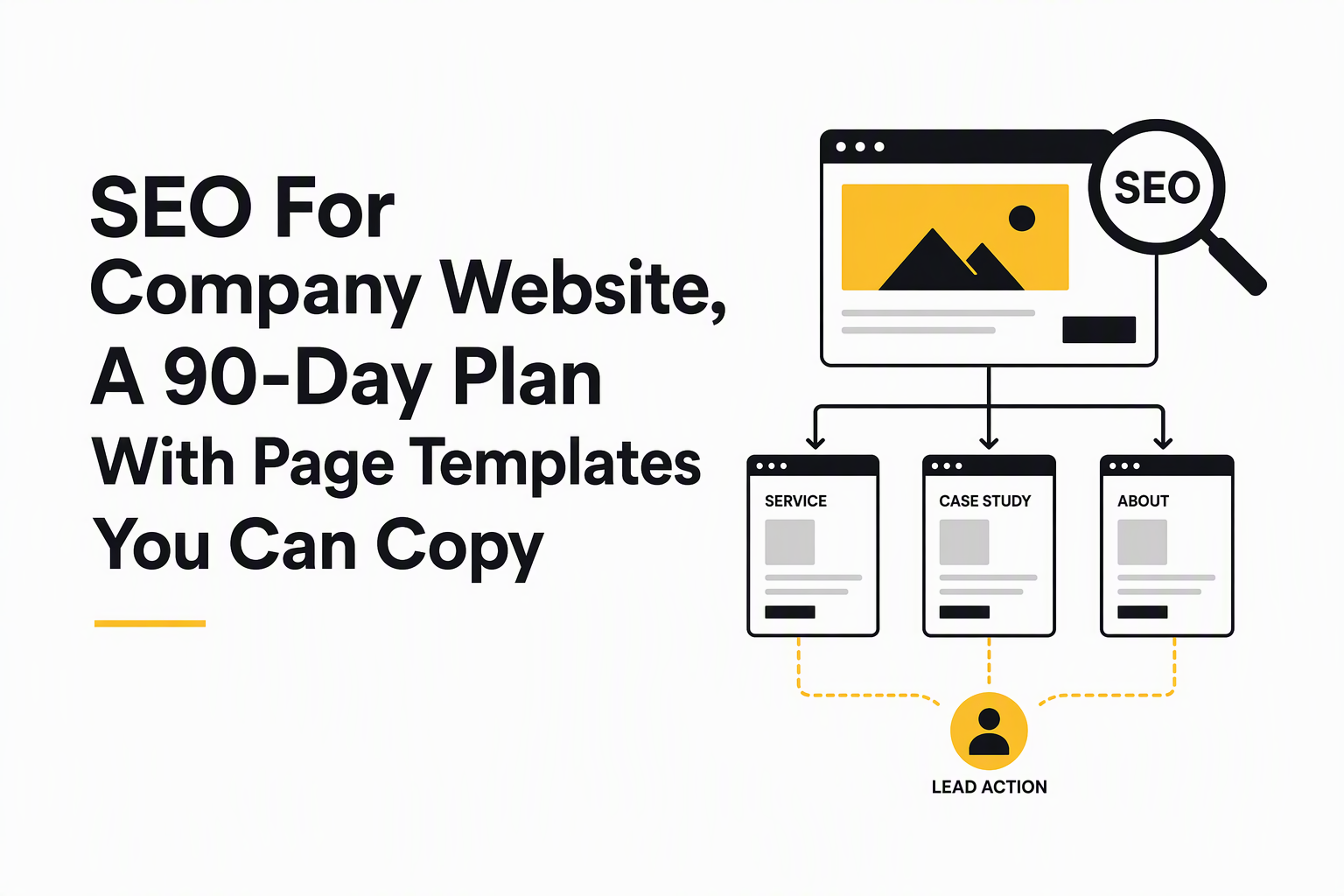
Free tool stack setup and exact reports to use weekly
SEO for company website operations can run on mostly free tools if you standardize the same weekly reports and tie each report to an action.
Google Search Console (GSC): the 4 reports you should actually use
- Performance: filter to Search results, then review Queries and Pages. Action: find pages with high impressions and low CTR, adjust titles and above-the-fold copy.
- Indexing: Pages report. Action: identify “Crawled, currently not indexed” and “Duplicate, Google chose different canonical” and resolve root causes (thin content, duplication, canonical conflicts).
- Sitemaps: confirm last read and discovered URLs. Action: fix sitemap generation issues and ensure money pages are included.
- Links: Top linked pages. Action: ensure top linked pages include internal links to money pages, so authority flows to revenue targets.
To measure visibility in a way that non-SEOs can understand, use search visibility in Google Search Console as your shared definition and baseline.
GA4: the 2 dashboards that keep SEO honest
- Landing page report (organic segment): Action: identify which money pages drive engaged sessions and conversions.
- Key events by page path: Action: confirm that pages gaining impressions also contribute to leads, not just traffic.
PageSpeed Insights or Lighthouse: focus on template-level fixes
Use PageSpeed Insights to test your key templates (homepage, service page, case study). Action: prioritize fixes that apply across templates (image sizing, render-blocking scripts, font loading), because one template fix can improve dozens of URLs.
Bing Webmaster Tools (optional but useful)
Bing often surfaces indexing issues differently than Google. Action: submit sitemaps, check crawl errors, and compare query themes for additional intent clues.
AI-assisted auditing with ChatGPT, prompts, guardrails, and verification
SEO for company website audits become faster with AI when you treat outputs as hypotheses and verify every recommended change against GSC URL Inspection and real SERPs.
What to export (15 minutes)
- From GSC Performance: last 3 months, export Pages and Queries for web search.
- From your crawl (any crawler you already use): URL list with status code, title, H1, canonical, word count.
- From GA4: organic landing pages with conversions (or key events).
Prompt pack (copy and use internally)
Prompt 1: Find quick CTR wins
“You are an SEO analyst. Using this GSC export of pages, clicks, impressions, CTR, and position, identify pages with high impressions and CTR below average for their position. Output a table: URL, query theme, current title hypothesis, improved title options (3), and the above-the-fold copy change to match intent. Avoid keyword stuffing.”
Prompt 2: Detect cannibalization candidates
“Using this list of queries and pages, identify queries that map to multiple URLs. Recommend which URL should be primary and what to change on secondary pages (merge, redirect, re-angle, or deoptimize). Output with rationale tied to intent.”
Prompt 3: Build a section outline for a service page
“Create an H2/H3 outline for /services/{service}/ aimed at {ideal customer}. Include: what’s included, process, proof, FAQs, and internal links to /case-studies/ and /industries/. Keep it specific, no generic claims.”
Guardrails that prevent AI from creating SEO problems
- No auto-publishing: every title/H1 change gets checked against GSC Performance and the page’s actual conversion goal.
- No invented proof: AI cannot write metrics, logos, or outcomes you cannot substantiate on-page.
- Verify indexing impact: after major edits, use URL Inspection and request indexing only for priority pages, not the entire site.
I rely on AI most for pattern detection across exports, not for final copy. The fastest way to lose trust is publishing “confident” language that your sales team cannot back up on a call.
Is SEO still worth it in 2026, the 80-20 moves, and what to expect
SEO for company website ROI is still compelling in 2026 when you focus on high-intent pages, measure conversions, and compound improvements instead of chasing broad informational traffic.
A practical KPI model (no made-up revenue math)
- Leading indicators (weekly): impressions and clicks to money pages, indexed pages count, crawl errors, CTR on top queries.
- Mid indicators (monthly): non-brand clicks growth, ranking movement for mapped service queries, engagement rate on money pages.
- Business indicators (monthly/quarterly): key events from organic traffic, assisted conversions, sales-qualified lead rate by landing page (if you track it).
The 80-20 moves that usually matter most
- Fix indexation and duplication: if Google cannot confidently index the right URL, nothing else scales.
- Upgrade service pages before publishing more blogs: make scope, process, and proof explicit.
- Internal-link proof to services: case studies should be your strongest support for rankings and conversions.
- Use GSC queries to expand sections: add the missing subsections buyers are searching for, directly on the page that converts.
- Standardize templates: consistency reduces errors and makes improvements repeatable across the site.
What to expect in timelines
- Weeks 1-4: tracking clarity, fewer technical blockers, a clean roadmap, faster iteration.
- Weeks 5-8: CTR improvements and early movement for pages already in striking distance.
- Weeks 9-12: broader query coverage as new money pages get crawled, indexed, and linked internally.
For teams considering outside help, this is also where a defined delivery scope matters. A clear search engine optimization service should specify what gets audited, what gets implemented, and how success is reported.
| Company-website SEO workstream | What “done” looks like | Primary KPI | Common pitfall |
|---|---|---|---|
| Information architecture | Service, location, industry, proof pages exist and are linked from nav and within content | Money pages indexed and receiving impressions | Publishing blogs while core pages stay thin |
| Technical SEO | Canonical consistency, clean sitemaps, minimal crawl errors, fast core templates | Index coverage stability, fewer excluded URLs | Fixing one-off URLs instead of templates |
| On-page upgrades | Each money page matches one intent, has clear scope, proof, and FAQs | CTR and conversions per landing page | Keyword repetition without added substance |
| Internal linking | Proof and supporting pages link into the exact service pages they validate | Clicks growth on service pages | Footer-only links that do not guide decisions |
| Measurement cadence | Weekly GSC/GA4 review with actions logged | Trend consistency, faster iteration cycles | Reporting without decisions or owners |
FAQ
If you want this exact blueprint implemented end to end, Freeways Agency can turn your current site into a decision-first architecture, ship the 30/60/90-day roadmap, and deliver copyable page templates your team can publish from immediately. Book a consultation and we will start with a prioritized SEO roadmap plus a ready-to-use set of service, location, industry, and case study templates.

Written by Joyce Ng.

Stop Treating GPT Ads Like Google Ads. Here’s How to Launch Right
Learn what gpt ads are in 2026, who can run them, what they may cost, and how to launch with a practical budgeting model and checks.
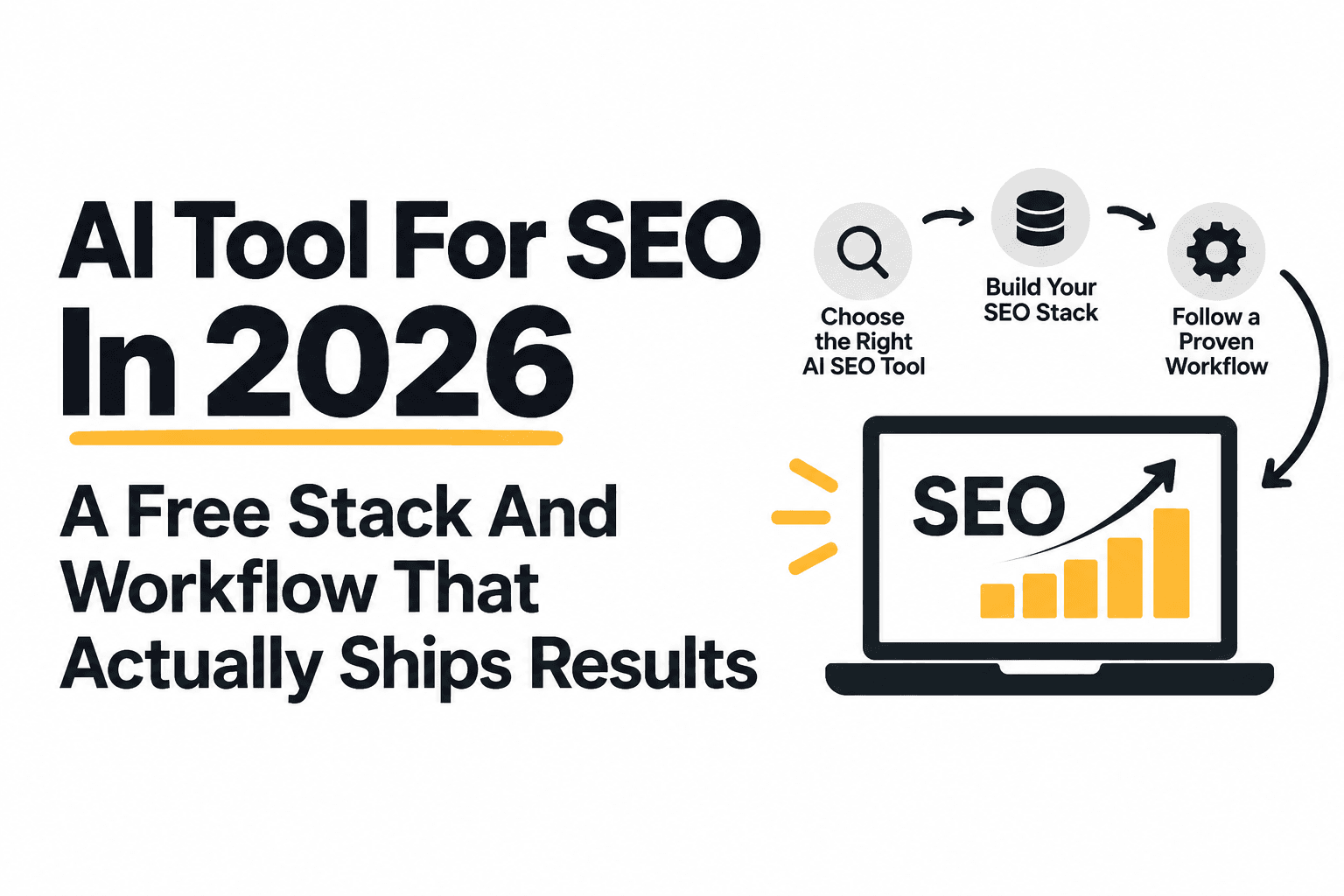
AI Tool For SEO In 2026 A Free Stack And Workflow That Actually Ships Results
Build an ai tool for seo stack you can run this week: free workflow, prompts, model picks, and reporting setup for measurable search growth.
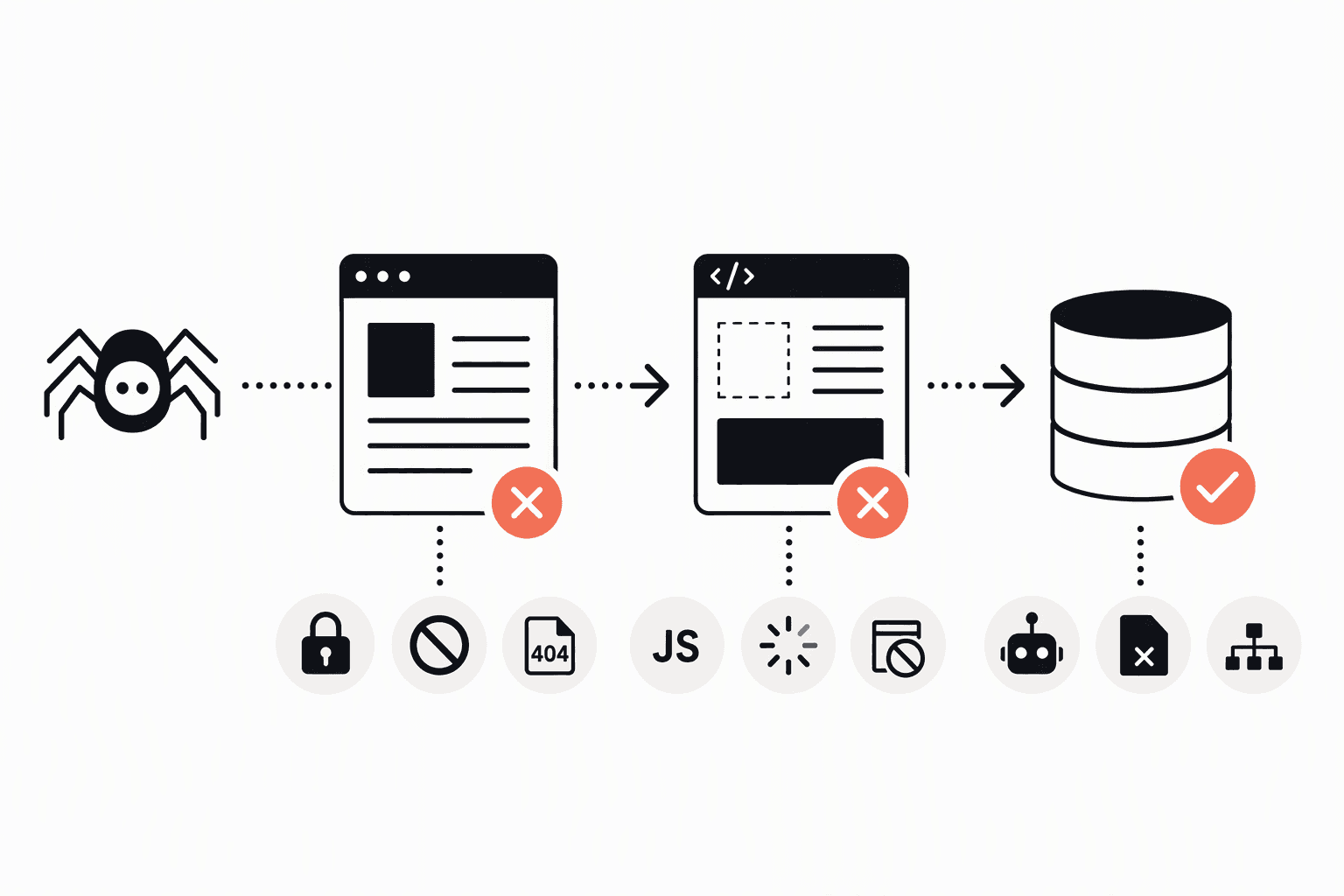
Technical SEO Explained, How It Works, What to Fix First, and Why It Matters
Learn technical seo basics, how crawl-render-index works, what breaks it, and a prioritized checklist to fix issues fast using GSC.