
SEO Using AI in 2026, A Free Workflow and KPI Loop You Can Actually Run

SEO using AI in 2026 works best as a controlled, human-led workflow where AI speeds up research, planning, drafting, and QA while you keep strategy, accuracy, and final edits in your hands.
- Use AI for repeatable SEO tasks (topic mining, briefs, outlines, first drafts, internal link suggestions), not for final truth or strategy.
- Follow the 30% rule: at least 30% of every publishable page must be verifiably human-added value (proof, examples, original structure, screenshots, or first-hand detail).
- Measure AI-assisted output with a simple Google Search Console loop: pages indexed, impressions, CTR, clicks, queries gained, and conversions tied to intent.
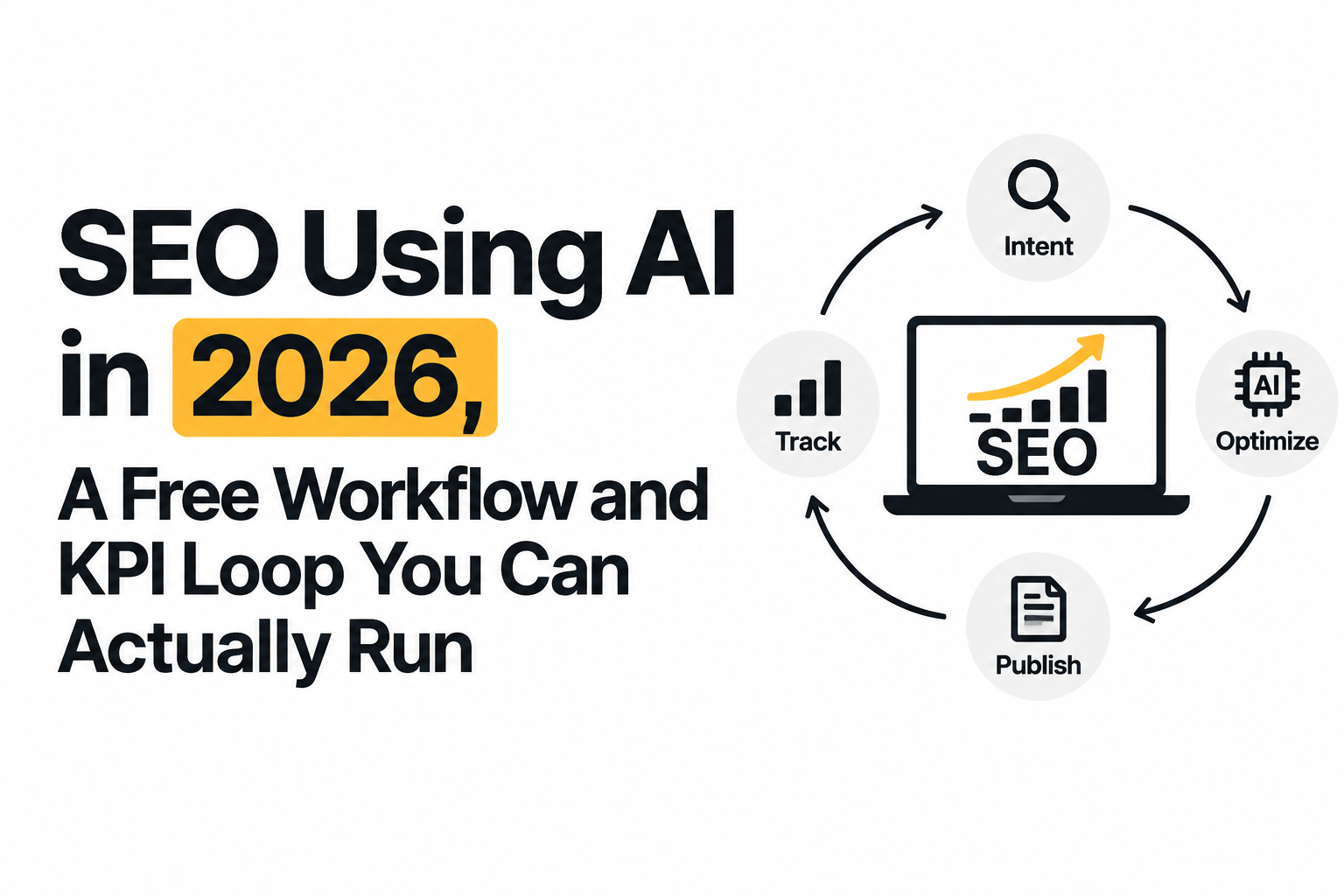
What SEO Using AI Means in 2026, And Where It Actually Helps
SEO using AI in 2026 is the practice of using generative models to accelerate SEO tasks while humans remain accountable for relevance, accuracy, and editorial quality.
AI-assisted SEO vs GEO and AEO, plain-English definitions
- AI-assisted SEO: using AI to help produce SEO work (research, briefs, drafts, QA) faster and more consistently.
- GEO (Generative Engine Optimization): shaping content so it is easy for generative engines (Google AI Overviews, ChatGPT-style answers, Perplexity) to extract and cite accurately. Practically, that means clear, direct passages, structured headings, and verifiable statements.
- AEO (Answer Engine Optimization): optimizing to win “answer-style” placements like featured snippets and “People also ask” by writing concise, direct answers and supporting them with details.
Where AI reliably helps (and where it tends to fail)
AI is strongest at language-heavy, pattern-based work and weakest at truth, novelty, and business-specific judgment.
| SEO task | Use AI for | Keep human-led | Risk if you don’t |
|---|---|---|---|
| Keyword discovery | Expand seed lists, cluster intent, draft topic maps | Pick the targets that match revenue and audience | Chasing irrelevant traffic |
| Content briefing | Outline sections, extract common subtopics | Decide unique angle, add first-hand details, define acceptance criteria | Generic content that does not rank |
| Drafting | First draft, alternative intros, rewrite for clarity | Final narrative, examples, claims, fact checks | Hallucinations and low trust |
| On-page SEO | Title variants, internal link suggestions, FAQ drafts | Final metadata, entity accuracy, UX decisions | Poor CTR or misalignment |
| Measurement | Summarize GSC exports, find query patterns | Decide what to change and why | Vanity metrics, no iteration loop |
In practice, I treat AI like a fast junior assistant: great at producing options, not great at choosing the right option or defending it with evidence.
A Free SEO Using AI Workflow You Can Run This Week
A free workflow for SEO using AI is an end-to-end checklist that starts with one search intent and ends with a published page plus a measurement plan in Google Search Console.
Step 1: Pick one intent, not ten keywords
- Input: one core intent (example: “how to do seo using ai”).
- Output: a one-line promise for the page, plus 5 to 8 sub-questions you will answer.
Free tools: Google autocomplete, People Also Ask, Google Search Console (if you have data), and your notes.
Acceptance criteria (copy/paste):
- The page answers the primary query directly in the first paragraph.
- Every H2 begins with a self-contained answer sentence.
- Every claim that sounds factual is either sourced, demonstrated, or removed.
Step 2: Build a “good enough” SERP model without scraping
A lightweight SERP model is a list of patterns you observe across top results, used to avoid missing obvious subtopics.
- Open the top 5 to 8 ranking pages.
- Write down: repeated subheadings, repeated tools, and what they avoid.
- Decide your differentiator: what you will include that they do not (example: a governance rule like the 30% rule and a KPI loop).
Step 3: Use AI to draft a brief, not the article
The fastest way to get publishable output is to make AI produce a strict content brief with constraints, then draft from that brief.
Prompt (tool-agnostic):
- Role: “You are an SEO content strategist.”
- Goal: “Create a brief for an article that teaches beginners a repeatable system for seo using ai.”
- Constraints: “No unverifiable stats. Include step-by-step checklists and a measurement loop in GSC. Include an SOP quality rule (30% human value).”
- Output format: “H2/H3 outline, key points per section, and a QA checklist.”
If you want deeper prompt workflows, see use ChatGPT for SEO.
Step 4: Draft, then add “human proof” before you edit
Editing a generic AI draft into excellence is slower than inserting your unique material first, then tightening the writing.
- Add 1 to 2 real examples from your product, service, or process (no confidential data).
- Add constraints and definitions that match your audience.
- Add internal links you actually want users to click.
Step 5: Publish with a measurement note attached
A publish checklist prevents “random acts of content” by forcing a KPI hypothesis.
- Primary intent: ______
- Secondary intents (3 to 5): ______
- Expected queries you want to earn: ______
- What would you change if impressions rise but CTR stays low: ______
- What would you change if CTR rises but clicks stay low (low impressions): ______
The 30% Rule for AI, A Practical Quality and Risk SOP for SEO Content
The 30% rule is a governance heuristic that says at least 30% of a page must be unmistakably human-added value that AI could not have produced without your specific context.
What counts as the “30%” in real pages
- Original structure: a framework, table, decision matrix, or checklist tailored to the query.
- Verifiable specificity: screenshots you took, step sequences you actually run, or concrete acceptance criteria.
- First-hand nuance: what you do when the ideal workflow breaks (edge cases).
- Editorial judgment: what to exclude, not just what to include.
What does not count: fluffy intros, paraphrased definitions, or tool lists that any competitor could copy in five minutes.
Why the 30% rule reduces SEO risk
- Quality risk: generic content struggles to earn links, mentions, and long-tail rankings.
- Accuracy risk: AI can invent steps, settings, or “facts.” The 30% requirement forces you to verify before publishing.
- Brand risk: your site becomes indistinguishable if every page reads like an AI average.
I have found the 30% rule easier to enforce than abstract “be better” guidance because an editor can actually check for it in a pass or two.
A copy-paste QA checklist (SOP) for AI-assisted pages
- Relevance: Does the first paragraph answer the query in one sentence?
- Originality: Can you point to at least 3 elements that are uniquely yours (framework, example, screenshot, dataset, decision criteria)?
- Fact safety: Are all factual claims either (a) sourced, (b) demonstrated, or (c) removed?
- Internal consistency: Do steps, definitions, and recommendations match across the page?
- Intent match: Does each H2 answer a sub-question a beginner actually has?
- UX: Are checklists scannable, and is the page navigable with headings?
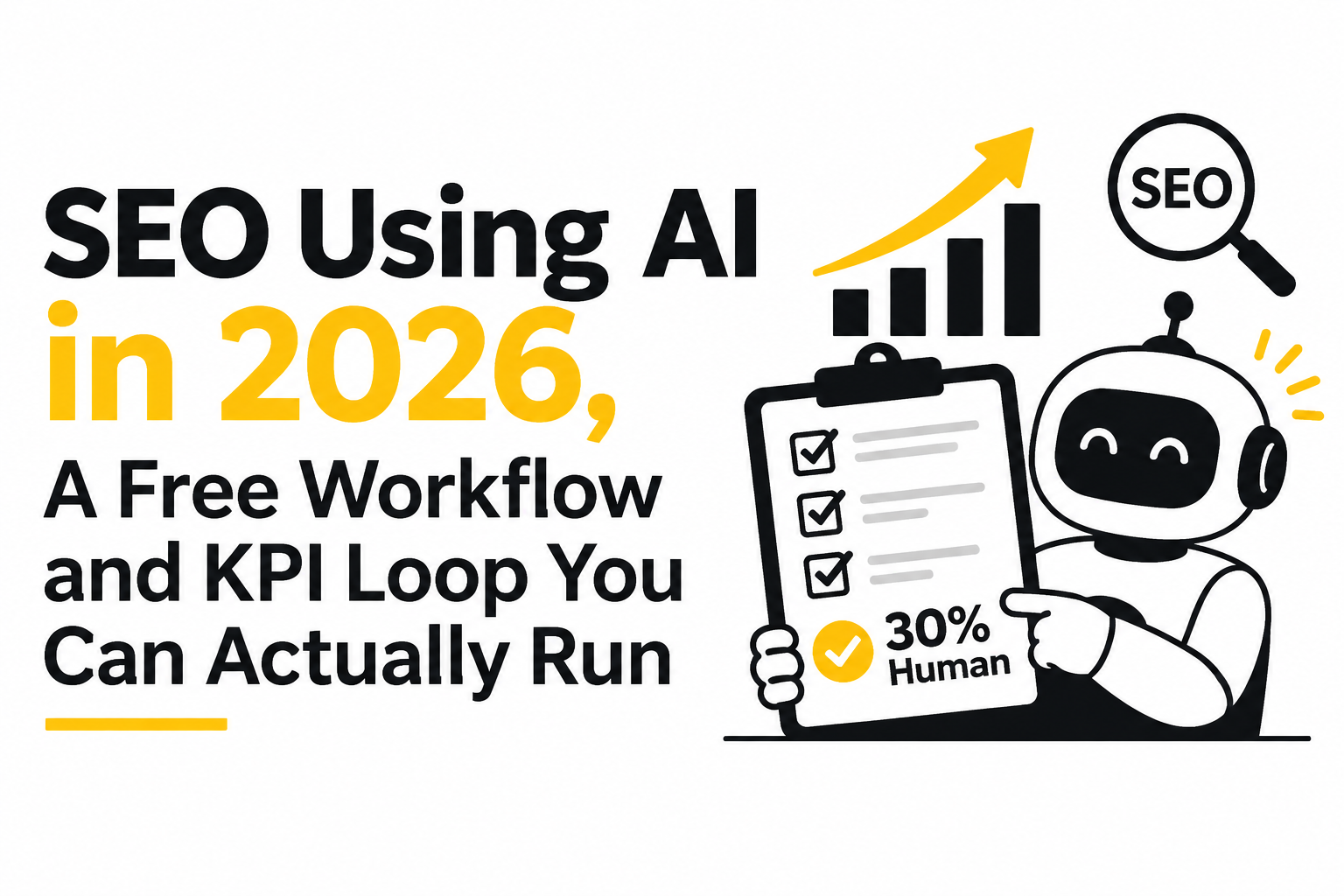
Prompts and Templates That Don’t Produce Bland SEO Content
Non-bland AI SEO content comes from forcing the model to work inside your constraints, your examples, and your acceptance criteria, not from asking it to “write a great article.”
Prompt pack (copy-paste) for seo using ai work
1) Topic expansion with intent labels
- Prompt: “Given the seed topic: [TOPIC], produce 25 subtopics grouped by intent: beginner definitions, step-by-step workflows, tools, mistakes, measurement, and decision criteria. Output as a table with: subtopic, intent label, why it matters, what a good answer must include.”
2) Brief generator with “30% rule” enforcement
- Prompt: “Create a content brief for: [QUERY]. Include: one-sentence promise, H2/H3 outline, ‘must include’ checklist, ‘must avoid’ list, and a section called ‘Human 30% additions’ with at least 6 concrete items (examples, process notes, screenshots, edge cases). No stats unless sourced.”
3) Drafting with evidence gates
- Prompt: “Draft section [H2 NAME] only. For every claim that sounds factual, add a bracketed tag: [NEEDS SOURCE] or [DEMONSTRATE]. Keep paragraphs under 4 lines. Include one checklist.”
4) Rewrite for clarity without changing meaning
- Prompt: “Rewrite the text below for clarity and scannability. Do not add new facts. Preserve meaning. Add bullet points where appropriate.”
Content brief template (fill-in) that ships
- Page goal: what the reader can do after reading
- Primary query:
- Audience starting point: what they already know, what they do not
- Unique angle: why your page is different
- Proof plan: what you will show (screenshots, steps, examples)
- Internal links to include: 3 to 5 relevant pages
- Success metric: what changes in GSC would indicate progress
Fact-checking steps that prevent “confident nonsense”
- Highlight claims: mark every sentence that implies a fact (numbers, policies, “Google prefers…”, “AI overviews do…”).
- Verify or remove: if you cannot verify quickly with a reliable source or direct observation, remove or soften it into a mechanism-based statement.
- Cross-check terms: make sure your definitions match how the industry uses them.
- Final human pass: read aloud and cut anything that sounds like it was written to “sound SEO.”
For a broader framework view, AI for SEO is a useful companion piece.
How to Measure AI-Assisted SEO, KPIs and a Simple GSC Loop
Measuring AI-assisted SEO is about proving that faster production still leads to better search outcomes, using a repeatable Google Search Console review cycle.
The KPI stack (what to track first vs later)
- Indexing and coverage (first): page is indexed, no technical blockers.
- Visibility (next): impressions by query and page.
- Engagement from SERP: CTR, average position (directional), query-page match.
- Traffic outcome: clicks from relevant queries.
- Business outcome: conversions tied to the page intent (newsletter, lead form, trial, purchase), tracked in analytics.
A simple weekly loop you can sustain
- Export GSC Performance data for the last 7 and 28 days (Pages and Queries).
- Tag each page: “new (0 to 30 days)”, “growing”, “stagnant”, “declining”.
- Diagnose using 3 patterns:
- High impressions, low CTR: rewrite title/H1 intro, align to intent, add clearer benefits.
- Good CTR, low impressions: add sections that cover missing subtopics, strengthen internal links, add supporting pages.
- Clicks but poor conversions: improve on-page CTA placement, match offer to intent, add trust elements.
- Ship 1 to 3 changes per week, not 20. Log what you changed.
- Re-check after 2 to 4 weeks because SEO feedback is delayed.
When I use AI here, I do not let it “interpret rankings.” I paste in the export and ask it to summarize patterns and anomalies, then I decide the next edits.
How to attribute “AI helped” without pretending it is a lab test
- Track throughput: briefs shipped per week, pages published per month.
- Track quality gates: percentage of pages passing the 30% checklist on first review.
- Track outcomes: pages that earn new queries, clicks, and conversions after updates.
If you want a deeper tooling view, see AI tool for SEO or AI driven SEO.
Reddit-Powered Topic Mining With AI Without Spamming or Hallucinating
Reddit-powered topic mining works when you extract real questions and language from threads, then validate them with search data before you write.
Ethical extraction workflow (no spam, no “Reddit farming”)
- Find 3 to 5 relevant subreddits for your niche.
- Search within Reddit for your seed topic plus “how”, “best”, “vs”, “tool”, “workflow”.
- Collect 20 to 40 question-style snippets (titles and top comments).
- Do not post for promotion. This is research, not distribution.
Use AI to cluster language, not to invent conclusions
Prompt:
- “Cluster the following questions into 6 to 10 themes. For each theme, output: the common frustration, the exact phrases people use, and what a satisfying answer must include. Do not add new topics beyond the text provided.”
Validate with Google before you commit
- Check Google autocomplete and People Also Ask for the same phrasing.
- If you have GSC data, look for existing impressions for related queries.
- Only then write the outline and brief.
Safe usage rules (quick guardrails)
- No quoting users as evidence unless you have permission and context.
- No medical, legal, financial advice generation from Reddit anecdotes.
- No fabricated “community consensus”: keep it as “questions we observed,” then answer with your verified process.
This approach improves seo using ai outputs because it gives you real user language that generic keyword tools often miss.
Is SEO Still Worth It With AI, A Decision Matrix for 2026
SEO is still worth it in 2026 when search traffic can realistically reach a page that converts, and when your business can publish content with defensible value beyond generic summaries.
A simple decision matrix (score yourself honestly)
| Criterion | Low (0) | Medium (1) | High (2) |
|---|---|---|---|
| Search intent fit | People do not search for this | Some search demand | Clear recurring demand |
| Ability to add 30% human value | No unique proof or process | Some examples available | Strong expertise, proof, or data |
| Conversion path | No relevant offer | Indirect offer | Direct next step matches intent |
| Competition reality | Dominated by giants | Mixed competition | Winnable long-tail and niche |
| Operational capacity | Cannot update content | Quarterly updates possible | Monthly iteration is realistic |
How to interpret:
- 0 to 3: do the minimum (core pages, basic technical SEO, targeted content only).
- 4 to 7: build a focused program (one content cluster at a time, strict QA, monthly updates).
- 8 to 10: invest seriously (topic moat, internal linking system, consistent publishing, and measurement cadence).
Quarterly success criteria you can use without vanity metrics
- Publish X pages that pass the 30% rule and QA checklist.
- Each page earns at least some new relevant queries in GSC within 60 to 90 days (varies by site authority).
- Update the bottom 20% of pages (by clicks or conversions) with specific fixes from the KPI loop.
If your team wants to go beyond a starter setup, reviewing a shortlist like best AI for SEO can help you choose tools based on real work, not hype.
| Stage | What you do | What AI does | Definition of done |
|---|---|---|---|
| Research | Choose intent and scope | Expand subtopics, cluster questions | List of sub-questions + angle |
| Brief | Set acceptance criteria | Draft outline + checklists | Brief includes 30% human plan |
| Draft | Add proof and examples | Write first pass sections | Draft tagged for [NEEDS SOURCE] |
| QA | Verify, edit, publish | Rewrite for clarity | Passes QA checklist |
| Measure | Decide changes | Summarize GSC exports | Logged edits + next actions |
FAQ
If you want help adapting this seo using ai system to your niche and existing pages, Freeways Agency can review your current workflow and suggest a practical plan for briefs, QA, internal linking, and a KPI loop you can actually maintain.

Written by Joyce Ng.
SEO For ChatGPT, The Prompt-to-Citation Playbook for 2026
Learn seo for chatgpt in 2026 with a prompt-to-citation workflow, technical indexing checklist, schema patterns, and KPIs to measure visibility.
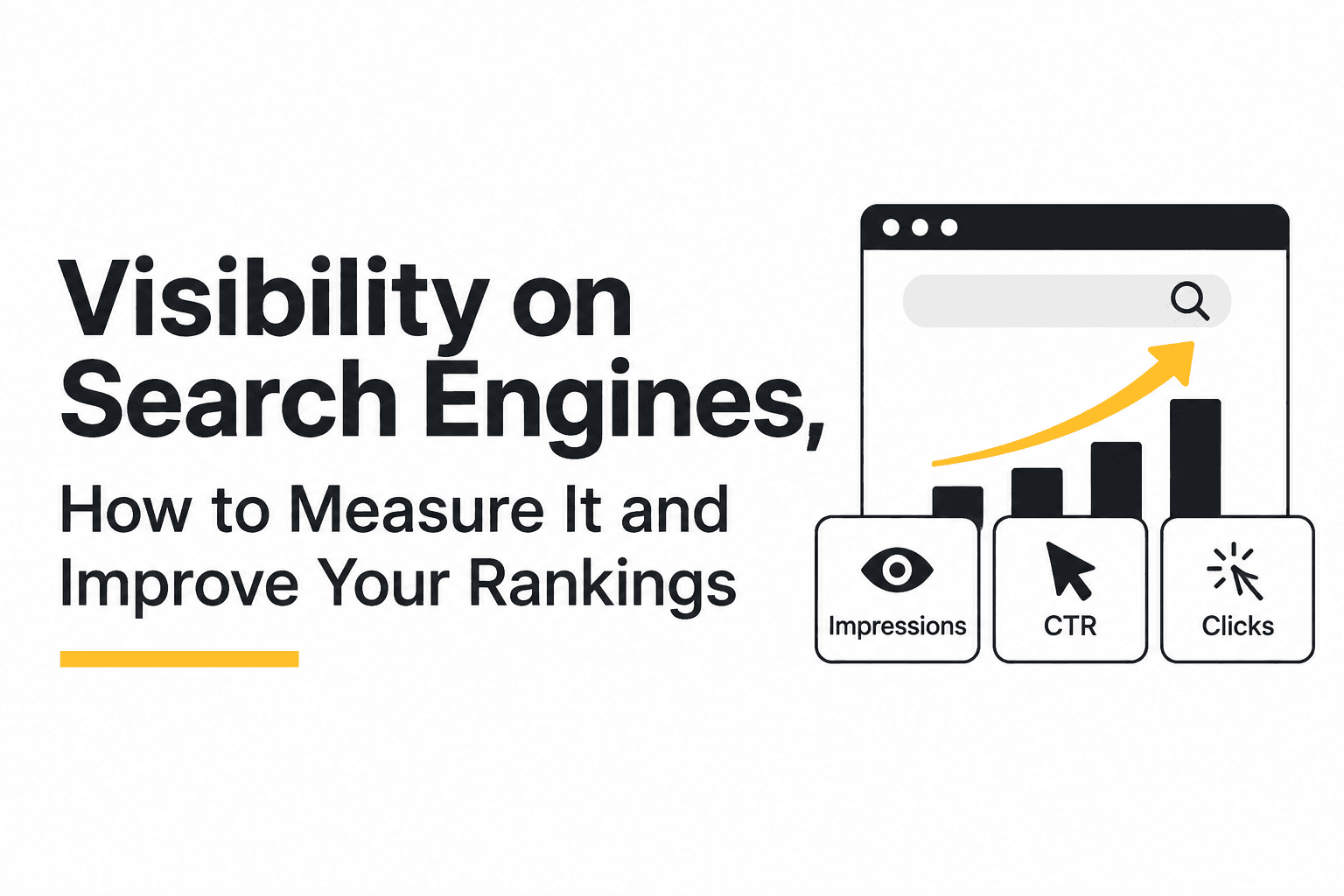
Visibility on Search Engines, How to Measure It and Improve Your Rankings
Learn what visibility on search engines means, how to measure it in Google Search Console, and a practical 30/60/90-day plan to improve it.

High-Volume SEO Keywords: A Gold Mine or a Money Pit?
Learn keywords and SEO with a practical keyword research workflow, search intent examples, prioritization criteria, and a content mapping template.