
Good Search Engine Optimization in 2026, A Practical Workflow You Can Run Weekly

Good search engine optimization in 2026 means you can reliably earn qualified impressions, clicks, and conversions from organic search while staying indexable, understandable to AI answers, and measurable in Google Search Console.
- Define “good SEO” by outcomes (qualified traffic and conversions) plus hygiene signals (indexing, crawlability, intent match, internal linking), not by rankings alone.
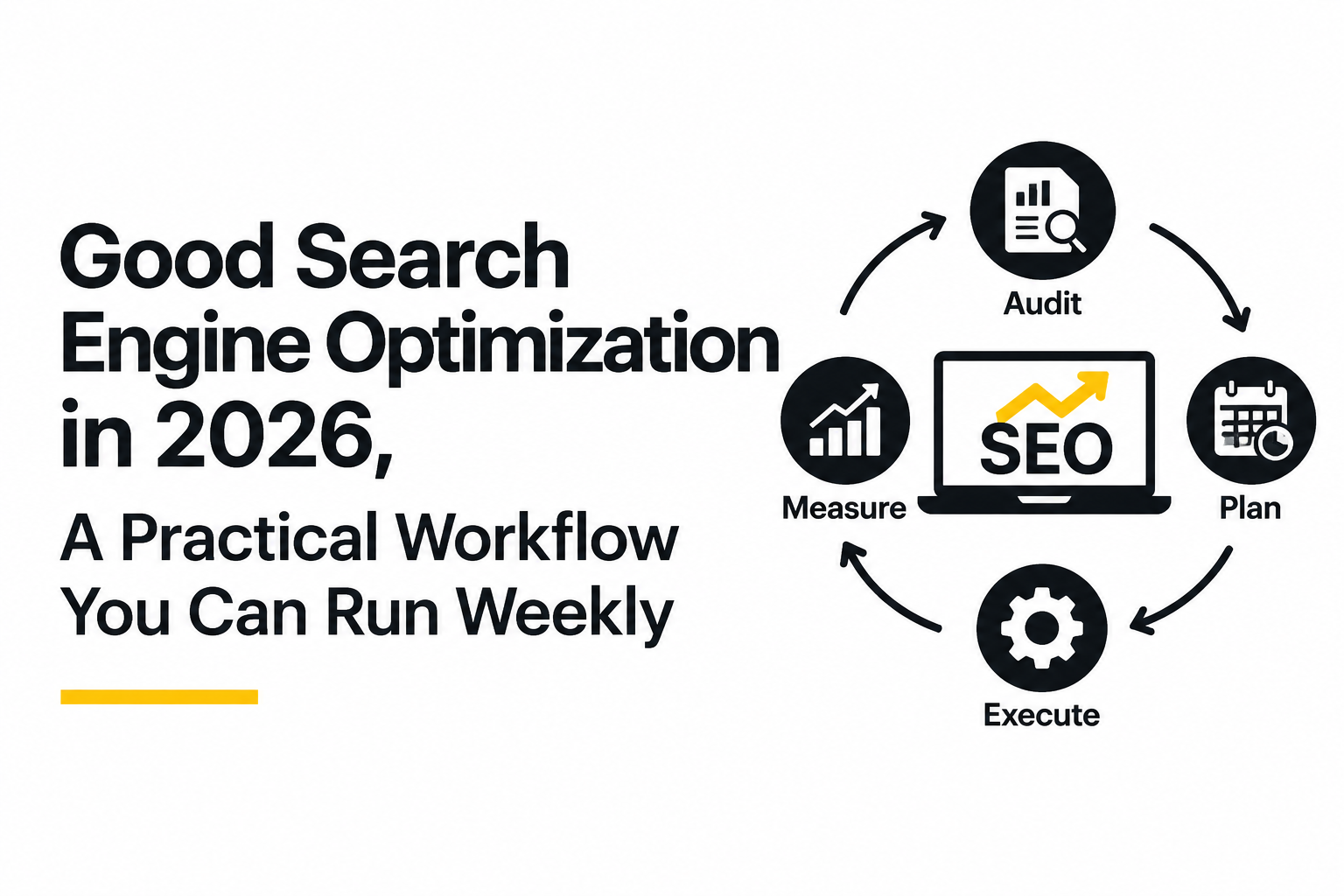
- Run SEO as an SOP: audit → plan → execute → measure, with clear deliverables, owners, and weekly checkpoints in Google Search Console.
- Use annotated page checks (titles, headings, internal links, canonicals, snippets) to spot quality quickly and avoid over-optimizing.
What Good Search Engine Optimization Looks Like in 2026
Good search engine optimization in 2026 looks like a system that produces consistent growth in organic demand capture while staying resilient to AI Overviews and answer-style results.
Quality is outcomes plus signals you can verify
In practice, I treat “good SEO” as two layers:
- Outcome metrics (what the business feels): organic signups, leads, revenue, assisted conversions, and qualified traffic (not just visits).
- Leading indicators (what SEO can control weekly): index coverage, crawlability, query-to-page alignment, internal link discovery, and snippet eligibility (clear answers on-page).
If an SEO effort cannot show progress in leading indicators inside 2 to 6 weeks, the outcomes usually stall later.
How AI Overviews changes “good”
AI answers often build summaries from passages on your page, so “good” now includes extractable answer blocks that are correct, specific, and close to the top of the relevant section. That does not mean keyword repetition. It means the page has:
- Direct answers to the main intent in 1 to 2 sentences
- Supporting detail: steps, criteria, and checks an engine can quote
- Clean page semantics (headings, lists, tables where they help)
SEO vs SEM decision rule for 2026
SEO is the right lever when you can publish durable pages that answer recurring needs and your site can be indexed cleanly. SEM is the right lever when you need demand immediately or you are validating a new offer. A simple operational rule: if you cannot wait 8 to 12 weeks to see compounding results, run SEM while you build the SEO foundation.
The Good SEO Workflow From Audit to Measurement
The fastest way to get good search engine optimization is to run a sequenced SOP with explicit deliverables and handoffs, not a pile of disconnected “best practices.”
Step 1 Audit what blocks crawling, indexing, and intent match
Deliverable: a one-page audit summary plus a prioritized issue list (P0, P1, P2) with owners.
- P0: pages not indexed that should be, wrong canonicals, accidental noindex, broken sitemaps, severe performance issues
- P1: duplicated titles, thin pages with no unique purpose, messy internal linking, redirect chains
- P2: incremental improvements like polishing snippets, adding supporting sections, image optimization
My practical check is to start from the business-critical pages and confirm: the URL is indexable, canonical points to itself (unless intentionally consolidated), and Google can fetch and render it.
Step 2 Plan pages as a map, not a list
Deliverable: a content and internal linking map that assigns one primary job to each URL.
Use a simple page taxonomy:
- Hub pages: broad topic coverage and navigation role
- Spoke pages: one intent, one promise, one conversion path
- Support pages: FAQs, comparisons, glossaries, use cases that strengthen hubs and spokes
Planning becomes much easier when every page has a “query set” and a “next click” (the internal link you want the user to take).
Step 3 Execute in the right order
Deliverable: weekly shipping cadence with a changelog.
- Fix technical blockers first, because content cannot rank if it is not reliably crawled and indexed.
- Upgrade on-page structure on revenue pages next (titles, headings, sections, internal links).
- Publish missing spokes that complete the map and reduce topical gaps.
- Strengthen internal links from hubs and high-traffic pages to the pages you want to win.
If you want deeper operating systems for each layer, these references are useful: on page seo and technical seo.
Step 4 Measure with a weekly scorecard
Deliverable: a weekly SEO scorecard that ties changes to Search Console signals.
- Visibility: impressions and clicks by page group (hub, spoke, revenue)
- Coverage: indexed vs not indexed for the pages you shipped
- Engagement proxy: query to page match (are the queries the ones you intended?)
- Business: conversions from organic landing pages (in analytics or CRM)
Good search engine optimization is measurable when each shipped change has a hypothesis and a tracking URL list.
Tool-by-Task SEO Toolkit With Beginner-Safe Defaults
A beginner-safe SEO toolkit in 2026 is mostly Google Search Console plus a crawler, because the hardest failures are often indexing, canonicals, and internal discovery.
Google Search Console checks to run every week
- Performance report: filter by Page, compare last 28 days vs previous 28 days, and spot pages losing impressions before clicks drop.
- Indexing report: export “Not indexed” reasons and tag which ones matter (ignore parameter and duplicate URLs unless they affect a canonical page).
- Sitemaps: confirm submitted URLs are being discovered; investigate sudden drops.
URL Inspection workflow for every page you ship
- Inspect the exact canonical URL you want indexed.
- Confirm “URL is available to Google” and review “Page indexing” and “User-declared canonical.”
- Test live URL after a major change.
- Request indexing only when the page is stable and internally linked, otherwise you waste crawl attention.
I have found that teams skip this step because it feels tedious, but it prevents weeks of confusion when a page “should rank” but is actually being canonicalized elsewhere.
Crawler and page QA defaults
Use a crawler to catch site-wide patterns: duplicate titles, missing H1s, broken internal links, 3xx chains, canonicals pointing to non-200 pages. Pair it with a simple human QA checklist: load speed on mobile, above-the-fold clarity, and whether the page answers the intent within the first screen.
Content planning and semantic coverage
For topic coverage and query sets, lean on your own Search Console queries, customer emails, sales call notes, and competitor SERP inspection. If you want a structured way to expand beyond one keyword without bloating pages, this guide on semantic seo maps well to 2026 ranking realities.
Annotated Examples of Good SEO on a Real Page
Good search engine optimization is visible on a page when the title, headings, internal links, and canonical signals all point to one clear job for that URL.
Example 1 A service page that earns qualified leads
- Title tag: specific promise + audience, readable as a sentence (avoid stuffing locations and variants).
- H1: mirrors the promise but can be longer and more explicit.
- First section: 2 to 3 sentences that answer “what you do, who it is for, what result to expect.” This is often what AI answers quote.
- H2 sections: “Process,” “Deliverables,” “Timeline,” “Pricing factors,” “FAQs.” Each starts with a direct answer line.
- Internal links: 2 to 5 contextual links to supporting resources, not a giant list in the footer.
- Canonical: self-referential unless you intentionally merge duplicates.
If you are evaluating an agency, ask to see how they structure this page type and what their first 90 days deliverables look like. This reference on a search engine optimization service is a good baseline for what should be explicit.
Example 2 A blog post built for AI answers and snippets
- Intro: one sentence definition or method (no scene-setting), then who the workflow is for.
- Answer blocks: short paragraphs or lists that can stand alone out of context.
- Table where it helps: comparisons, checklists, or decision rules, not decorative tables.
- FAQ section: questions phrased the way users ask them; answers are direct and do not repeat the same line.
- Update behavior: a monthly refresh cadence beats one-time publishing for competitive topics.
When I review pages that underperform despite “good writing,” the most common gap is that the post never commits to a single intent. The fix is usually to rewrite the first 20 percent to be more direct, then tighten headings so each section answers one sub-question.
A 30-60-90 Day Plan to Build Good SEO Habits
A 30-60-90 day plan makes good search engine optimization realistic because it turns SEO into weekly shipping and measurement rather than a quarterly hope.
Days 1-30 Establish indexing and measurement
- Set up Search Console ownership and sitemap submission.
- Create a “money URL list” of your top 10 to 30 pages that should drive outcomes.
- Run URL Inspection on each money URL and fix any noindex, wrong canonical, redirect chains, or 404s.
- Publish one internal linking pass from your highest-traffic pages to your highest-value pages.
KPI checkpoints: fewer critical indexing errors, stable crawl discovery, and impressions trending up on the refreshed pages.
Days 31-60 Upgrade on-page and ship missing spokes
- Rewrite titles and H1s for clarity and intent match.
- Add “answer-first” openings to key H2 sections.
- Ship 4 to 8 spoke pages that close obvious gaps and link them from a hub page.
KPI checkpoints: new pages indexed, impressions for new query sets, and early clicks on long-tail queries.
Days 61-90 Turn wins into a repeatable monthly strategy
- Refresh the pages that gained impressions but have low clicks by improving snippet clarity and above-the-fold value.
- Consolidate or redirect near-duplicate pages cannibalizing the same intent.
- Build a simple editorial calendar tied to Search Console query data.
KPI checkpoints: more pages earning consistent impressions, improved click-through on key pages, and at least one organic conversion path performing end-to-end.
For a repeatable cadence, this monthly search engine optimization strategy framework pairs well with the SOP above.
One-Page Checklist and How to Use It Without Over-Optimizing
A one-page checklist keeps good search engine optimization focused because it forces prioritization: indexability first, clarity second, scale third.
Copy-paste HTML checklist
<ul>
  <li>Indexing: URL is indexable, returns 200, not blocked by robots, no unintended noindex</li>
  <li>Canonical: self-canonical (or intentional canonical target), canonical points to a 200 URL</li>
  <li>Intent: page states the promise in first screen; each H2 answers one sub-question</li>
  <li>Internal links: at least 2 contextual links in, and 2 out to relevant next steps</li>
  <li>Snippet readiness: one direct answer paragraph + at least one list/table where helpful</li>
  <li>Media: images have descriptive alt text when meaningful (not keyword stuffing)</li>
  <li>Measurement: page added to a tracked list in Search Console and analytics</li>
</ul>
How to prioritize without spiraling into “SEO theater”
- Rule 1: never polish titles and headings on a page that is not indexable.
- Rule 2: if two pages target the same intent, consolidate rather than “optimize harder.”
- Rule 3: add sections only when they help a user decide or act, not to hit a word count.
- Rule 4: measure by page groups and outcomes, not by individual keyword rank screenshots.
When teams over-optimize, it is usually because success criteria were never defined. Decide up front whether the page’s job is to educate, convert, or route to another page, then optimize to that job only.
When to Use an SEO Agency and What to Ask Before You Sign
An SEO agency is worth it when your team can define goals and approve changes but cannot consistently execute audits, content, technical fixes, and reporting with weekly momentum.
Scope-to-goals matching guide
- If indexing is unstable: prioritize technical cleanup and a measurement baseline.
- If pages are indexed but not winning impressions: prioritize content mapping and intent alignment.
- If impressions are up but leads are flat: prioritize conversion paths, internal links to money pages, and offer clarity.
Questions that reveal whether the agency has an SOP
- What are your first 10 checks in Search Console and URL Inspection during week one?
- How do you decide whether to refresh, consolidate, or create a new page?
- What is your default reporting cadence and what metrics do you consider leading indicators?
- How do you document changes so we can connect actions to outcomes later?
Red flags you can verify quickly
- Guarantees of rankings or timelines without seeing your Search Console.
- Reporting that shows only keyword positions, not indexing coverage, page groups, or conversions.
- Vague deliverables like “optimize content” without specifying which URLs and what will change.
Good search engine optimization is collaborative, so the best engagements have a clear approval loop: the agency proposes, you validate brand and claims, then both sides review weekly measurement together.
| Checkpoint | What “good” looks like | Where to verify |
|---|---|---|
| Indexing | Important URLs are indexed, correct canonical chosen | Search Console URL Inspection, Indexing report |
| Intent match | Queries align with the page’s promise and sections answer sub-questions | Search Console Performance by Page + Queries |
| Internal discovery | Pages have contextual links in and out, hubs route to spokes | Crawler + manual navigation test |
| Snippet readiness | Direct answer blocks, lists, and clear headings | On-page review + SERP appearance |
| Business impact | Organic landing pages contribute leads or sales | Analytics + CRM attribution |
FAQ
If you use the checklist above to self-audit and want a second set of eyes, Freeways Agency can run a Search Console-based SEO audit and roadmap call to validate priorities, sequence the work, and turn it into an execution plan your team can ship weekly.

Written by Joyce Ng.

AI Search Statistics 2026: Clicks, Conversions & Brand Visibility
AI Overviews hit 2.5B users, but top-ranking CTR fell 58%. Explore 2026 AI search statistics plus Freeways’ test of 216 brands across 5 AI platforms.
SEO For ChatGPT, The Prompt-to-Citation Playbook for 2026
Learn seo for chatgpt in 2026 with a prompt-to-citation workflow, technical indexing checklist, schema patterns, and KPIs to measure visibility.

Internet Marketing SEO Feels Like a Maze? Here’s Your 90-Day Way Out
Learn internet marketing seo in 2026 with a beginner framework, Google Search Console steps, and a practical 30/60/90-day plan to measure results.