
Visibility SEO Explained, How to Measure It and Improve It in 2026

Visibility SEO is the practice of increasing how often and how prominently your pages appear across the full search results page, including classic links and AI-driven surfaces, for the queries your audience actually uses.
- Measure visibility with a simple system: query coverage, rank distribution, and SERP real estate, not a single “visibility score.”
- Run a 60-minute diagnostic to find your biggest leak: coverage (missing pages), relevance (wrong page), or prominence (not competitive).
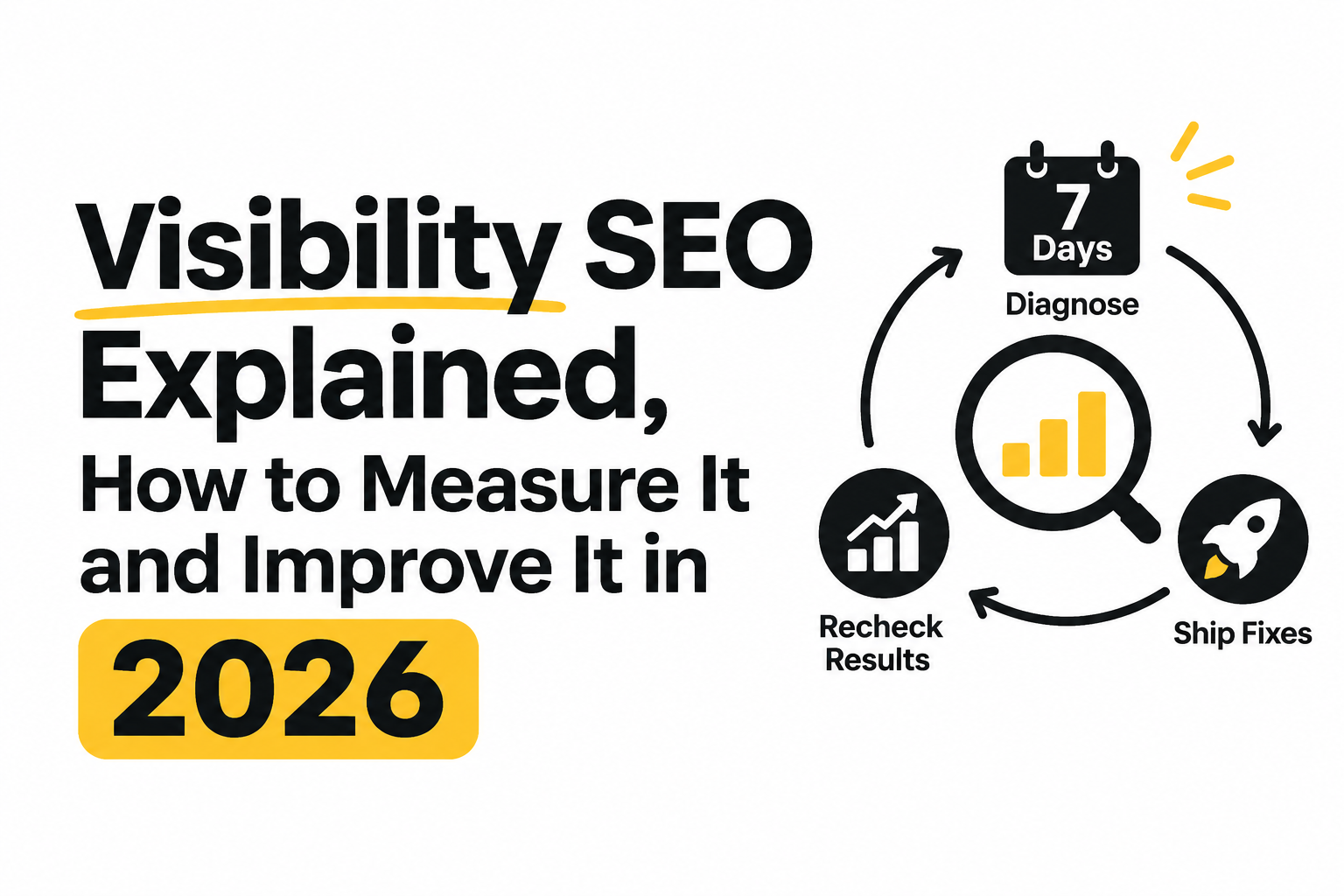
- Use a 7-day fix-ship-recheck loop to improve visibility SEO sustainably, including actions for AI answers and SERP features.

What Visibility SEO Means in 2026 and Why Rankings Alone Mislead
Visibility SEO in 2026 is better understood as “share of attention” across a topic, not a single keyword ranking.
Visibility has three parts you can measure
- Coverage: how many relevant queries you show up for at all (and whether you have the right landing page for each).
- Prominence: where you land in the results (rank buckets), because positions 1 to 3 behave differently than 8 to 12.
- SERP real estate: how much screen space you occupy, including snippets, FAQs, video, images, local packs, “People also ask,” and AI summaries when they appear.
Why “we moved from #9 to #6” can still be a loss
Rankings alone mislead because the results page itself changes. A page can improve its numeric rank but lose clicks if an AI overview, a video carousel, or a local pack pushes organic links further down. In my audits, the biggest “surprise drops” usually happen when teams track only a handful of trophy keywords and miss that long-tail coverage is shrinking quietly week over week.
A practical definition you can apply to any site
Use this definition to keep it concrete: SEO visibility equals (1) the set of queries you appear for, multiplied by (2) how high you appear, adjusted by (3) how much of the SERP you occupy. This is why a healthy visibility SEO program watches groups of queries and the page types that serve them, not a single “visibility score.”
How to Measure SEO Visibility Without Getting Trapped by One Score
Measuring visibility SEO reliably starts by grouping queries and tracking rank buckets and SERP features, rather than trusting one blended metric from a tool.
Step 1: Create 5 query groups (a lightweight map)
Pick 5 groups that match how customers search, not how your org is structured. Example for a service business:
- Problem queries: “how to fix…”, “why is…”, “best way to…”
- Solution category queries: “SEO audit”, “technical SEO checklist”
- Comparison queries: “X vs Y”, “best agency for…”
- Brand and branded products: brand name, product names
- Local/near-me queries: location modifiers if relevant
If you already track search visibility in Google Search Console, reuse the same clusters so your measurement stays consistent across weeks.
Step 2: Track rank distribution in buckets (not averages)
For each query group, count how many keywords/pages sit in these buckets:
- Top 3
- 4 to 10 (page 1, but not leading)
- 11 to 20 (page 2, “near win”)
- 21+ (needs more than polishing)
Why buckets: an average rank can look stable while you actually lose Top 3 placements and gain low page-1 placements, which usually reduces real visibility.
Step 3: Add a simple SERP real-estate marker
For each group, mark whether you own any of these for your main queries: featured snippet, “People also ask,” video result, image pack, local pack, or an AI-cited mention. A simple Yes/No is enough to start. If you want a free source of truth for performance, Google Search Console is the baseline, and Google’s own documentation is the closest thing to a standard reference: Search Console Performance report.
Step 4: Use two outcome metrics to keep yourself honest
- Impressions by query group: a proxy for coverage and eligibility.
- Clicks and click-through rate (CTR) by query group: a proxy for prominence and snippet competitiveness.
Put these into a weekly spreadsheet. The goal is not perfection, it is to spot movement: “more queries entering 11 to 20” is a strong leading indicator that visibility SEO work is compounding.
The Visibility SEO Diagnostic, Find Your Biggest Leak in 60 Minutes
A 60-minute visibility SEO diagnostic works by forcing every issue into one of three buckets: coverage, relevance, or prominence.
Prepare: pick one query group and 10 representative queries
Choose the group with the biggest business value or the most obvious decline in impressions. Pull 10 queries from Search Console that have impressions but low clicks, or rising impressions with flat clicks.
Step 1: Coverage check (do you have a page that deserves to rank?)
- For each query, write down the URL Google shows most often for your site.
- If there is no consistent URL, or the URL is clearly off-topic, label it coverage leak.
- Quick confirmation: run a site search in Google (site:yourdomain.com + query theme) to see if your content set is thin.
Coverage leaks usually mean you need a new page or a restructured hub, not “more keywords” on an existing page.
Step 2: Relevance check (is the right page ranking for the right intent?)
- Open the top 3 results and label their intent: guide, checklist, category, tool, local, or pricing.
- Compare that intent to your ranking page. If you are serving a “service page” when the SERP expects a guide, label it relevance leak.
- Check internal cannibalization: if two of your URLs swap positions for the same query, label it relevance plus architecture.
This is where on page seo work matters most, because you are aligning a page to the dominant intent rather than trying to brute-force rankings.
Step 3: Prominence check (are you competitive on the page?)
- Compare your page to the top results on three criteria: completeness (topics covered), specificity (examples, steps, definitions), and trust signals (about page, author, citations, clear business details where relevant).
- Scan the SERP for features you are missing: snippet, PAA, video, images.
- If your content is aligned but still stuck 8 to 20, label it prominence leak.
Prominence leaks are often fixed by improving structure, adding missing subtopics, and tightening internal links, not by rewriting everything.
The 7-Day Visibility SEO Improvement Loop, Fix, Ship, Recheck
A 7-day visibility SEO loop improves results fastest when you ship one targeted change per day and remeasure the same query group at the end of the week.
Day 1: Choose one leak and define “done”
Pick the single biggest leak you found. Define a measurable “done” condition, such as: “one new page published,” “one page intent-aligned with a new section structure,” or “FAQ snippet-ready block added.”
Day 2 to 4: Apply the right fix for the leak
- If coverage leak: create a dedicated page, then link it from the most relevant hub page and navigation path. Keep scope narrow and match intent.
- If relevance leak: rewrite the page outline to match the dominant SERP format (guide, checklist, definition page). Update headings first, then fill gaps.
- If prominence leak: add “extractable blocks” such as definitions, steps, and decision criteria; strengthen internal links; add unique examples that competitors lack.
I have found the fastest wins usually come from fixing relevance first, because a page that matches intent can jump buckets without needing months of link building.
Day 5: Resolve technical blockers that mute visibility
Even perfect content can stay invisible if indexing or rendering is unstable. Run a short pass on: indexability (no accidental noindex), canonical correctness, internal link crawlability, and page experience issues that prevent full rendering. If you need a practical starting point, technical seo prioritization should start with what affects discovery and indexing before performance fine-tuning.
Day 6: Update SERP real estate, not just the body text
- Add a short definition near the top for snippet eligibility.
- Add a concise step list (5 to 9 steps) for PAA and “how-to” extraction.
- Add a small FAQ section on the page itself if the SERP shows PAA questions repeatedly.
Day 7: Remeasure and log movement by buckets
Return to the same 10 queries and log: which URL ranks, what bucket it sits in, and which SERP features appear. The goal is a repeatable loop: diagnose, fix, ship, recheck. If you want to go deeper later, a structured search engine optimization service roadmap usually formalizes this loop across multiple query groups at once.
Visibility SEO for AI Answers and SERP Features, What to Do Differently
Visibility in AI answers improves when pages provide direct, citable passages, clear entities, and structured context that can be extracted without guessing.
Write for citation, not just ranking
- Lead with the answer: one sentence that stands alone and defines the concept or gives the method.
- Add “quotable blocks”: short definitions, bullet steps, and decision rules.
- Use consistent entity language: keep naming stable for products, services, locations, and concepts.
Make snippet readiness a checklist
- One 40 to 60 word definition near the top of the page.
- One numbered list that matches “how to” intent.
- One short comparison table if the query is evaluative.
Use structured data only where it reflects the page truth
Schema can help machines interpret your content, but it is not a substitute for clarity. Add FAQPage markup only if the questions and answers are visible on the page and accurate. For implementation standards, refer to Schema.org.
Common Visibility SEO Mistakes and a Simple Checklist to Start Today
Most visibility SEO failures come from measuring the wrong thing, fixing the wrong page, or treating visibility as a single score you can “game.”
Mistakes that quietly reduce visibility
- Tracking only a handful of keywords: you miss coverage decline across long-tail queries.
- Optimizing the wrong URL: relevance leaks persist because intent is mismatched.
- Ignoring SERP features: you “rank” but lose clicks to AI summaries, videos, or local packs.
- Publishing without internal links: new pages exist but are not discoverable enough.
- Chasing a visibility score: you improve the number while clicks and qualified leads stay flat.
Copy-ready checklist for a first pass
- Select 1 query group and 10 queries with impressions in Search Console.
- Assign each query a ranking URL and label the leak: coverage, relevance, or prominence.
- Pick 1 fix you can ship in 7 days and define “done.”
- Add one snippet-ready definition and one step list to the target page.
- Add 3 to 5 internal links pointing to the target page from relevant pages.
- Remeasure rank buckets and impressions at the end of the week.
If you want a deeper baseline, expand from 10 queries to 50 per group and repeat. That is usually enough to see whether your visibility SEO problem is primarily missing coverage or weak prominence.
| Visibility lever | What you measure weekly | Typical fix | Best leading indicator |
|---|---|---|---|
| Coverage | Number of queries/pages with impressions per group | New page, hub restructuring, better internal discovery | Impressions rising for new URLs |
| Relevance | Right URL matching the dominant SERP intent | Rewrite outline, consolidate cannibalized pages | More queries moving into 11-20 |
| Prominence | Rank bucket distribution and CTR | Fill topic gaps, improve extractable blocks, strengthen internal links | More Top 10 placements, CTR lift |
| SERP real estate | Snippet/PAA/video/local/AI-cited presence (Yes/No) | Snippet-ready formatting, structured content, media where relevant | Feature acquisition on priority queries |
FAQ about visibility SEO
If you want a no-pressure starting point, Freeways Agency can share a visibility diagnostic checklist and, if helpful, run a baseline visibility SEO audit to identify whether your biggest leak is coverage, relevance, or prominence.

Written by Joyce Ng.

Top SEO Companies In 2026, A Global Shortlist By Specialty, Budget, And Business Type
Compare seo top companies by specialty, budget, proof, deliverables, and business fit before choosing an agency for 2026.
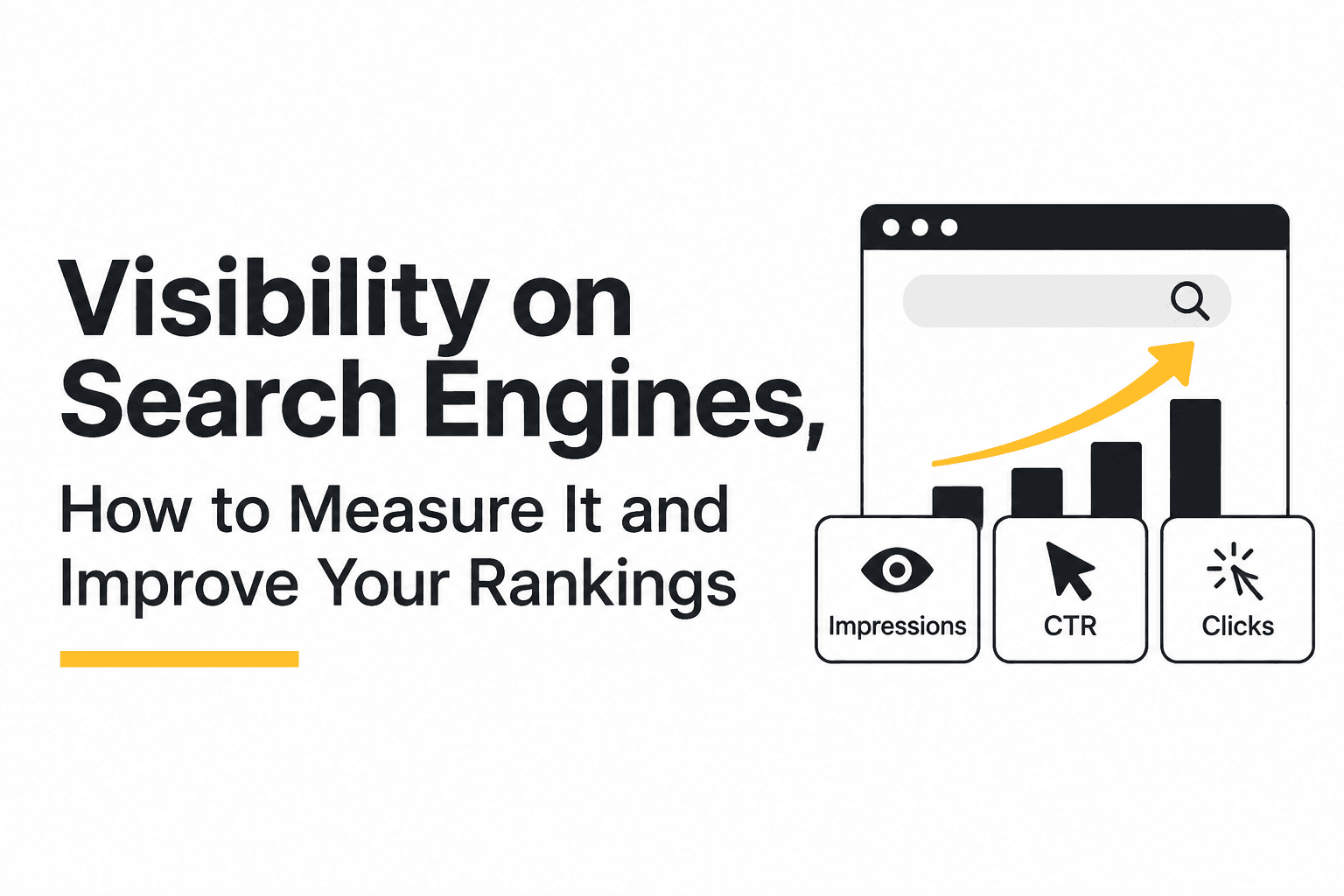
Visibility on Search Engines, How to Measure It and Improve Your Rankings
Learn what visibility on search engines means, how to measure it in Google Search Console, and a practical 30/60/90-day plan to improve it.

Chat GPT for SEO in 2026, A Practical Workflow and Prompt Library
Learn chat gpt for seo in 2026 with a QA-first workflow, copy-paste prompts, and measurement tips for AI Overviews and changing clicks.